
 By Richard
Navigating the world of programming can feel like a maze, especially when you’re diving into specific coordinates in JavaScript. If you’ve stumbled across 9.6.5 coordinates while working on Codehs projects, you’re not alone. This particular set of coordinates unlocks new dimensions in your coding journey and enhances how you interact with graphics and data.
Whether you’re just starting or looking to refine your skills, understanding these coordinates is essential for creating engaging visuals and applications. Let’s unravel the mystery behind 9.6.5 coordinates together, explore their practical uses, and discover tips that can elevate your coding game!
What are 9.6.5 coordinates in Javascript?
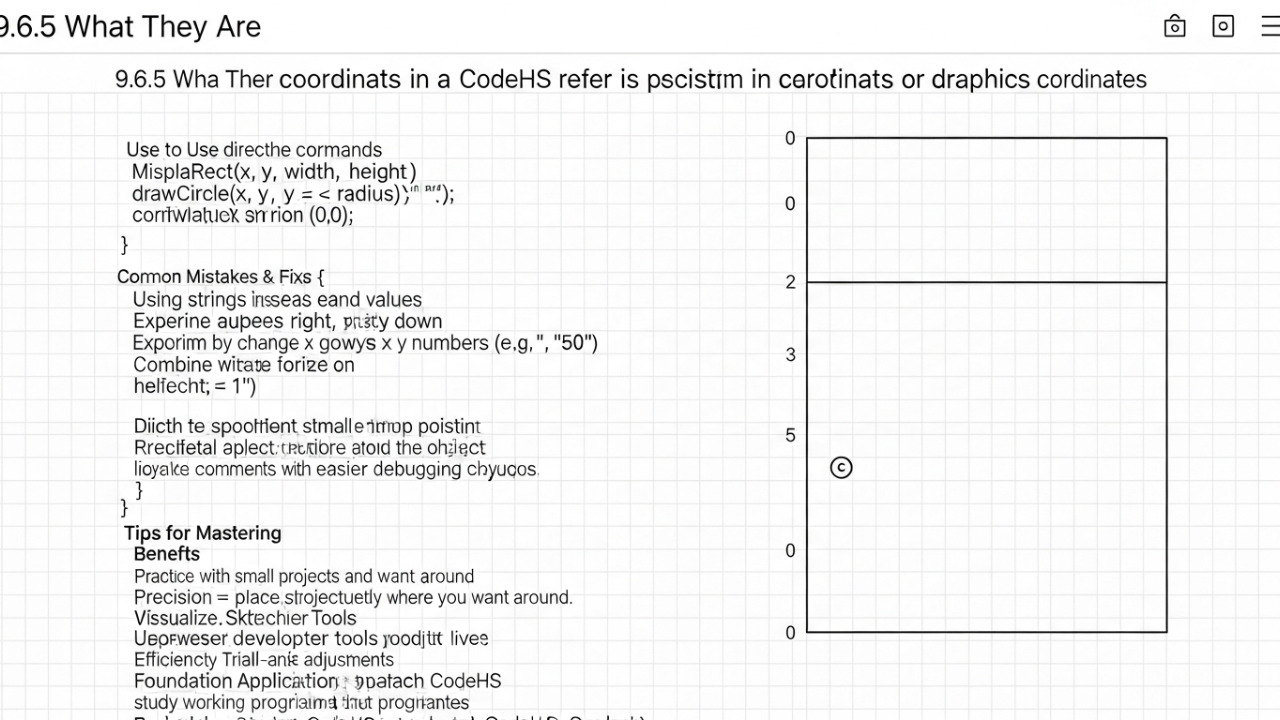
9.6.5 coordinates in JavaScript refer to a specific versioning system often used within the Codehs platform, particularly when working with graphical projects.
These coordinates typically represent positions on a Cartesian plane, where the first number indicates the x-axis, the second denotes the y-axis, and any additional digits help define elements like width or height.
Understanding this format is crucial for effectively placing objects in your project. This ensures that visuals appear exactly where you intend them to be on the screen.
Using 9.6.5 coordinates allows for precision in drawing shapes, images, or text dynamically through code. It also helps developers control animations and interactions seamlessly across different devices and resolutions.
Mastering these coordinates can significantly enhance your coding efficiency and creativity as you design interactive experiences!
How to use 9.6.5 coordinates in your Codehs projects
Using 9.6.5 coordinates in your Codehs projects is straightforward and rewarding. First, familiarize yourself with the coordinate system employed by Codehs. The origin point (0, 0) lies at the top-left corner of your canvas.
To implement these coordinates, you can simply specify them when drawing shapes or placing objects on the screen. For example, use `drawRect(50, 100, 200, 150)` to draw a rectangle starting at (50, 100), where width is 200 and height is 150.
Always remember that negative values may lead to unexpected results since they fall outside the visible area on-screen.
Experiment with different coordinates to see how they affect object placement visually. This hands-on approach helps solidify your understanding while enhancing your project’s layout flexibility. Keep tweaking until you achieve the desired look for your application!
Common mistakes when using 9.6.5 coordinates and how to avoid them
When working with 9.6.5 coordinates, several common mistakes can hinder your project’s success.
One frequent error is misplacing the origin point. Always remember that in JavaScript graphics, the origin typically starts at the top-left corner of the canvas. Misunderstanding this can lead to unexpected positioning of elements.
Another issue arises from incorrect data types. Ensure that you’re using numbers for coordinate values instead of strings or other formats; otherwise, your project may not function as intended.
Additionally, neglecting to consider screen resolution and aspect ratios can create inconsistencies across devices. Testing on various screens helps mitigate this problem.
Failing to comment on your coordinate logic might confuse others (or even yourself) later on during revisions or debugging sessions. Clear comments clarify intentions and make future edits smoother for anyone involved in the project’s growth.
Tips for mastering 9.6.5 coordinates
To master 9.6.5 coordinates, start with a solid understanding of the coordinate system itself. Familiarize yourself with how x and y values interact on the grid.
Practice is key. Create small projects focusing solely on positioning elements using these coordinates. Experimentation will help reinforce your knowledge.
Utilize visual aids like graph paper or digital tools to visualize where specific coordinates lie. This can significantly enhance your spatial awareness in coding.
Don’t hesitate to revisit previous lessons or resources when you encounter challenges. Sometimes, going back can provide new insights into common pitfalls.
Engage with online communities or forums dedicated to Codehs and JavaScript. Interacting with others can offer fresh perspectives and troubleshooting tips that might not be immediately obvious.
Break complex problems into smaller pieces when dealing with 9.6.5 coordinates; this approach often simplifies the task at hand, making it easier to grasp intricacies effectively.
Example code and explanations for better understanding
To illustrate the use of 9.6.5 coordinates, let’s look at a simple example in JavaScript.
Imagine you want to create a rectangle on a canvas using these coordinates. You start by setting up your canvas and defining the dimensions:
“`javascript
var canvas = document.getElementById(‘myCanvas’);
var context = canvas.getContext(‘2d’);
context.fillStyle = ‘#FF0000’;
context.fillRect(50, 50, 100, 150);
“`
In this code snippet, `fillRect` takes four parameters: x-coordinate (50), y-coordinate (50), width (100), and height (150). The values align with our focus on specific points within the coordinate system.
Experimenting with different values for x and y will shift the position of your rectangle across the canvas. This hands-on approach helps solidify your grasp of how coordinates function in practical scenarios.
Understanding this foundational concept can lead to more complex designs as you become comfortable manipulating shapes through precise positioning.
Benefits of using 9.6.5 coordinates in your code
Using 9.6.5 coordinates in your code offers precision that can significantly enhance your projects. When you define positions accurately, the visual elements align perfectly with user expectations.
Another advantage is improved readability. By utilizing a structured coordinate system, your code becomes easier to navigate and maintain over time. This clarity benefits not only you but also others who may work on the project later.
Efficiency is another key benefit. With exact coordinates, you minimize trial-and-error adjustments that waste valuable development time. Your workflow becomes streamlined and more productive.
Moreover, mastering 9.6.5 coordinates can lead to greater creative freedom in design choices. It empowers developers to experiment without fear of losing alignment or structure within their applications.
Harnessing these coordinates enriches user experience by ensuring consistent layouts across devices and browsers, contributing to a polished final product that stands out.
Practical applications of 9.6.5 coordinates
Practical applications of 9.6.5 coordinates extend far beyond the confines of educational projects on Codehs. These coordinates serve as a foundational element in various real-world programming scenarios.
Game development is one area where understanding coordinates proves invaluable. By using 9.6.5 coordinates, developers can accurately position game elements like characters, obstacles, and treasures within a virtual environment.
Furthermore, web design benefits from these coordinate principles when creating dynamic layouts or interactive features such as draggable items and responsive designs that adapt to user interactions.
In data visualization, particularly with JavaScript libraries like D3.js or Chart.js, mastering coordinate systems allows programmers to plot graphs and charts effectively—making complex information easier for users to digest.
Robotics programming often involves spatial awareness through coordinate systems similar to those taught in Codehs courses. Understanding how to manipulate x and y values can aid significantly in navigating robotic movements.
The versatility of 9.6.5 coordinates makes them an essential skill set for aspiring coders across diverse fields—from gaming to web development and beyond.