
 By Richard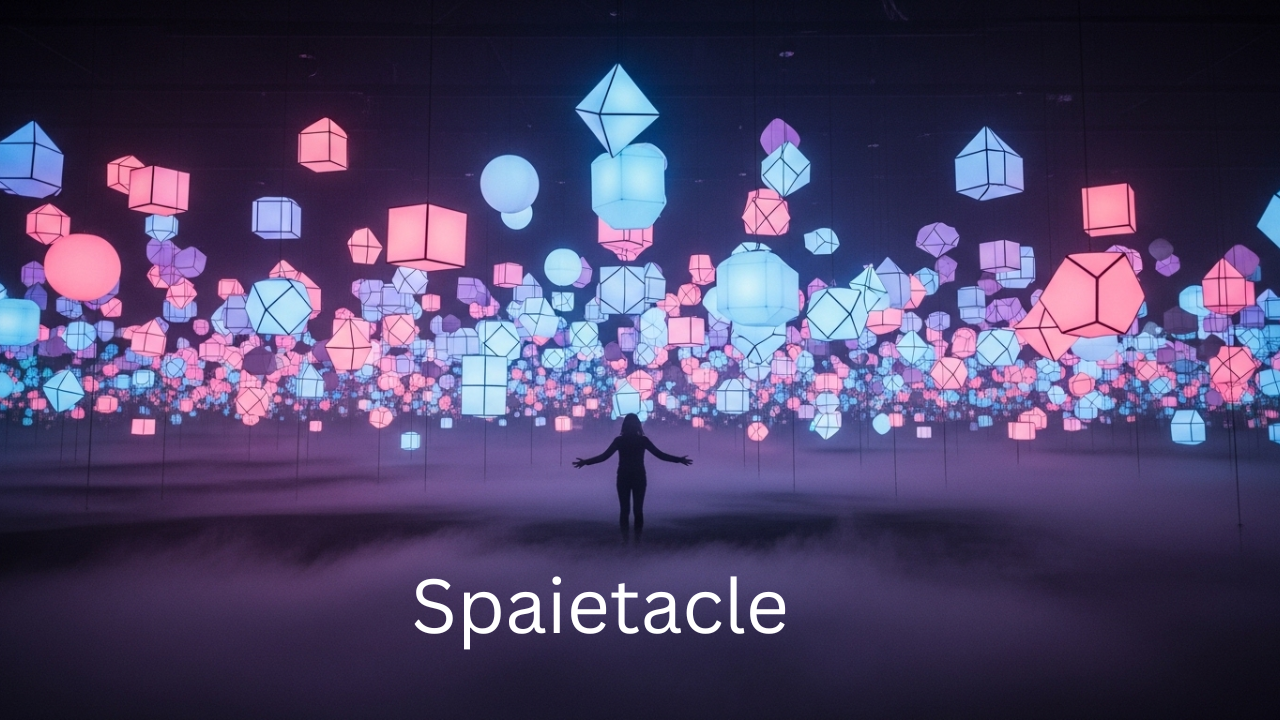
Imagine walking into a room that doesn’t just display art but wraps itself around you—walls that breathe with light, sounds that shift as you move, and a story that unfolds with every step you take. This isn’t a traditional exhibition or performance. This is a spaietacle.
In an era where attention is the world’s most valuable currency, a new concept has emerged that transforms how we experience space, storytelling, and connection. Whether you’ve encountered the term in creative blogs, design discussions, or conversations about the future of entertainment, spaietacle represents a fundamental shift in how we engage with our environment .
But what exactly is a spaietacle? Where did this idea come from, and why is it suddenly everywhere? More importantly, how can you create or experience one yourself?
This comprehensive guide will take you on a journey through the fascinating world of spaietacle—from its conceptual roots to its practical applications—and show you why this innovative approach to experience design is reshaping industries from entertainment to education, retail to personal well-being.
What is a Spaietacle? Defining a Revolutionary Concept
At its most essential level, a spaietacle is an immersive experience where the environment itself becomes the medium of storytelling and engagement . The term represents a fusion of two ideas: “space” and “spectacle” .
Unlike a traditional spectacle—where audiences passively observe a performance on a stage or screen—a spaietacle surrounds participants completely. There is no fourth wall, no passive observation. Instead, the audience inhabits the experience. Every element of the environment—light, sound, texture, even scent—works in harmony to create something unforgettable .
Core Characteristics of a Spaietacle
What transforms an ordinary space into a true spaietacle? Several key elements must come together :
Immersive Space – The environment surrounds the audience physically or visually, creating a sense of complete presence.
Sensory Impact – Multiple senses are engaged simultaneously—sight, sound, touch, and sometimes even smell and taste—to create a holistic experience.
Emotional Connection – A spaietacle is designed to evoke feelings, not just visual appreciation. Whether it’s wonder, joy, calm, or curiosity, emotion is central.
Interactive Element – Participants don’t just watch; they engage. Movement, choices, and even presence itself shape the unfolding experience.
Narrative Depth – Beneath the sensory layers lies a story or meaning that gives coherence to the experience.
Think of it this way: if a spectacle is something you observe, a spaietacle is something you live .
Beyond the Definition: What Spaietacle Is Not
To truly understand spaietacle, it helps to clarify what it isn’t:
| Traditional Spectacle | Spaietacle |
|---|---|
| Passive observation | Active participation |
| Centralized focus (stage/screen) | Decentralized, environmental engagement |
| Fixed narrative | Adaptive, co-created experience |
| Audience as consumer | Audience as participant |
| One-way communication | Dialogue between space and person |
A spaietacle dissolves the boundary between observer and environment. You don’t watch it happen—you happen within it .
The Origins of Spaietacle: From Ancient Roots to Modern Innovation
While the word “spaietacle” is decidedly modern, its essence reaches deep into human history .
Ancient Foundations
Long before the term existed, humans created spaietacles. Consider the Roman amphitheaters, where audiences were surrounded by massive architecture, visceral action, and communal energy. Or the grand religious festivals of ancient Egypt and Greece, where entire cities transformed into stages for ritual and celebration .
These early spectacles weren’t just entertainment—they were immersive experiences that united communities, told foundational stories, and connected people to something larger than themselves.
The Theoretical Lens
In the 1960s, French theorist Guy Debord described modern society as “the society of the spectacle,” arguing that authentic human experience had been replaced by representation—images and media that mediated reality .
The spaietacle offers a compelling counterpoint to Debord’s critique. Rather than creating passive consumers, spaietacles invite active participation and co-creation. The audience doesn’t just consume meaning; they help shape it .
The Digital Age Catalyst
The concept of spaietacle gained urgency with the rise of digital culture. As screens saturated everyday life, a hunger emerged for experiences that were physically present, multi-sensory, and genuinely immersive .
Technological advances made new forms of experience possible: projection mapping, spatial audio, responsive environments, augmented reality. Yet the real innovation wasn’t technological—it was conceptual. Creators began asking not “What can we show?” but “What can we create for people to inhabit?” .
The Birth of the Term
The word “spaietacle” itself emerged organically in creative and design circles, a portmanteau capturing the marriage of space and spectacle . While not yet found in dictionaries, it fills a linguistic gap—naming a type of experience that had no precise label .
The Five Pillars of a True Spaietacle
Not every immersive experience qualifies as a true spaietacle. For an environment to earn this designation, it must rest on five fundamental pillars :
1. Immersion
Immersion goes beyond surrounding someone with stimuli. True immersion creates psychological presence—the feeling that you have truly entered another reality. The outside world fades. You are here, in this constructed environment, fully and completely .
Achieving this requires coherence. Every element must align with the experience’s internal logic. A single discordant note—a flickering fluorescent light in a carefully crafted atmosphere—can shatter immersion instantly.
2. Interaction
A spaietacle doesn’t just happen to you; it responds to you. Interaction creates agency, the sense that your presence and choices matter .
This interaction can take many forms:
-
Physical movement through space
-
Choices that influence narrative direction
-
Touch that triggers environmental responses
-
Social interaction with other participants
The key is that interaction feels meaningful, not merely decorative. Your engagement should shape the experience in ways you can perceive and appreciate.
3. Narrative Layering
Beneath the sensory surface, a spaietacle tells a story—but not necessarily in the linear way of traditional narrative. Stories in spaietacles are often layered, discoverable through exploration rather than delivered through exposition .
Some participants may experience the surface narrative; others may uncover deeper meanings. The story rewards attention without punishing inattention. It’s always there, woven into the fabric of the space, waiting to be discovered.
4. Sensory Orchestration
A spaietacle engages multiple senses in deliberate, coordinated ways . This isn’t sensory overload but sensory orchestration—each element supporting and enhancing the others.
Light shapes mood and directs attention. Sound creates atmosphere and signals meaning. Texture invites touch and grounds experience. Even scent and temperature can play roles, operating beneath conscious awareness to shape emotional response.
When sensory orchestration works well, participants don’t notice individual elements—they simply feel transported.
5. Adaptive Intelligence
The most sophisticated spaietacles respond dynamically to participants . Powered by sensors, AI, or simply human performers reading the room, these environments adjust in real-time.
Lighting shifts as you move. Soundscapes change with your proximity. Narrative branches based on collective choices. The environment thinks, reacts, and evolves—creating a genuine dialogue between space and inhabitant.
Spaietacle Across Industries: Where Immersive Experiences Are Transforming Everything
The principles of spaietacle are being applied across an astonishing range of fields .
Entertainment and Performing Arts
Entertainment has been the most visible arena for spaietacle innovation .
Immersive theater productions like Sleep No More invite audiences to wander through elaborately designed spaces, choosing their own paths through the narrative. No two experiences are identical because no two audience members take the same journey .
Music festivals like Coachella and Burning Man have transformed into spaietacles themselves—environments where art installations, performance, and community create experiences far beyond the music .
Concert experiences now routinely feature 3D projection mapping, drone light shows, and immersive sound design that wraps audiences in multi-sensory performance .
Retail and Branding
Forward-thinking brands are using spaietacle principles to transform shopping from transaction to experience .
Flagship stores become immersive environments where products are discovered within narrative contexts. Pop-up activations create temporary spaietacles that generate buzz and social sharing. Product launches become events that customers don’t just attend but inhabit.
Apple’s product launches, for example, function as spaietacles—carefully orchestrated experiences blending visuals, narrative, and anticipation .
Education and Learning
Educators are embracing spaietacle concepts to create learning environments that engage students deeply .
Imagine history classrooms where students walk through historically accurate environments rather than reading about them. Science education where learners navigate molecular landscapes rather than memorizing diagrams. Language learning where cultural immersion happens without leaving the room.
These approaches leverage the brain’s natural affinity for spatial and experiential learning, creating stronger encoding and longer retention .
Museum and Cultural Heritage
Museums are evolving from static collections to dynamic spaietacles . Rather than viewing objects behind glass, visitors journey through curated experiences where artifacts appear in context, stories unfold around them, and interpretation becomes exploration.
The most innovative institutions now create exhibitions that are fundamentally participatory—visitors don’t just learn about history or art; they experience versions of it themselves.
Interior Design and Personal Spaces
Perhaps surprisingly, spaietacle principles apply even to our most intimate environments: our homes .
The concept of spaietacle in interior design (sometimes called “spatial spectacle”) transforms living spaces into experiences. Rather than merely functional rooms, homes become environments that evoke emotion, support well-being, and tell personal stories .
This involves:
-
Layered lighting that shifts with mood and activity
-
Thoughtful sensory engagement through texture, sound, and scent
-
Flow that guides movement and creates discovery
-
Personal narrative woven into design choices
Even modest spaces can become spaietacles when designed with intention .
Digital and Virtual Environments
Digital spaces increasingly embrace spaietacle principles . Interactive websites, virtual reality experiences, and augmented reality applications create environments where users don’t just consume content but inhabit digital worlds.
The metaverse represents spaietacle thinking applied at massive scale—persistent digital environments where presence, interaction, and co-creation define experience .
The Psychology of Spaietacle: Why Immersive Experiences Affect Us So Deeply
Spaietacles work because they align with fundamental aspects of human psychology .
Spatial Memory and Emotional Encoding
Research in environmental psychology reveals that multi-sensory, participatory environments create stronger emotional encoding and longer retention than passive experiences .
When we navigate a space rather than observe it, the hippocampus—responsible for spatial memory and navigation—becomes highly active. This neurological engagement deepens emotional investment. Meaning discovered through exploration feels more personal than meaning delivered through instruction.
The Power of Agency
Spaietacles give us agency—the sense that our actions matter . In a world where much of life feels predetermined, the experience of shaping our own journey through an environment satisfies a deep psychological need.
This is why participants in spaietacles often report feeling more connected, more engaged, and more transformed than audience members at traditional events. They didn’t just witness something—they participated in creating it.
Attention and Presence
In an era of constant distraction, spaietacles offer something precious: full presence . By engaging multiple senses and demanding participation, they pull us completely into the moment.
This quality explains why spaietacle experiences often feel restorative. For their duration, we aren’t elsewhere—we’re fully here, fully now.
The Social Dimension
Many spaietacles create shared experiences that build connection . Whether with companions or strangers, navigating an immersive environment together creates bonds and shared memories that last long after the experience ends.
This social dimension taps into humanity’s oldest form of experience: communal ritual and celebration .
How to Create Your Own Spaietacle: A Practical Guide
Creating a spaietacle might sound like the province of major institutions with massive budgets. But spaietacle thinking can apply at any scale—from a room in your home to a small event .
Step 1: Define the Core Experience
Begin not with technology or design but with emotion and intention . Ask yourself:
-
What do you want people to feel?
-
What story do you want them to discover?
-
What should they remember afterward?
Clarity about purpose guides every subsequent decision.
Step 2: Design the Spatial Journey
Map how participants will move through your environment . Consider:
-
Entry and transition—how do people leave the ordinary world behind?
-
Pacing—how does experience intensify, relax, or change?
-
Discovery—what rewards exploration?
-
Exit—how do people return to normalcy, changed?
Step 3: Orchestrate Sensory Elements
Layer sensory engagement deliberately :
-
Light shapes mood and guides attention. Can it change or move?
-
Sound creates atmosphere and can shift with position.
-
Texture invites touch and grounds experience.
-
Scent works beneath awareness to evoke emotion.
-
Temperature can subtly influence comfort and alertness.
Step 4: Build in Interaction
Consider how participants can shape the experience :
-
Can their movement trigger changes?
-
Can choices affect what they encounter?
-
Can they leave traces of their presence?
Step 5: Test and Refine
Spaietacles are iterative . Observe how people actually experience your environment versus how you imagined they would. Adjust based on real response. The most successful spaietacles evolve through feedback and refinement.
Starting Small: Spaietacle at Home
You don’t need massive resources to apply spaietacle thinking :
-
Transform a room for a dinner party with carefully chosen lighting, music, and scent.
-
Create a personal meditation space that engages all the senses.
-
Design a children’s play area that invites discovery and imagination.
-
Host an evening where guests journey through differently designed spaces.
The principles scale. What matters is intention, not budget.
The Challenges and Criticisms of Spaietacle
For all its promise, spaietacle thinking faces legitimate challenges .
Cost and Accessibility
Creating sophisticated immersive experiences requires resources—technology, expertise, time. This can make spaietacles inaccessible to many, potentially reinforcing class divides where transformative experiences become privileges rather than universal possibilities .
Performative Wellness and Authenticity
When self-care and wellness become spaietacles—staged for social media rather than genuinely practiced—something essential may be lost . The line between authentic experience and curated performance can blur, leaving participants uncertain whether they’re living or performing their lives.
Overstimulation
More sensory input isn’t always better . Poorly designed spaietacles can overwhelm rather than engage, creating stress instead of wonder. Restraint and subtlety often achieve more than sensory excess.
Sustainability
Large-scale immersive productions have environmental footprints—energy consumption, materials, waste . The spaietacle community increasingly grapples with how to create wonder responsibly.
The Risk of Shallowness
Without genuine meaning beneath the sensory surface, spaietacles become mere entertainment—pleasurable but forgettable. The deepest experiences require substance, not just style .
The Future of Spaietacle: Where Immersive Experience Is Headed
As we look ahead, several trends will shape the evolution of spaietacle .
AI-Driven Personalization
Artificial intelligence will enable environments that adapt in real-time to individual participants . Imagine spaietacles that know your preferences, respond to your emotional state, and customize narrative journeys uniquely for you—while still sharing core experience with others.
Hybrid Physical-Digital Experiences
The line between physical and digital will continue to blur . Augmented reality will layer digital content seamlessly onto physical spaces. Virtual spaietacles will allow participation from anywhere. Hybrid events will connect in-person and remote audiences in shared immersive experiences.
Sustainable Spaietacle
Environmental consciousness will drive innovation . Eco-friendly materials, energy-efficient technologies, and designs that work with natural systems will become standard. Drone light shows already offer alternatives to fireworks; future innovations will push further.
Democratization
Tools for creating immersive experiences will become more accessible . Smaller organizations, communities, and even individuals will create spaietacles, diversifying whose stories are told and who gets to shape experience.
Integration into Daily Life
Spaietacle thinking will increasingly inform everyday environments—workplaces that support well-being, public spaces that invite connection, homes that nurture and restore . The boundary between “special” experiences and ordinary life will soften as more environments embrace immersive, human-centered design.
Conclusion: Embracing the Spaietacle Mindset
Spaietacle is more than a buzzword or a trend. It represents a fundamental shift in how we relate to environment, experience, and each other .
At its best, spaietacle thinking invites us to see space not as background but as participant—a medium for connection, meaning, and transformation. It reminds us that experience isn’t something that happens to us but something we co-create with our environment and companions.
In a world that often fragments attention and isolates individuals, spaietacle offers something precious: the chance to be fully present, fully engaged, and fully connected—if only for a moment .
Whether you seek to create spaietacles for others or simply wish to recognize and appreciate them in your own life, the concept invites a more intentional, more wonder-filled relationship with the spaces you inhabit.
So here’s your invitation:
Look around your world with fresh eyes. Where might spaietacle be hiding? In a shaft of morning light across your kitchen floor? In the way a favorite café wraps you in comfort? In the next event, exhibition, or gathering you attend?
And more importantly: What spaietacle will you create?
The spaces are waiting. The only question is what experience you’ll bring to life within them.