
 By Richard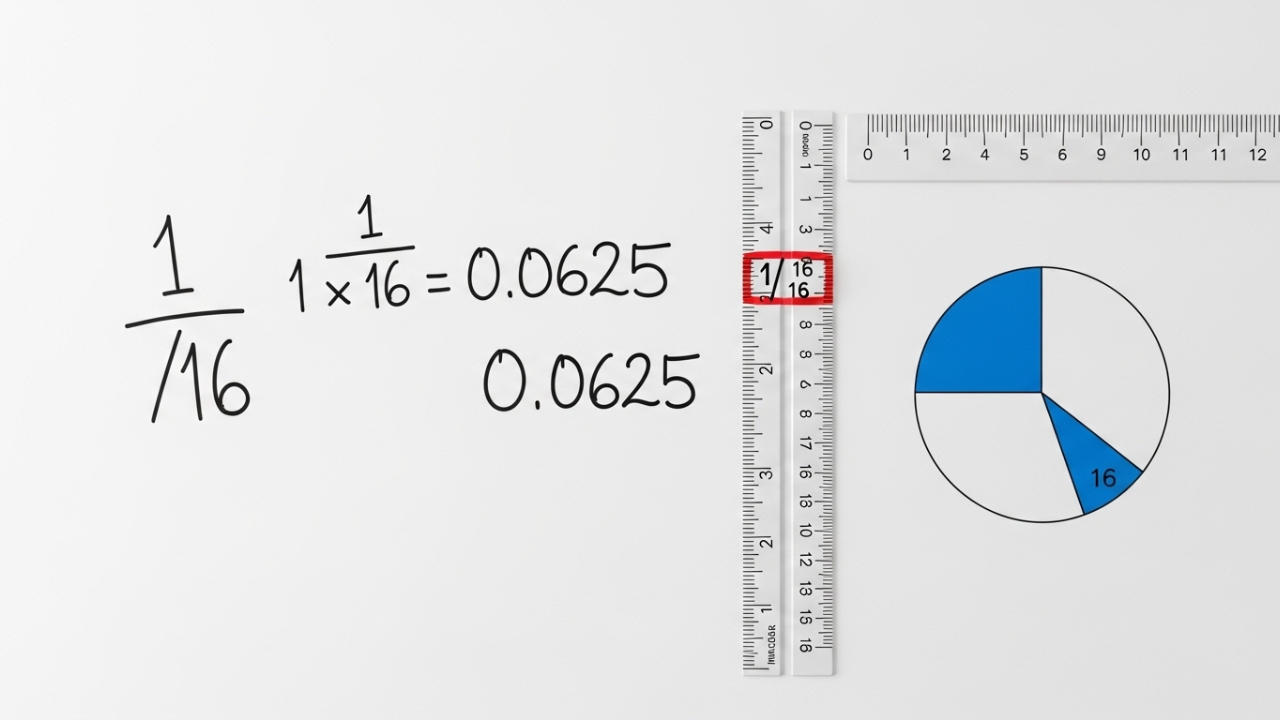
Fractions can often feel intimidating, but they hold the key to understanding many mathematical concepts. One of the simplest yet essential fractions is 1/16. Have you ever wondered what 1/16 translates to as a decimal? This small fraction plays a significant role in various real-life applications, from cooking measurements to engineering calculations. In this blog post, we’ll break down the process of converting fractions into decimals and explore why mastering this skill can make your life easier. Let’s dive deep into the world of 1/16!
Understanding Fractions: What is 1/16 as a Decimal?
Understanding fractions is crucial for grasping various mathematical concepts. When it comes to 1/16, converting it into a decimal reveals its value as 0.0625. This simple transformation helps bridge the gap between fractions and decimals, making calculations more accessible in everyday scenarios like cooking or budgeting. Knowing this conversion can enhance your numeracy skills significantly.
Exploring Fraction to Decimal Conversion
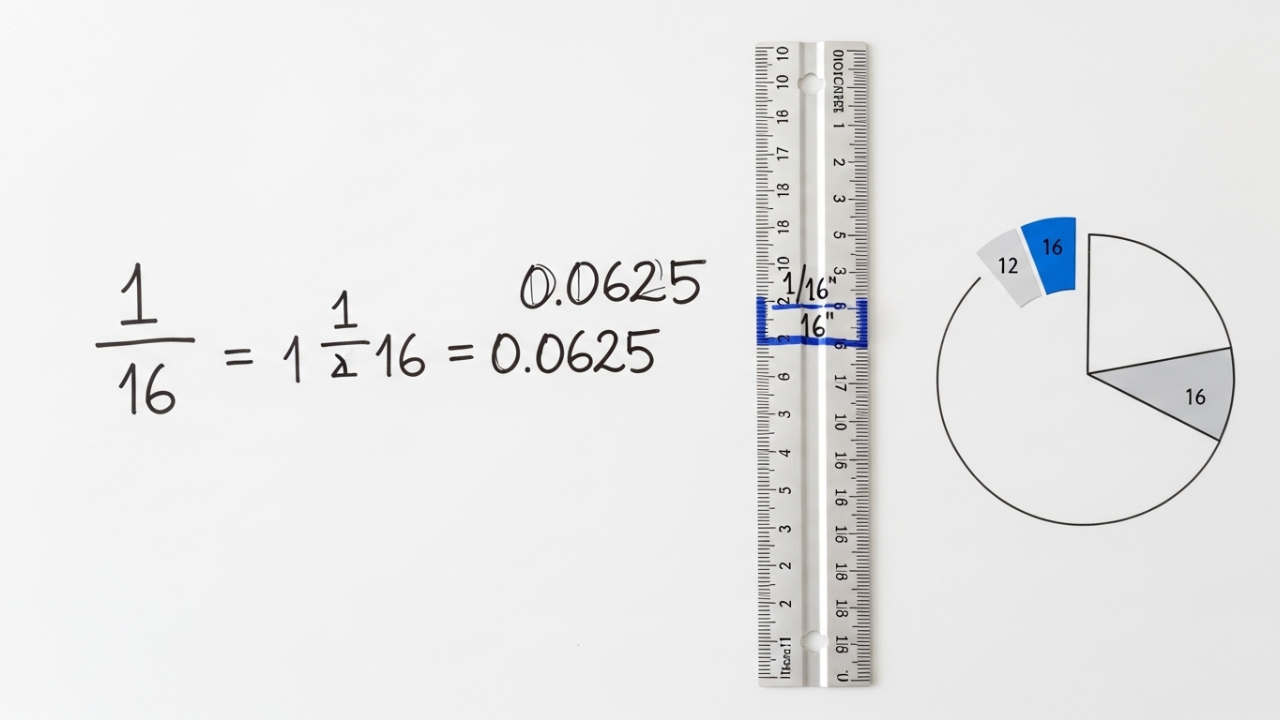
Converting fractions to decimals is a fundamental skill in mathematics. It allows for easier calculations and comparisons. Understanding this conversion can simplify tasks in everyday life, from budgeting to cooking. Knowing how to switch between these two forms enhances numerical fluency, making it essential for students and professionals alike. The process opens up new perspectives on numbers.
Fundamental Concept of Fraction and Decimal
Fractions and decimals are two ways to represent parts of a whole. A fraction shows this relationship with a numerator and denominator, while a decimal expresses it using place value. Understanding both is crucial for math concepts, as they often work together in calculations and real-life applications like measurements or financial transactions.
Why Knowing Fraction to Decimal Conversion is Important
Understanding fraction to decimal conversion is crucial in everyday life. It helps with cooking measurements, budgeting finances, and understanding statistics. Whether you’re dividing a pizza or calculating interest rates, knowing how to convert fractions enhances accuracy. This skill simplifies complex calculations and fosters better comprehension of numerical data in various contexts.
Converting 1/16 to Decimal
To convert 1/16 to decimal, divide the numerator by the denominator. Simply take 1 and divide it by 16. This calculation results in 0.0625. Understanding this conversion is essential for various applications, from cooking measurements to financial calculations, making fractions more manageable in everyday life.
Step-by-Step Guide to Convert 1/16 to Decimal
To convert 1/16 to a decimal, divide the numerator (1) by the denominator (16). Start with long division: 1 divided by 16 equals 0.0625. You can also use a calculator for quick results. This method works consistently across any fraction conversion you encounter in daily life or academic situations.
Illustrative Examples for Better Understanding
To grasp the concept of converting fractions to decimals, consider 1/4 as an example. Dividing 1 by 4 gives you 0.25. Similarly, for 1/2, dividing yields 0.5. These examples illustrate how simple division helps translate fractional values into decimals easily and effectively, enhancing your understanding of numbers in various forms.
Applications and Relevance
Understanding how to convert fractions like 1/16 to decimals has practical applications in cooking, measurements, and financial calculations. It helps in accurately scaling recipes or determining costs. This knowledge is essential for students, professionals, and anyone involved in tasks that require precise numerical conversions. Mastering these concepts enhances everyday problem-solving skills across various fields.
Real-Life Scenarios Utilizing Fraction to Decimal Conversion
In everyday life, fraction to decimal conversion is essential. For example, when baking, a recipe might call for 1/16 of a cup. Understanding this as 0.0625 helps in accurate measurements. Similarly, carpenters often convert fractions to decimals for precise cuts and fittings, ensuring their projects are executed flawlessly and efficiently without any guesswork involved.
Additional Fraction Conversions
Understanding other fractions can enhance your math skills. For example, 1/8 converts to 0.125, while 3/16 equals 0.1875. Knowing these conversions is useful in various fields such as cooking and construction, where precision matters. Using a decimal chart can simplify this process further for quick reference when needed.
Exploring Various Fractions and Their Decimal Equivalents
Fractions can often be tricky, but understanding their decimal equivalents simplifies many calculations. For instance, 1/4 equals 0.25 and 3/8 translates to 0.375. Each fraction has a unique decimal counterpart that plays a significant role in everyday math, from cooking measurements to financial transactions. Familiarizing yourself with these conversions enhances your numerical fluency significantly.
Seeking Further Assistance or Providing Feedback
If you have questions about converting fractions to decimals, feel free to reach out. Your feedback is valuable and helps improve the content. Whether you’re curious about specific examples or need clarification on certain concepts, we’re here to assist. Share your thoughts or inquiries anytime; engagement enhances everyone’s understanding of these essential math skills.
Options for Questions and Feedback on the Conversion Process
If you have questions about converting fractions to decimals, feel free to reach out. Your feedback is crucial in enhancing understanding. Whether you’re puzzled by a specific conversion or want tips on related topics, we’re here to help. Engage with us through comments or direct messages for personalized assistance and insights!
what is 1 32 as a decimal
To find what 1/32 is as a decimal, you divide 1 by 32. This results in 0.03125. Understanding this conversion can help in various applications, from cooking measurements to financial calculations, making it essential to grasp fractions and their decimal equivalents for everyday use.
what is 1 16 as a decimal example
To understand what 1/16 as a decimal looks like, simply perform the division. When you divide 1 by 16, you get 0.0625. This means that if you have one part out of sixteen total parts, it represents just over six hundredths in decimal form. Simple yet essential for various calculations!
what is 1 16 in percentage
To convert 1/16 into a percentage, simply divide 1 by 16 and then multiply the result by 100. This gives you approximately 6.25%. Understanding this conversion can be helpful in various mathematical applications, whether you’re dealing with fractions or percentages in everyday tasks or academic settings.
1/8 to decimal
To convert 1/8 to a decimal, simply divide the numerator (1) by the denominator (8). This gives you 0.125. Understanding this conversion helps with various calculations in math and everyday situations. It’s useful for measurements, cooking, and financial decisions where precision is key. Knowing how fractions transform into decimals can simplify your numerical tasks significantly.
what is 3 16 as a decimal
To find what 3/16 is as a decimal, simply divide the numerator by the denominator. When you calculate 3 divided by 16, you get 0.1875. This simple conversion shows how fractions can easily translate into decimal form for various applications in everyday life and mathematics.
1 16 decimal chart
A 1/16 decimal chart is a handy tool for quick conversions. It lists the fractional equivalents of common measurements, making it easier to visualize values like 0.0625 for 1/16. Such charts are particularly useful in carpentry and cooking, where precise measurements matter. Having this reference can save time and reduce errors in calculations.
1 16 inch to decimal
When converting 1/16 inch to decimal, you get 0.0625. This conversion is helpful in various fields like construction and woodworking, where precision matters. Understanding this small fraction can make a big difference in measurements and calculations, ensuring accuracy in your projects or tasks that involve fractional inches.
1 16 to inches
When converting 1/16 to inches, you’re essentially looking at a fractional measurement. In decimal form, it’s equivalent to 0.0625 inches. This small fraction is often used in carpentry and sewing, where precise measurements are crucial for accuracy. Knowing how fractions relate to inches can help enhance your DIY projects or crafting skills effectively.
FAQs
Got questions about fractions and decimals? You’re not alone! Many people wonder about conversions like what is 1/16 as a decimal or how to express percentages. If you’re curious about related topics, such as converting other fractions or understanding their real-life applications, feel free to ask. Your inquiries help deepen the conversation around math concepts.
What is 1 16th as a decimal?
To find what 1/16 is as a decimal, simply divide 1 by 16. The result is 0.0625. This number represents the same quantity as the fraction but in a different format, making it easier to understand and use in various calculations or comparisons involving decimals.
Is 0.125 as a fraction?
Yes, 0.125 can be expressed as a fraction. It is equivalent to 1/8. To convert it, recognize that the decimal represents 125 thousandths, which simplifies to 1/8 when divided by their greatest common divisor. This conversion illustrates how decimals and fractions are interconnected in mathematics.
What is 1 ⁄ 8 as a decimal?
To find what 1/8 is as a decimal, you simply divide 1 by 8. This results in 0.125. Understanding this conversion helps with various calculations, whether you’re baking or handling measurements in construction projects. Knowing fractional values can make tasks easier and more precise for anyone working with numbers regularly.
What is 0.86 as a fraction?
Understanding fractions and their decimal equivalents is essential for various calculations. When looking at the number 0.86, it can be expressed as a fraction by recognizing its position relative to whole numbers.
To convert 0.86 into a fraction, we place it over 1: \( \frac{0.86}{1} \). Now multiply both numerator and denominator by 100 to eliminate the decimal:
\( \frac{86}{100} \).
This fraction can be simplified further:
\( \frac{43}{50} \).
Thus, 0.86 as a fraction is \( \frac{43}{50} \). Understanding these conversions enriches your mathematical knowledge and practical skills in everyday situations where fractions play an important role!