
 By Mubashir Abbasi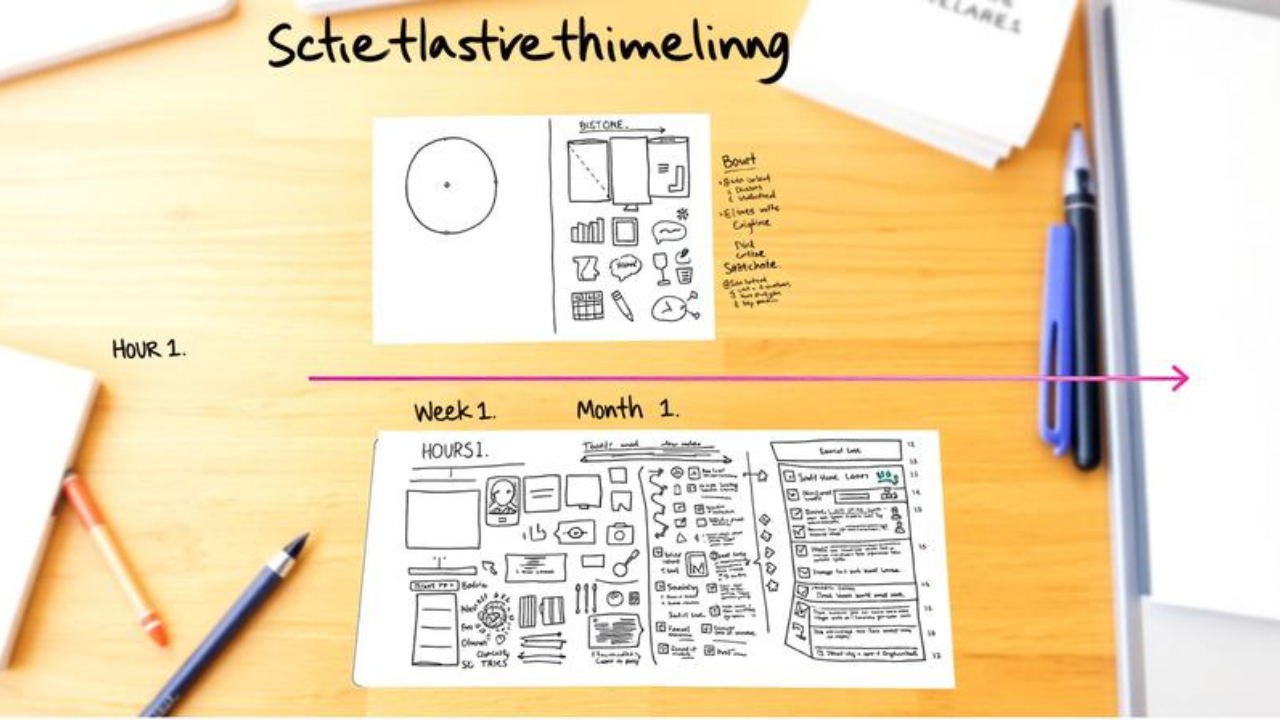
The honest truth about the sketchnoting learning curve—and why you’re probably closer to mastering it than you think.
Introduction
You’ve seen them online. Those beautiful, sprawling visual notes that look like they belong in an art gallery. Someone took a one-hour talk and transformed it into a masterpiece of words, icons, arrows, and containers. And you think: I could never do that. It would take years to learn.
Here’s the plot twist: it doesn’t.
According to one experienced sketchnoter, you can master the basic sketchnoting skills in less than one hour. Not weeks. Not months. One hour.
Now, before you get skeptical, let’s be clear about what that means. You won’t be producing gallery-worthy work in sixty minutes. But you will have everything you need to start taking effective visual notes—right now, with whatever pen and paper you have on hand.
The question “how long does it take to learn sketchnoting” is one of the most common barriers to entry. It’s the excuse that keeps people stuck in linear, boring, forgettable note-taking. But the truth is far more encouraging than most beginners imagine. This article will give you a realistic roadmap—not just the timeline, but what you can expect at each stage, and how to accelerate your progress without burning out.
Why Everyone’s Asking This Question Right Now
Sketchnoting has moved from niche hobby to mainstream skill. In classrooms, boardrooms, and conference halls, visual note-taking is being recognized as a powerful tool for learning, retention, and communication.
The pandemic accelerated this shift. With endless Zoom calls and information overload, people desperately needed better ways to process and remember what they were hearing. Sketchnoting offered a solution: a method that forces active listening, synthesis, and personal meaning-making.
But there’s a gap between wanting to sketchnote and actually doing it. That gap is filled with fear—fear of not being artistic enough, fear of wasting time, fear of looking foolish. And at the heart of that fear is a single question: How long will this take?
The good news is that the sketchnoting community has been remarkably honest about the learning curve. From academic courses to online challenges, we now have a clear picture of what to expect. And the timeline is far more accessible than most people assume.
The Real Timeline: What to Expect at Every Stage
Stage 1: The First Hour – You Can Start Right Now
Here’s the most liberating truth about sketchnoting: you already have the skills you need to begin.
Sketchnoting is built on five basic components: a dot, a line, a triangle, a square, and a circle. That’s it. If you can draw those five shapes—and you absolutely can—you have the visual vocabulary to sketchnote.
One beginner’s guide puts it bluntly: “Sketchnoting is not about learning drawing; it’s about learning and practicing creative thinking”. The goal isn’t to create a masterpiece. It’s to translate words into visuals, to break complex concepts into digestible pieces.
In that first hour, you can:
-
Learn the five basic shapes and how they combine to create simple icons
-
Understand the core elements: text, containers, connectors, and emphasis
-
Create your first rough sketchnote from a short video or podcast
As one educator advises: “Try not to spend more than an hour per sketchnote” when you’re starting out. For a typical reading or short talk, 90 minutes is a reasonable upper limit. The key is to start creating, not just consuming tutorials.
Stage 2: The First Week – Building Confidence and Vocabulary
Once you’ve taken the plunge, the first week is about practice and expansion. This is where you begin developing your personal “visual dictionary”—the set of icons, symbols, and layouts that feel natural to you.
During this phase, you might:
-
Practice drawing common objects using only basic shapes
-
Take sketchnotes from TED talks or conference recordings
-
Experiment with different layouts and structures
Many beginners find that using video recordings is particularly helpful. “You begin to get a feel on what to write, draw or letter depending upon what resonates with you, and how you choose to structure the page”. The pressure is lower than a live event, and you can pause and rewind as needed.
One sketchnoter describes this phase as moving from “totally intimidated” to “oh, that’s actually fun!”. The shift happens quickly when you stop worrying about perfection and start focusing on the process.
Stage 3: The First Month – Developing Fluency
A 30-day sketchnoting challenge can take you from “NOT a sketch” to “Sketches of Note”. Over the course of a month, you’ll work through daily exercises that build confidence and skill.
What changes in this stage?
-
Speed improves: Your hand-eye coordination develops, and you spend less time hesitating over each line.
-
Your visual vocabulary expands: You accumulate a library of icons and symbols that you can draw without thinking.
-
Layout becomes intuitive: You start to see how information can be structured before you even put pen to paper.
One academic course expects students to reduce their sketchnote time from 90 minutes to 60 minutes over the course of a semester. That’s a realistic pace—steady improvement without the pressure of overnight mastery.
Stage 4: Ongoing Growth – The Journey Never Ends
Here’s the counterintuitive truth: even experienced sketchnoters are still learning. The skill isn’t a destination; it’s a practice.
As one sketchnoter notes, “We are taking 15 weeks to explore and practice the fundamental principles of sketching simply, quickly and clearly”. Even after years of practice, there’s always more to learn—new techniques, new layouts, new ways to express ideas visually.
But here’s the liberating part: you don’t need to be an expert to benefit from sketchnoting. The cognitive benefits—better retention, deeper understanding, improved focus—kick in from day one. You don’t have to wait until you’re “good” to start reaping the rewards.
What Actually Accelerates the Learning Curve?
If you want to learn sketchnoting faster, focus on these three things:
1. Practice with Purpose, Not Perfection
The biggest mistake beginners make is trying to make every sketchnote beautiful. That’s not the goal. “The whole idea of visual note-taking is not creating a masterpiece but learning how to translate words to visuals”.
Instead, focus on:
-
Capturing the core argument, not every detail
-
Using simple shapes and lines—no shading, no perspective, no artistic flourishes
-
Creating notes that you can understand, not notes that would impress others
2. Build Your Visual Vocabulary Systematically
Rather than trying to learn a thousand icons at once, start with the concepts you encounter most frequently. Create a simple symbol for each one, and practice drawing it until it becomes automatic.
This is what experts call developing your “visual dictionary”. It’s the same way you learned to write—one letter at a time, then words, then sentences.
3. Embrace the Learning Process
Sketchnoting is as much about thinking as it is about drawing. It’s a tool to “learn how to paraphrase, summarize, and refocus to what’s really meaningful”.
When you view sketchnoting as a thinking exercise rather than an art project, the pressure dissolves. You’re not trying to be an illustrator; you’re trying to be a better learner.
The Counterargument: It’s Not for Everyone, and That’s Fine
Let’s be honest: sketchnoting does require some investment. For some people, the cognitive load of listening, synthesizing, and drawing simultaneously is simply too high. Others find that the drawing aspect distracts them from the content rather than enhancing it.
And that’s perfectly okay.
Sketchnoting is a tool, not a religion. If it doesn’t work for you, there are plenty of other effective note-taking methods. The goal is better learning, not forcing yourself into a system that doesn’t fit.
There’s also the question of when to sketchnote. Live events—with their unpredictable pacing and rapid-fire information—are the most challenging context. One beginner’s guide recommends starting with recorded content (like TED talks) where you can pause and rewind. Build your skills in low-pressure environments before tackling high-stakes situations.
The key is to be realistic about your goals. If you want to produce publication-ready sketchnotes, yes, that will take months or years of practice. But if you want to think better and remember more, you can start seeing benefits today.
Actionable Takeaways
-
Start in the next hour. You don’t need special skills or supplies. A pen and paper are enough. Draw a dot, a line, a circle, a triangle, and a square. You’re now a sketchnoter.
-
Practice with video first. TED talks and conference recordings let you pause, rewind, and practice without the pressure of live events.
-
Aim for 60–90 minutes per sketchnote initially. As the semester or your practice progresses, try to get it down to 60 minutes.
-
Build your visual dictionary gradually. Create simple symbols for concepts you encounter frequently. Add to it over time.
-
Focus on thinking, not drawing. Sketchnoting is about translating words into visuals, not creating art. The cognitive benefits come from the process, not the product.
FAQs
1. How long does it take to learn sketchnoting?
You can master the basic skills in under one hour. Developing fluency and speed typically takes several weeks of regular practice.
2. Do I need to be good at drawing to sketchnote?
No. Sketchnoting uses only five basic shapes: a dot, a line, a circle, a triangle, and a square. If you can draw these, you can sketchnote.
3. How long should my first sketchnote take?
Aim for no more than 60–90 minutes for your first sketchnote. As you practice, you’ll get faster.
4. What’s the fastest way to learn sketchnoting?
Practice with video recordings (like TED talks) where you can pause and rewind. Focus on capturing key ideas, not creating perfect drawings.
5. Is there a 30-day sketchnoting challenge?
Yes. Several courses offer 30-day challenges that take you from beginner to confident sketchnoter through daily exercises.
6. Can I learn sketchnoting in a weekend?
Intensive 2-day workshops are available and can provide a solid foundation. However, skill development continues with ongoing practice.
7. How do I know if I’m making progress?
You’ll notice your sketchnotes taking less time, your visual vocabulary expanding, and your ability to capture key ideas improving.
Conclusion: The Clock Starts Now
Here’s the truth that most people don’t want to hear: the time is going to pass anyway. You can spend the next month wishing you could sketchnote, or you can spend the next month actually doing it.
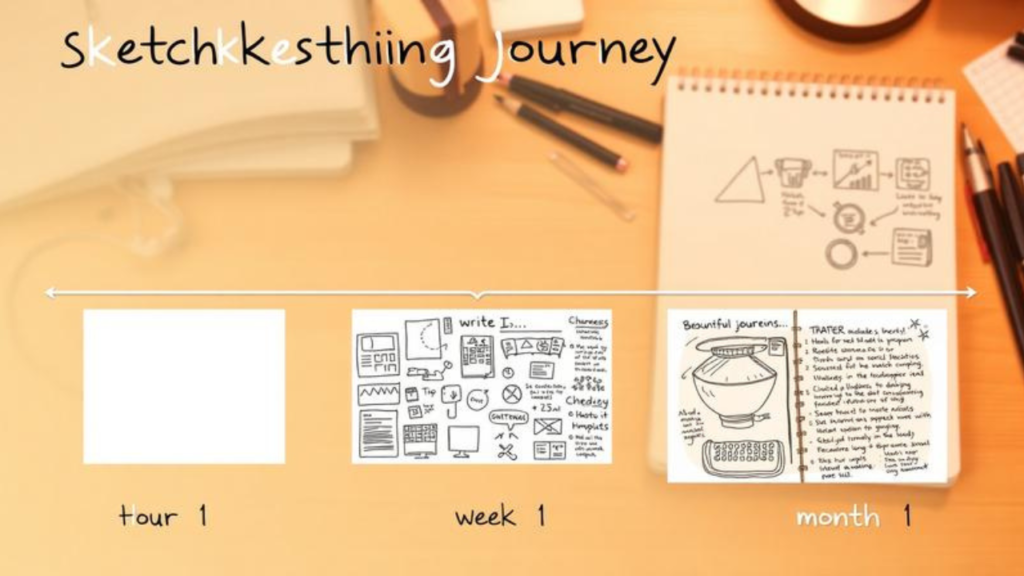
The learning curve for sketchnoting is remarkably gentle. Within an hour, you can grasp the fundamentals. Within a week, you’ll have a growing visual vocabulary and a collection of sketchnotes you’re proud of. within a month, you’ll be faster, more confident, and wondering why you waited so long to start.
But here’s the most important thing: you don’t need to wait until you’re “good” to benefit. The cognitive advantages—better retention, deeper understanding, improved focus—start from your very first sketchnote.
So pick up a pen. Draw a dot. Then a line. hen a circle. then a triangle. Then a square. You’ve just taken the first step.
The question isn’t “how long does it take to learn sketchnoting?” The real question is: “What are you waiting for?”
The best time to start was yesterday. The second best time is right now.
What is sketchnoting used for?
Sketchnoting is a versatile visual note-taking technique used to capture and communicate ideas. It can be used in a wide range of situations, including during lectures, tutorials, and workshops; for academic readings like papers and book chapters; in professional settings like meetings, conferences, and professional development sessions; for personal activities like journaling, goal setting, and planning; and even for brainstorming, presenting information, and capturing design processes. Its underlying value lies in its ability to capture rich, detailed information by combining text and visuals.
Is sketchnoting the same as doodling?
No, they are fundamentally different. Doodling is often a passive activity done to keep hands busy while the mind may wander. Sketchnoting, on the other hand, is an active, purposeful, and productive strategy. It’s often described as “directed doodling” because it involves intentionally drawing connections and visual elements to record and understand information, boosting engagement, comprehension, and retention.
Do you need to be an artist to sketchnote?
Absolutely not. This is one of the biggest misconceptions. The focus of sketchnoting is on capturing ideas, not creating art. You don’t need any special drawing ability. You can create effective sketchnotes using just basic shapes like squares, circles, and triangles. The goal is to develop a personal style that works for you and to capture concepts, not to produce a masterpiece.
What are the best sketchnoting apps?
The “best” app depends on your needs and skill level. Here are some top contenders:
-
Paper: Ideal for beginners due to its minimal and simple interface.
-
Procreate: Excellent for advanced users who want to add depth and detail with layers and brushes.
-
Concepts: A vector-based app great for precision, as sketches can be edited and scaled without losing quality.
-
Goodnotes: Perfect for those who prefer a traditional, notebook-like organization system.
-
Notability: Great for students, as it allows you to sync audio recordings with your notes.
-
Adobe Fresco: A strong choice for professionals already using the Adobe Creative Suite.
How do I create a sketchnote layout?
There’s no single “right” way, but here are some common tips:
-
Pick a structure: Choose a layout to organize your ideas, such as a row, grid, column, or a more freeform flow.
-
Use frames and containers: Use boxes, speech bubbles, or banners to group related ideas.
-
Add connectors: Use arrows and lines to link ideas and show relationships.
-
Create a visual hierarchy: Use different font sizes (e.g., bold for headings) and emphasis to show what’s most important.
-
Focus on key ideas: Aim for capturing big concepts in 2-5 word chunks rather than full sentences.
-
Develop an icon library: Create simple, recognizable symbols for common words or concepts you use often.
What tools do I need for sketchnoting?
The most essential tools are simple: a notebook (or paper) and a pen.
-
Notebook: Both ruled and blank notebooks or sketchpads work well.
-
Pen: A fast-drying pen is crucial to prevent smudging. Having a fine tip for details and a slightly thicker one for bold lines is helpful. Fineliners and brush pens are also popular choices.
-
Optional tools: Bold markers for emphasis, highlighters, and a few different colors can add another layer of organization.
Can sketchnoting improve memory?
Yes, research strongly supports that sketchnoting improves memory and retention. This is largely due to dual coding theory, which posits that combining visual and verbal information creates a stronger memory trace. Sketchnoting requires you to draw connections between pieces of information and personalize your notes, leading to deeper processing. Studies have shown that drawing information helps you recall it better than simply writing it down. Some educators note it can improve retention by up to 55%.
What is the difference between sketchnoting and mind mapping?
While both are visual thinking tools, they have key differences:
-
Mind maps are a specific, structured diagram that radiates out from a single central topic using branches to show a clear hierarchy and relationships.
-
Sketchnotes are a more flexible form of visual note-taking. They are not tied to a single hierarchy and can indicate a flow of ideas in many different layouts (e.g., linear, grid, or even radial).
-
In essence, a sketchnote can be a mind map if it uses a radial layout with a clear central hierarchy, but not all mind maps are sketchnotes, and many sketchnotes use layouts that are very different from a mind map.
-
The author Hard Work
- Its my almost 18 days of hard work to fully guide you in all kind of skechnoting guide its my real experience of my life that the niche holds hops you will enjoy all my experience of skechnoting in every term i will guide you in evey possible ways of creative skechnoting stay with ask a comment that i will reply you Being lovely.