
 By Richard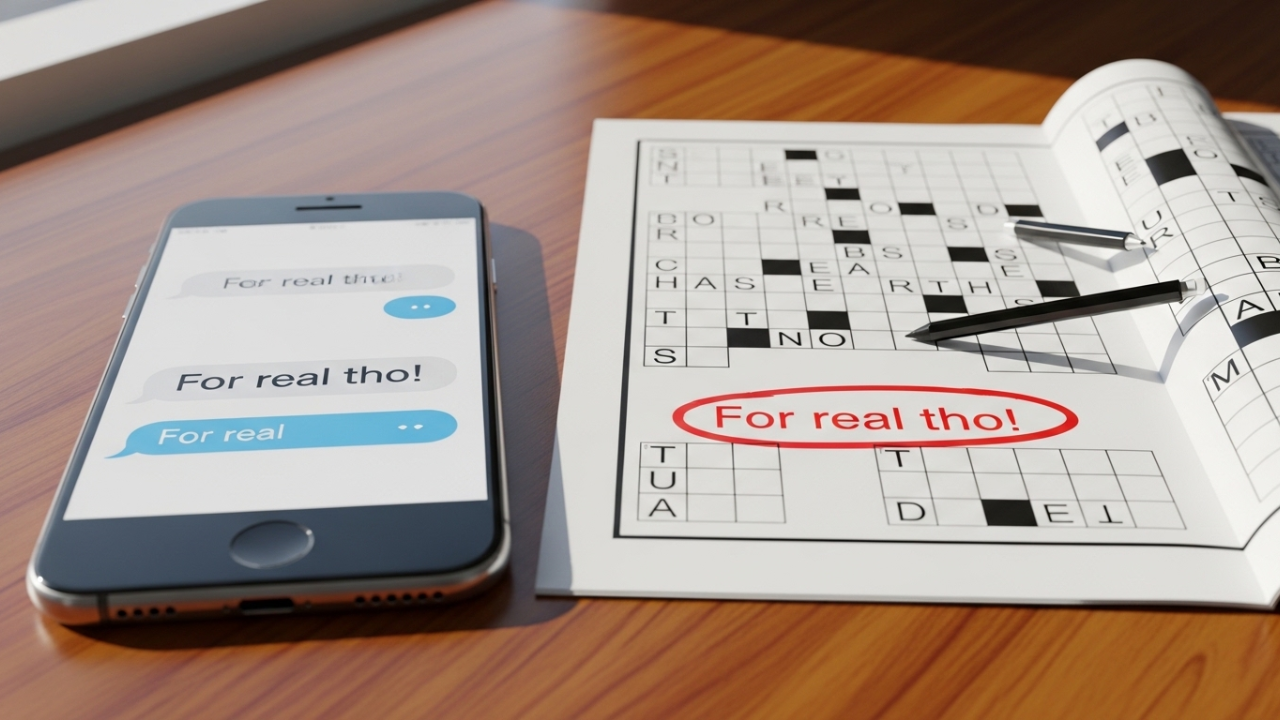
If you have been tackling modern crossword puzzles—especially the younger, hipper grids found in The New York Times, The Atlantic, or various indie puzzle apps—you have likely encountered a moment of pause. You are staring at a clue that reads “For real tho!” or “Seriously!” and the answer space requires a three-letter word.
For traditionalists, this can be jarring. Crosswords were once the domain of stuffy vocabulary, archaic terms like “ERE” (before) and “OLDE” (old). But language evolves, and so do puzzles. The phrase “for real tho” is a piece of modern vernacular that has found its way into the constructor’s toolkit.
In this article, we will explore why casual slang appears in crosswords, what the most common answers for “for real tho” are, and how you can train your brain to switch between Shakespearean English and internet slang in a split second.
The Rise of Vernacular in Crossword Puzzles
For decades, crossword constructors relied on a specific “crossword-ese”—a collection of words that rarely appeared in everyday conversation but were perfect for grids because of their vowel-heavy or consonant-heavy structures. Words like “ANOA” (a type of buffalo) and “ETUI” (a small case) were staples.
However, as puzzle editors like Will Shortz at the NYT have embraced a more modern audience, the grids have changed. They now reflect the way people actually speak. This shift means that common phrases from texting, social media, and Gen Z slang are now fair game.
When you see a clue like “For real tho,” the constructor isn’t trying to be obscure; they are trying to be relatable. They are tapping into a phrase used millions of times a day on Twitter, TikTok, and in text messages to express earnest agreement or emphasis.
What Does “For Real Tho” Mean?
Before we dive into the answers, let’s break down the clue itself.
“For real” is an idiom used to express sincerity. It is a way of saying, “I am not joking,” or “I completely agree.” The addition of “tho” (a phonetic abbreviation of “though”) adds a conversational tone. It often comes at the end of a statement to emphasize a point that might be contrary to what was just said, or to stress genuine emotion.
-
Example: “I know we were joking about the heat, but for real tho, we need to get air conditioning.”
In a crossword context, the clue “For real tho” is almost always looking for a short, punchy interjection that conveys seriousness or affirmation.
Common Crossword Answers for “For Real Tho”
Depending on the letter count and the specific tone of the puzzle, here are the answers you are most likely to encounter.
1. IMO (3 Letters)
While “IMO” technically stands for “In My Opinion,” it is often used in digital communication to preface a statement that the user feels strongly about. Because “for real tho” is a phrase used to introduce a serious opinion, “IMO” is a frequent fit. It is short, vowel-light, and a crossword favorite.
2. TBH (3 Letters)
“To Be Honest” is perhaps the closest cousin to “for real tho.” When someone says “TBH,” they are signaling a break from sarcasm or banter to deliver a sincere thought. It is one of the most common three-letter initialisms in modern crosswords. If you see a clue like “Honestly…” or “For real tho,” TBH is usually the safe bet.
3. THO (3 Letters)
This is a bit of a trick. Sometimes the clue “For real tho” is a meta clue. The word “tho” itself is a shortened version of “though.” If the puzzle is feeling playful, the answer might simply be THO, as it is literally the second half of the clue phrase.
4. SERIOUSLY (9 Letters)
For puzzles with more space, the constructor might opt for the full adverb. “SERIOUSLY” captures the exact sentiment of “for real tho.” It expresses disbelief or intense agreement.
5. HONEST (6 Letters)
Similarly, “HONEST” or “HONESTLY” can appear. A clue like “For real tho” might be clued as “HONEST?” with a question mark to indicate that it’s a definition rather than a synonym. As in, “Are you for real?” = “HONEST?”
6. YESS (4 Letters)
Sometimes, “for real tho” is used as an enthusiastic affirmation. In these cases, the answer might be an emphatic “YES” spelled with an extra ‘S’—YESS—to convey the intensity of the slang.
Why “Tho” Instead of “Though”?
A common question from new solvers is: “Why do they use misspellings?”
In crossword construction, space is king. “Though” is six letters, while “tho” is three. By using the abbreviated, internet-friendly version “tho,” constructors can fit the word into tighter spaces and use the remaining squares for more interesting, long answers.
Furthermore, the use of “tho” signals a specific cultural register. It tells the solver that this puzzle is in tune with modern digital communication. It’s not a mistake; it’s a stylistic choice.
The Etiquette of Slang in Crosswords
Not everyone is a fan of slang in their puzzles. Purists argue that crosswords should be a bastion of proper English and classical vocabulary. However, proponents of modern slang argue that language is fluid.
When you see “for real tho” in a puzzle, it serves a few purposes:
-
Accessibility: It makes puzzles more accessible to younger solvers who might not know what a “LEA” (a meadow) is but definitely know what “TBH” means.
-
Timeliness: It anchors the puzzle in the current era. Fifty years from now, solvers might look back at “TBH” and “IMO” as charming artifacts of early 21st-century internet culture.
-
Difficulty Balance: By using a familiar slang phrase for an easy clue, constructors can offset a difficult theme or obscure long answer elsewhere in the grid.
How to Solve Slang Clues
If you are not a heavy texter or social media user, clues like “For real tho” can be intimidating. Here is how to approach them.
1. Think Digitally
When you see a clue that sounds like something a teenager would say, your mind should immediately jump to acronyms. TBH, IMO, IDK (I don’t know), and SMH (shaking my head) are the heavy hitters of crossword slang.
2. Consider the Tone
Is the clue an exclamation? “For real tho!” with an exclamation mark suggests excitement or strong agreement. This could point to a word like “RIGHT?” or “YES!” rather than an acronym.
3. Look at the Crosses
This is the universal rule of crosswords. If you are torn between “TBH” and “IMO,” look at the second letter of the answer. If it is “B,” it’s TBH. If it is “M,” it’s IMO. The crossing words will almost always give you the correct letter.
4. Embrace the Vernacular
The best way to get better at solving modern clues is to consume modern media. Scroll through social media, read comment sections, or listen to how young people talk. The phrases “no cap” (meaning “no lie” or “for real”) and “fr” (an abbreviation for “for real”) are starting to appear in puzzles as well. The language of the internet is now the language of crosswords.
The Puzzle as a Time Capsule
One of the fascinating aspects of crossword puzzles is how they document language. A puzzle from the 1950s is filled with slang from that era (like “SWELL” or “DADDY-O” as in “cool”). A puzzle from 2024 is filled with “TBH,” “THO,” and “IMO.”
When you solve a clue like “For real tho,” you are participating in a linguistic tradition. You are acknowledging that the way we emphasize sincerity has changed. We no longer say “Verily” or “Forsooth” (though those show up in crosswords too). We say “For real tho.”
Conclusion: Keepin’ It Real
So, the next time you are filling in a grid and you come across a clue that feels more like a text message than a dictionary entry, embrace it. The answer is likely TBH or IMO. These small acronyms are the building blocks of modern communication, and they have officially taken their place in the pantheon of crossword answers alongside “ARE” and “ERA.”
Whether you love it or hate it, the inclusion of phrases like “for real tho” signals a healthy, evolving puzzle community. It means the crossword is adapting, staying relevant, and inviting a new generation of solvers to pick up a pencil (or stylus) and join the fun.