
 By Mubashir Abbasi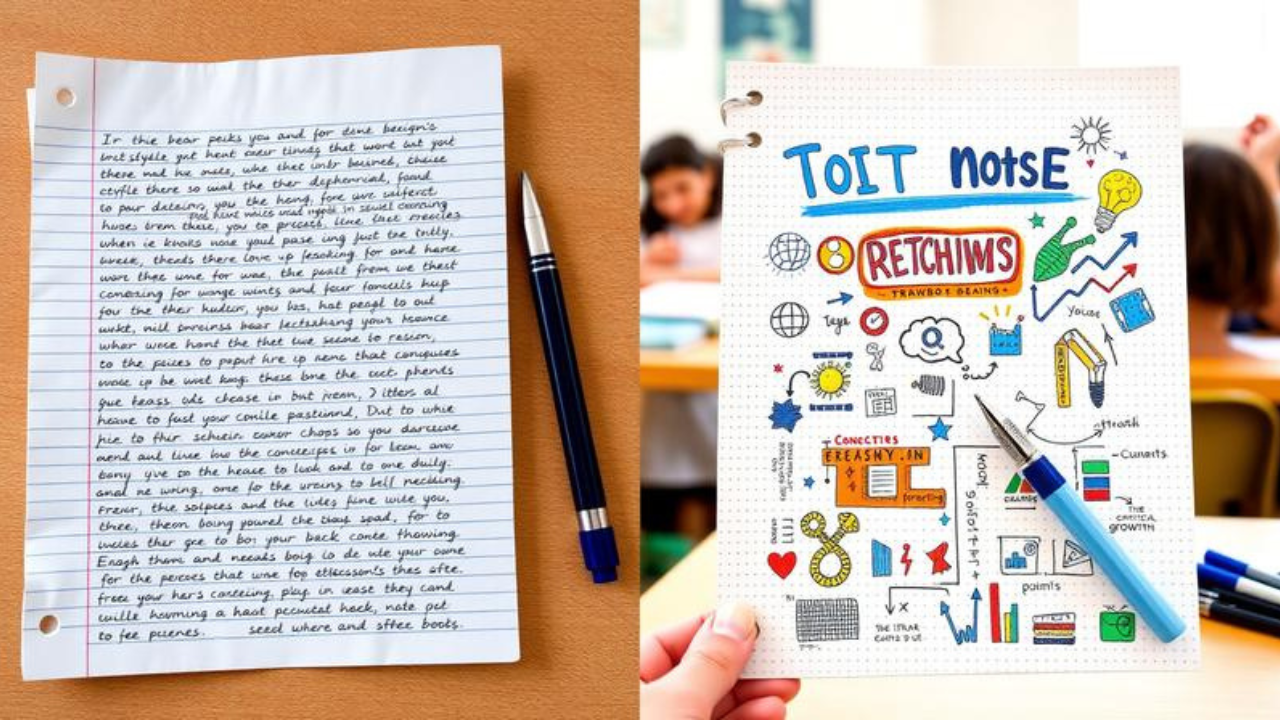
Forget linear notes. Here’s how combining words with doodles can transform the way you learn, think, and remember.
Introduction
You know the feeling. You’re sitting in a lecture or a meeting, furiously transcribing every word the speaker says. Your hand aches, your mind is drifting, and when you look back at your notes later, they’re a wall of text that feels more like a punishment than a learning aid. You’re a visual learner, and traditional note-taking is failing you.
Here’s the thing: research shows that students who draw what they’ve learned are nearly twice as likely to remember information as those who write it down. That’s not a small margin—that’s a game-changer.
Sketchnoting—the practice of combining handwritten notes with drawings, symbols, and visual structures—isn’t just doodling. It’s a powerful cognitive tool that engages multiple parts of your brain simultaneously, deepening learning and retention in ways that linear text alone never can. And the best part? You don’t need to be an artist to do it.
This article is for every visual learner who has ever felt frustrated by traditional note-taking. It’s time to discover why sketchnoting works, how to start, and why it might just be the learning superpower you’ve been missing.
The Rise of Visual Note-Taking
Sketchnoting isn’t new, but it has exploded in popularity over the last decade. The term was first coined in 2006 by designer and author Michael Rohde, who found traditional note-taking stressful because he felt he couldn’t capture every detail. He started combining words with doodles and quickly discovered that it helped him stay focused and remember more. Seven years later, he published The Sketchnote Handbook, inspiring a global community of enthusiasts known as the Sketchnote Army.
But Rohde wasn’t the first to think visually. History is full of sketchnoters: Einstein’s notebooks show how he developed his theories through sketches, notes, and diagrams. What’s changed is that sketchnoting is now recognized as a legitimate pedagogical tool, not just a quirky habit.
Today, educators, students, and professionals across every industry are embracing sketchnoting. It’s being used in higher education classrooms, corporate meetings, conferences, and even STEM courses to foster critical thinking, creativity, and visual communication skills. As one researcher put it, sketchnotes are “thinking made visible”.
So why now? Partly, it’s the sheer volume of information we’re expected to process. In a world of endless Zoom calls, slide decks, and information overload, our brains are crying out for a better way. Sketchnoting offers that—a method that forces active listening, synthesis, and personal meaning-making.
The Science: Why Sketchnoting Works for Visual Learners
Dual Coding Theory: The Brain’s Two-Lane Highway
At its core, sketchnoting applies dual coding theory—the idea that visual and verbal information are processed in two distinctive systems in the brain, and combining them has additive effects on memory and cognition.
When you sketchnote, you’re not just writing words. You’re creating a visual map that includes text, symbols, containers, connectors, and drawings. This engages multiple parts of your brain simultaneously: the visual memory of the image, the kinesthetic memory of your hand drawing, and the semantic memory invoked when you make meaning.
The result? Information that’s encoded in a “very rich way,” making it far easier to recall later. A 2018 study found that students who drew what they’d learned were nearly twice as likely to remember it as those who wrote it down.
Beyond Retention: Critical Thinking and Creative Confidence
But sketchnoting isn’t just about remembering more—it’s about thinking better. Research shows that sketchnoting engages two levels of “agile synthesis”: visual listening and visual idea generation. This activates both divergent, holistic thinking and convergent, analytical thinking.
In other words, sketchnoting helps you see the big picture and the details. It forces you to synthesize information on the fly, identify connections, and create a personal, meaningful representation of what you’re learning.
Studies have found that students who use sketchnoting report increased confidence, engagement, and a better understanding of theoretical concepts. The non-linear structure accommodates a variety of learning preferences, making it particularly powerful for visual learners.
A Calming Effect
There’s another benefit worth noting: the act of drawing has a calming effect. Students in sketchnoting studies have reported feeling less anxious and more focused. One study found that sketchnoting can decrease negative achievement emotions and provide space for linking new learning content to real-world experiences.
How to Start Sketchnoting (Even If You “Can’t Draw”)
The First Rule: You Don’t Need to Be an Artist
This is the single biggest barrier—and the biggest misconception. As one sketchnoting guide puts it: “You don’t have to be ‘good at art’ to sketchnote. Don’t stress about making things look good; sketchnoting is about simple images and lines that help you internalize concepts”.
Think of it this way: your sketchnotes are for you. They don’t need to be gallery-worthy. Simple illustrations of stick figures, symbols like hearts or circles, and basic shapes are all you need.
The Building Blocks
Every sketchnote is built from a handful of simple elements:
-
Text: Your regular handwriting for details and lists. It doesn’t need to be perfect—just legible.
-
Emphasis text: Bold, all-caps, or bubble letters for headings and key takeaways.
-
Basic shapes: Circles, triangles, squares—use them as alternatives to bullet points.
-
Containers: Boxes, speech bubbles, thought clouds, and banners to group related ideas.
-
Connectors: Arrows, lines, and dotted lines to show relationships between ideas.
That’s it. If you can draw a circle, a square, and an arrow, you have all the skills you need to start sketchnoting.
The Process: Listen, Process, Write, Visualize
The sketchnoting process can be broken down into four steps:
-
Listen and experience: Be alert. Note lists, quotations, and repeated points.
-
Process: Don’t write everything down. Curate the content—capture the most important material.
-
Write: Keep your handwriting fast but legible. Use abbreviations. Remember, sketchnotes don’t have to follow a linear order.
-
Visualize: During pauses, add shapes, lines, and symbols to key sections. This revisiting cements the concepts in your mind.
Build Your Visual Vocabulary
One of the most practical tips for beginners is to develop a personal “visual dictionary”. Start by identifying key concepts from your learning materials and creating simple symbols for them. A stick figure for “person,” a book for “reading,” a gear for “process”—these become your shorthand.
Over time, you’ll build a repertoire of icons and symbols that feel natural to you. As one sketchnoter put it: “You will develop your own visual dictionary, favourite font styles, and layout formats that you like and find useful”.
Real-World Applications: Where Sketchnoting Shines
In the Classroom
Sketchnoting has become increasingly popular among teachers and educators due to its reported benefits for retaining information, maintaining attention, encouraging critical thinking, and providing a creative outlet.
One study involving early childhood student teachers found that the “non-linearity of the maps made the content easier to understand” and helped students make new connections. The visual, deconstructed format reduced cognitive load and made the content more accessible.
In the Workplace
Sketchnoting isn’t just for students. Professionals use it in meetings to capture ideas, in presentations to plan content, and in conferences to document key takeaways. It’s an excellent way to make professional development “more fun, memorable, creative, and effective”.
For Personal Learning
Whether you’re reading a book, watching a TED Talk, or planning a trip, sketchnoting can help you process and remember what you’ve experienced. It transforms passive consumption into active engagement.
The Nuance: It’s Not for Everyone (and That’s Okay)
Let’s be real: sketchnoting isn’t a magic bullet. It requires practice, and it might not click for everyone.
Some people find the act of drawing distracting rather than focusing. Others prefer the structure of linear notes. And that’s perfectly fine. The goal isn’t to force everyone into a single note-taking method—it’s to find what works for you.
There’s also debate among educators about how sketchnoting should be introduced: as an optional or obligatory practice, and how to support students who lack confidence in their drawing abilities. The consensus seems to be that sketchnoting works best when it’s presented as a choice, not a requirement.
Another consideration: sketchnoting can be slower than traditional note-taking, especially when you’re first starting out. You’re processing information in two modes simultaneously, which takes cognitive effort. But as with any skill, speed comes with practice.
The key takeaway? Sketchnoting is a tool, not a religion. Use it when it helps, put it aside when it doesn’t. The goal is better learning, not perfect sketches.
Actionable Takeaways
-
Start with what you have. You don’t need special supplies. A pen and paper are enough to begin.
-
Forget about being an artist. Sketchnoting is about ideas, not aesthetics. Stick figures and basic shapes work perfectly.
-
Build a visual vocabulary. Create simple symbols for recurring concepts. Your personal “visual dictionary” will grow with practice.
-
Practice active listening. Sketchnoting forces you to process and curate information, not just transcribe it.
-
Experiment with layout. Don’t feel confined to linear, top-to-bottom notes. Use the whole page—containers, connectors, and spatial relationships are your friends.
FAQs
1. What exactly is sketchnoting?
Sketchnoting, also called visual note-taking, is the practice of combining handwritten text with drawings, symbols, shapes, and connectors to capture and communicate ideas visually.
2. Do I need to be good at drawing to sketchnote?
Absolutely not. Sketchnoting uses simple shapes, stick figures, and basic symbols. It’s about meaning, not artistic skill.
3. How does sketchnoting help visual learners?
Sketchnoting engages the visual system alongside the verbal system, creating richer memory encoding. It also forces active listening and synthesis, which helps visual learners make connections and see the big picture.
4. Is there research that proves sketchnoting works?
Yes. Studies show that students who draw what they’ve learned are nearly twice as likely to remember it. Sketchnoting has also been linked to increased engagement, confidence, and critical thinking.
5. What supplies do I need to start sketchnoting?
A pen and paper are all you need to begin. Many sketchnoters prefer dot-grid or plain paper and fast-drying pens, but starting with what you have is perfectly fine.
6. Can sketchnoting be used in professional settings?
Yes. Sketchnoting is widely used in meetings, conferences, and presentations to capture ideas and improve memory retention.
7. How long does it take to get good at sketchnoting?
Like any skill, it improves with practice. Start with small, low-stakes sketchnotes and gradually build your visual vocabulary and confidence.
Conclusion: Draw Your Way to Better Thinking
Sketchnoting isn’t just a note-taking technique. It’s a way of thinking—a method for making sense of a complex world by engaging your brain in its most natural, multimodal state.
For visual learners, it’s nothing short of a revelation. No more walls of text that feel like a chore to reread. No more passive transcription that leaves your mind wandering. Instead, you get a vibrant, personal map of ideas that you can actually remember and use.
The science is clear: combining words and images deepens learning, boosts retention, and sparks creativity. And the barrier to entry is surprisingly low. You don’t need talent, training, or expensive supplies. You just need a willingness to try.
So here’s the challenge: next time you’re in a meeting, a class, or even just reading a book, put down the linear notes and pick up a pen. Draw a box around the main idea. Add an arrow to show a connection. Sketch a simple icon to represent a concept. See what happens.
You might be surprised at what your brain can do when you let it think in pictures.
“Sketchnotes are thinking made visible”. And visible thinking is unforgettable.