
 By Richard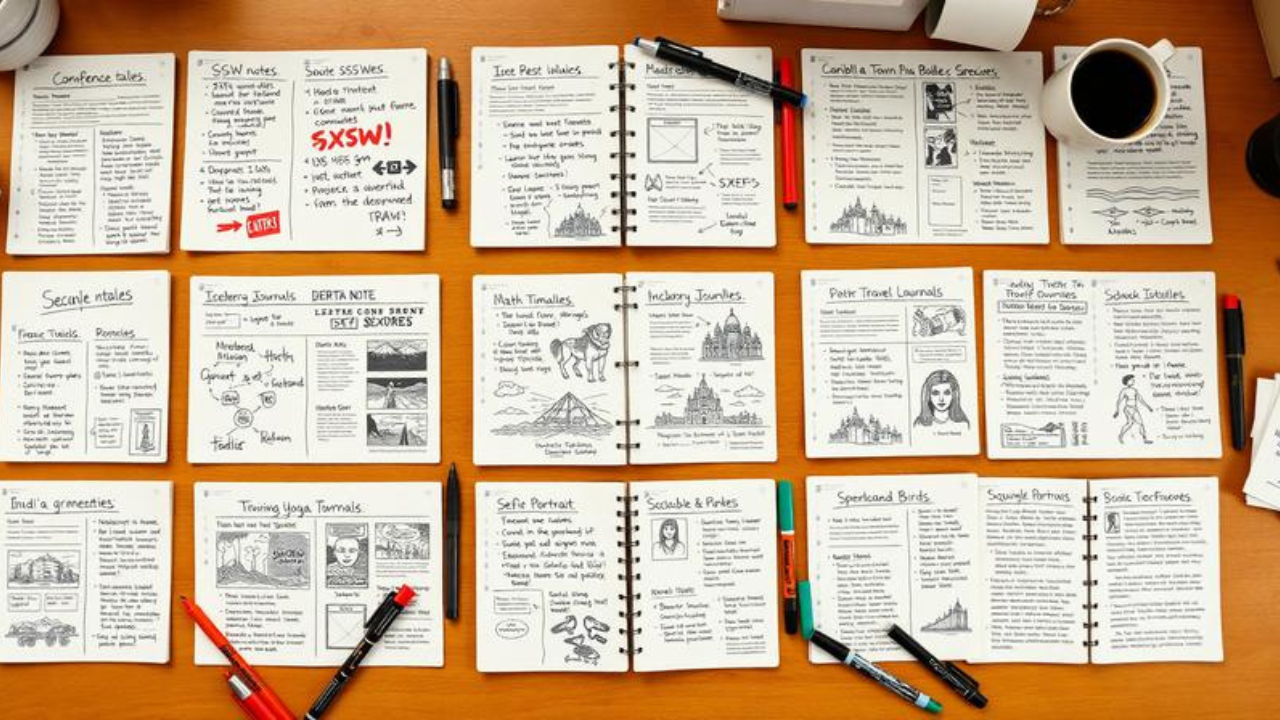
You’re sitting in a conference session, furiously typing notes into your laptop. The speaker drops a profound insight, and you capture it verbatim. Three weeks later, you scroll through that document and realize you remember nothing. The words are there, but the meaning is gone.
Now picture the person next to you. They’re not typing. They’re drawing. Their page is a living canvas of bold titles, playful icons, connecting arrows, and handwritten quotes. A month later, they flip open that notebook and instantly recall not just what was said, but how it felt.
That’s the power of sketchnoting.
Sketchnotes are “rich visual notes created from a mix of handwriting, drawings, hand-drawn typography, shapes, and visual elements like arrows, boxes, and lines”. They’re not about being an artist—they’re about being a better thinker. As one sketchnoter puts it, “Being impressive is not the goal. Being effective is”.
In this article, we’re showcasing 20 stunning sketchnote examples across six categories. Each one offers a unique lesson in visual thinking. By the end, you’ll have all the inspiration you need to pick up a pen and transform your note-taking forever.
Why Sketchnoting Is Taking Over the Note-Taking World
The term “Sketchnote” was coined by designer and author Mike Rohde. Since then, it has grown into a global movement with tens of thousands of converts. Rohde has been hired to illustrate business books like REWORK by 37signals, collaborate on a TEDMED notebook, and create live sketchnotes for major conferences including SXSW Interactive.
But why has sketchnoting exploded in popularity?
The answer lies in how our brains work. Sketchnoting taps into dual coding theory, which suggests that humans perceive verbal and visual information via separate channels. When you combine words with images, you’re encoding information in two ways, making it stickier and more memorable. Research shows that students who use sketchnoting remember information significantly better. At Auburn University, more than 800 first-year engineering students learned sketchnoting as part of their curriculum.
As Mike Rohde explains: “If you draw something, no matter how mundane the subject, no matter how badly, you really look at the thing, and therefore, you remember it better”.
The beauty of sketchnoting is its accessibility. Sketchnotes are “hand-drawn visual notes of talks, presentations, meetings” that “facilitate visual thinking, sense making, reflection, application of ideas, sketching practice, and sharing”. You don’t need artistic talent. You just need a pen, paper, and an open mind.
20 Sketchnote Examples That Will Inspire You
Conference Sketchnotes: capturing Live Events in Real Time
1. Mike Rohde’s SXSW Interactive Sketchnotes (2008)
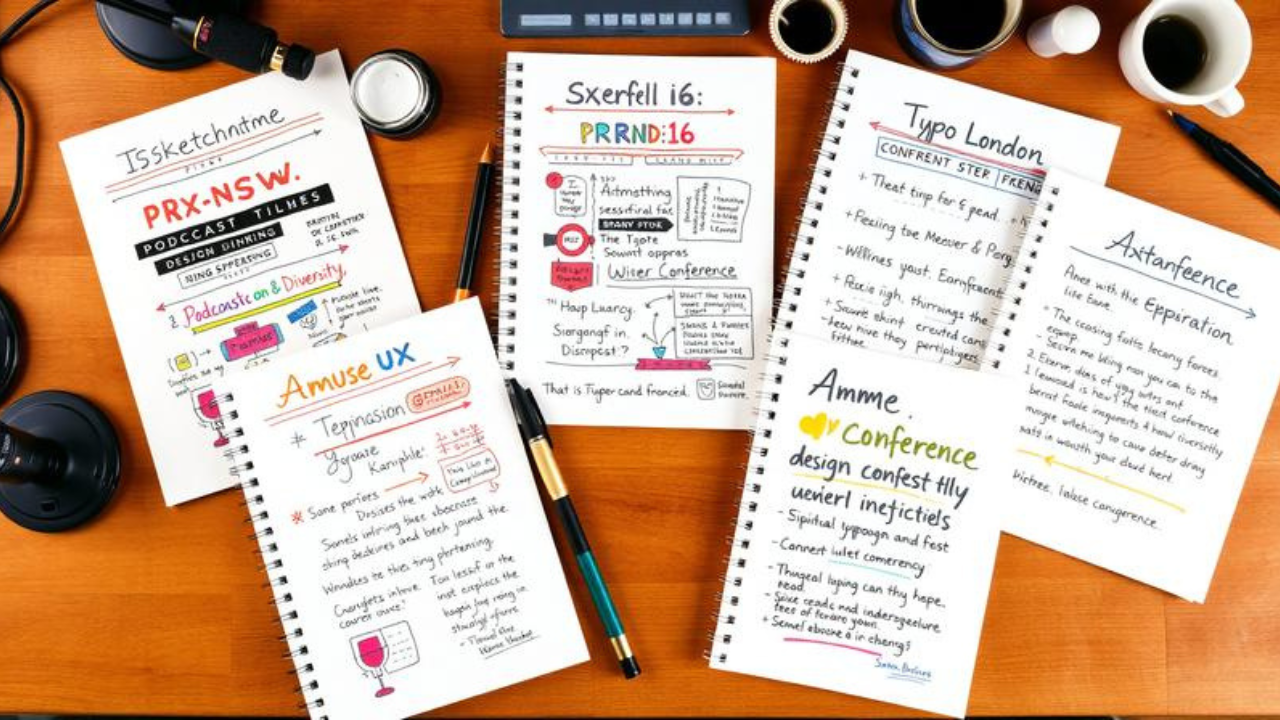
Designer Mike Rohde attended several panels at SXSW Interactive and created 34 pages of sketchnotes in real-time, captured in a Moleskine sketchbook. His work helped define the sketchnoting genre. What makes these notes remarkable is their clarity amid chaos. Rohde captured complex panel discussions with clean lettering, simple icons, and strategic use of white space. Four of his large posters sold at silent auction for $681, all donated to non-profits.
Lesson: Even in fast-paced environments, sketchnoting is possible. Focus on the big ideas, not every word.
2. Mike Rohde’s SXSW Interactive Sketchnotes (2009)
The following year, Rohde returned to SXSW and created even more—70 pages of sketchnotes captured on-site and live in a Moleskine pocket sketchbook. The 2009 set demonstrates his evolution as a sketchnoter. The layouts are more confident, the hierarchy clearer, and the visual storytelling more sophisticated. Rohde shared these freely on Flickr, pulling out key quotes and lessons learned.
Lesson: Sketchnoting is a skill that improves with practice. Each session makes you better.
3. PRNDI16 Conference Sketchnotes by Veronica Erb
At the 2016 Public Radio News Directors Incorporated conference, researcher and designer Veronica Erb took sketchnotes at every session she attended. The conference covered topics ranging from “Covering Race in your Community” to “Podcasting: The Macro Level” to “Diversity in the Newsroom”. Erb’s notes demonstrate that sketchnoting works in professional, journalistic settings. She notes: “When you practice sketchnoting, your visual vocabulary will grow, your working memory will strengthen, and you will get better at picking out what is most meaningful to you”.
Lesson: Sketchnoting helps you filter signal from noise. You naturally prioritize what matters.
4. Eva-Lotta Lamm’s Typo London 2011 Sketchnotes
Eva-Lotta Lamm, an interaction designer at Google, created stunning sketchnotes from the Typo London 2011 design conference. Her work is characterized by clean layouts, elegant lettering, and a confident use of space. Lamm has sketchnoted over 100 talks at design events and conferences. Her approach proves that sketchnoting can be both functional and beautiful.
Lesson: Sketchnotes can be works of art without sacrificing substance. Form and function can coexist.
5. Amuse UX Conference 2018 Sketchnotes
One sketchnoter attended the Amuse UX Conference and had “a lot of fun capturing the talks by creating sketchnotes”. The notes from this event show how sketchnoting can capture user experience concepts—often abstract and complex—in visual form. The sketchnoter focused on key takeaways like “Mindful” and explored the problem of note-taking itself.
Lesson: Sketchnoting can help you understand and remember abstract or technical concepts.
Educational Sketchnotes: Learning in the Classroom
6. Sylvia Duckworth’s Educational Sketchnotes
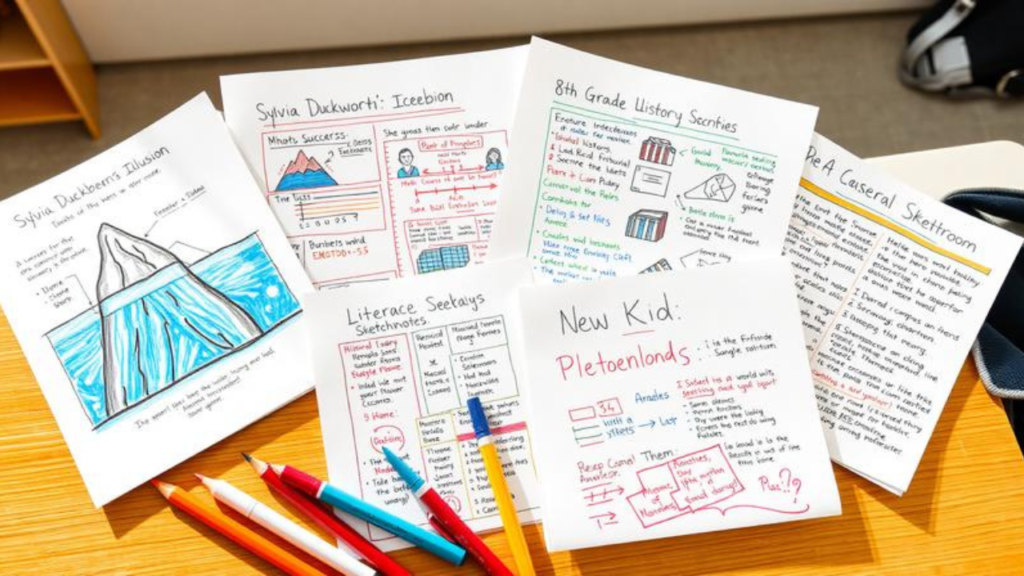
Sylvia Duckworth is a Canadian teacher whose sketchnotes have taken social media by storm. Her drawings “provide clarity and provoke dialogue on many topics related to education”. Her book, Sketchnotes for Educators, contains 100 of her most popular sketchnotes with links to original downloads. Duckworth’s work is remarkable because it proves that sketchnoting isn’t just for designers—it’s for teachers, students, and lifelong learners.
Lesson: Sketchnoting is for everyone, regardless of profession or background.
7. The “Iceberg Illusion” Sketchnote
One of Duckworth’s most famous sketchnotes visualizes the “Iceberg Illusion”—the idea that what we see of success is just the tip, while beneath the surface lies failure, sacrifice, and hard work. This sketchnote has been shared thousands of times because it makes a complex psychological concept instantly understandable.
Lesson: A good sketchnote can make abstract ideas concrete and shareable.
8. Student Math Sketchnotes
Svenja Simajchl created visual notes from a math course, proving that even abstract subjects can be sketchnoted effectively. Math is often thought of as purely logical and verbal, but Simajchl’s work shows how visual representations can make mathematical concepts more accessible.
Lesson: No subject is too “serious” or “abstract” for sketchnoting.
9. 8th Grade History Sketchnotes
Teacher David Roach uses sketchnotes to engage his middle school students. His students create visually rich notes to summarize historical events and concepts. This approach proves that sketchnoting works across age groups—from elementary school to higher education.
Lesson: Sketchnoting can engage students who struggle with traditional note-taking.
10. “New Kid” Book Sketchnotes
Students created sketchnotes to summarize literary elements like mood, tone, and characterization from the book New Kid. This example shows how sketchnoting can be used for reading comprehension and literary analysis.
Lesson: Sketchnoting can enhance understanding of literature and storytelling.
Travel Sketchnotes: Capturing Memories and Experiences
11. Eva-Lotta Lamm’s World Travel Sketchnotes
Eva-Lotta Lamm’s book Sketchnotes einer Weltreise documents her journey around the world—from India to New Zealand, the USA to Peru and Bolivia. Her travel sketchnotes are “creative, individual, and full of joie de vivre”. They capture not just what she saw, but how she felt.
Lesson: Sketchnotes can be a form of personal journaling and memory-keeping.
12. Reflective Travel Sketchnotes of Scotland
One sketchnoter created 24 pages of travel sketchnotes from a family trip to Scotland. What makes this example unique is the approach: rather than sketching during the trip, the creator took photos and voice notes each day, then created the sketchnotes after returning home. This “reflective” approach revealed unexpected benefits—including deeper enjoyment of the memories.
Lesson: You don’t have to sketchnote in real-time. Reflective sketchnoting can be just as powerful.
13. Eva-Lotta Lamm’s Travel Doodles of Laos
Lamm’s travel sketches from Laos show how sketchnoting can capture the essence of a place. Her doodles are simple yet evocative, proving that you don’t need elaborate drawings to convey a sense of place.
Lesson: Simple sketches can be incredibly powerful. You don’t need to be a master artist.
14. Vincent Loustau’s Business Travel Sketchnote
Vincent Loustau created a sketchnote to summarize a two-week business trip with a remote team. He wrote: “It was so fun to do and share 🙂 I love sketchnoting. Since I discovered it 6-months ago I’ve moved my mind to visual. I could never come back”. Loustau’s example shows that sketchnoting isn’t just for personal use—it’s a powerful business tool.
Lesson: Sketchnoting can enhance remote work and team communication.
Personal and Lifestyle Sketchnotes
15. Yoga Teacher Training Sketchnotes
Eva-Lotta Lamm documented her 200-hour Hatha Yoga Teacher Training Course in Rishikesh, India. Her hand-drawn notes include Asana and Pranayama practice, alignment, anatomy, and yoga philosophy. She also captured full sequences and detailed alignment notes from additional classes. This example shows how sketchnoting can document immersive learning experiences.
Lesson: Sketchnoting can capture complex, embodied learning—not just verbal information.
16. The “Sketchnote Selfie”
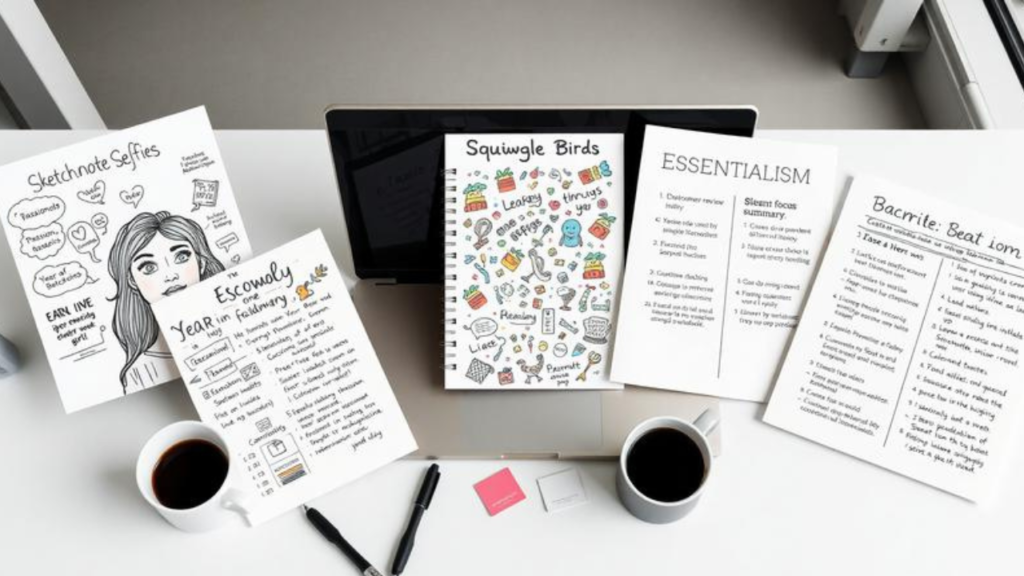
One creative exercise challenges you to create an info-rich portrait with character: portrait, name, info, location, passions, hobbies, interests, social usernames, and a “now” section. This is a fantastic way to practice sketchnoting while creating something personal and meaningful.
Lesson: Sketchnoting can be a form of self-expression and personal branding.
17. Squiggle Birds Exercise
A simple but delightful exercise: take squiggles and give them beaks, eyes, and bird feet. This teaches you that you can create recognizable images from the simplest starting points—a core lesson for sketchnoting beginners.
Lesson: You can create recognizable images from the simplest marks. Start with squiggles.
18. Year-in-Review Sketchnote
One sketchnoter describes an annual tradition: “Document your creative year with a sketchnote to summarize 2024”. This process creates “an illustrated summary of the year” that can be “really beautiful in its own way”.
Lesson: Sketchnoting can be a powerful tool for reflection and personal growth.
Business and Professional Sketchnotes
19. “Essentialism” Book Sketchnote
One sketchnoter created a visual summary of Greg McKeown’s book Essentialism. The sketchnote captures the core message: “You can’t do it all, so focus on the essential”. This example shows how sketchnoting can be used for professional development and learning.
Lesson: Sketchnoting can help you synthesize and remember key ideas from books and courses.
20. Customer Review of The Sketchnote Workbook
A customer review of Mike Rohde’s Sketchnote Workbook notes that the book offers “a quick overview of techniques followed by great examples and different applications of sketch noting”. The reviewer found sketchnoting useful for “highly effective note-taking during meetings” and “organizing my own thoughts in a visual and engaging way”.
Lesson: Sketchnoting has practical applications in the workplace—from meetings to strategic planning.
The Counterargument: Isn’t This Just Fancy Doodling?
Let’s be honest. Some people look at sketchnotes and see nothing more than glorified doodling. “Why spend time drawing when you could just write faster?” they ask.
It’s a fair question. And here’s the nuanced answer: Sketchnoting isn’t about replacing words with pictures. It’s about integrating them. The goal isn’t to create art—it’s to create understanding.
Sketchnotes “can take a variety of forms, from simple infographics, to stick figures, to complex representations of processes”. They’re not about artistic skill—they’re about “receiving and processing the world in a more” meaningful way.
Yes, sketchnoting requires practice. Yes, your first attempts might look messy. But as Mike Rohde reminds us, the mantra is “Ideas, not Art”. Your sketchnotes don’t need to be beautiful to be effective. They just need to work for you.
One sketchnoter puts it perfectly: “Sketchnotes should be personal. Reducing things down to their bare essentials removes that personality. It’s up to you to find your balance”.
Actionable Takeaways
1. Start with “Ideas, Not Art.” Don’t worry about making your sketchnotes pretty. Focus on capturing the meaning. As one educator emphasizes, “Big Ideas, NOT ART”.
2. Use the three-font system. Regular handwriting for body text, bold for titles, and a special style for quotes.
3. Master five basic shapes. Almost anything can be drawn using a rectangle, circle, triangle, line, and dot.
4. Look for inspiration everywhere. Check out Sketchnote Army for great examples. Flip through galleries and experiment with ideas you like.
5. Practice, practice, practice. As one sketchnoter advises, “Develop your personal style by looking for inspiration and experimenting with ideas”.
Frequently Asked Questions
1. Do I need to be good at drawing to sketchnote?
Absolutely not. The mantra of sketchnoting is “Ideas, not Art”. You can start with basic shapes—rectangle, circle, triangle, line, and dot—and build from there. Sketchnotes “don’t require advanced drawing or hand-lettering skills; anyone can learn how to use simple lines, connectors, shapes, and text to take dynamic notes”.
2. What materials do I need to start?
Surprisingly little. Many sketchnoters start with just a pen and notebook. As Brad Colbow’s example shows, two pens, a few outlines, arrows, and boxes can create something super engaging.
3. Can I sketchnote digitally?
Yes! Many sketchnoters use iPads with apps like Procreate, Paper, or GoodNotes. Digital tools also let you experiment with different styles without wasting paper.
4. How do I sketchnote during a fast-paced talk?
The key is to focus on the big ideas, not every word. Use abbreviations, simple icons, and don’t worry about capturing everything. Remember: “Ideas, not Art”. As one sketchnoter notes, “I write it down not to remember it later. I write it down to remember it now”.
5. Where can I find more sketchnote examples?
Check out Sketchnote Army, which gathers sketchnotes from around the world. Also explore Ogilvy Notes and search Google Images for inspiration.
6. Is sketchnoting effective for learning?
Yes. Research on dual coding theory shows that combining verbal and visual information enhances memory and comprehension. Case studies have found that students who sketchnote remember information better.
7. Can sketchnoting be used in professional settings?
Absolutely. Companies hire sketchnoters for conferences and events. Sketchnotes are used in business meetings, product development, and strategic planning.
Conclusion
Sketchnoting isn’t about being an artist. It’s about being a better thinker, learner, and communicator. The 20 examples we’ve explored—from conference halls to classrooms, from yoga studios to business meetings—all share one thing in common: they transform abstract ideas into something you can see.
Mike Rohde coined the term “sketchnote” and built a movement around the simple idea that visual thinking is for everyone. Eva-Lotta Lamm has sketchnoted her way around the world. Sylvia Duckworth has inspired educators globally. And you? You can start today with nothing more than a pen, paper, and an open mind.
So here’s your challenge: Pick one of the examples above. Try to recreate it in your own style. Make it messy. Make it yours. Because the most beautiful sketchnote in the world isn’t the one that looks perfect—it’s the one that helps you think.
As one sketchnoter wisely observed: “Being impressive is not the goal. Being effective is”.
Now go make some visual magic. Your brain will thank you.