
 By Mubashir Abbasi
Did you know one Picasso painting sold for over $179 million at auction? That price tag tells only part of the story. Picasso paintings changed how the world sees art, moving from realistic portraits to fractured, multi-angle compositions that still feel bold more than a century later.
If you have ever stared at a canvas of distorted faces and wondered what the fuss was about, this guide is for you. You will learn who Pablo Picasso was, why his work matters, and how his style evolved across his major periods. You will also discover the most famous works, what drives their value, and how to spot authentic pieces.
Whether you are a student, a future collector, or simply curious, you will leave with clear answers. Let’s start with the basics.
Table of Contents
- Introduction to Picasso Paintings
- Why Picasso Paintings Matter Today
- Picasso Paintings: Key Facts, Styles and Periods
- How to Appreciate and Buy Picasso Paintings
- Common Mistakes and Myths About Picasso Paintings
- Expert Tips for Best Results With Picasso Paintings
- Frequently Asked Questions About Picasso Paintings
Introduction to Picasso Paintings
Picasso paintings are the works created by Pablo Picasso (1881–1973), a Spanish artist who spent most of his career in France. Over roughly seven decades, he produced thousands of paintings, along with sculptures, prints, and ceramics. His work is known for experimenting with form, color, and perspective.
Think of Picasso as a chef who never stopped changing recipes. In one decade, he cooked gentle, sorrowful meals in shades of blue. In the next, he broke his ingredients into pieces and rearranged them on the plate. Many people still find those rearrangements startling.
Here is a helpful way to picture the famous Cubist approach. Imagine photographing a face from the front and from the side, then printing both images on one sheet. Picasso applied that idea to entire scenes, showing several viewpoints at once. Your eyes have to work harder, and that effort is exactly why his paintings still feel alive.
Why Picasso Paintings Matter Today
Understanding why these works endure will help you appreciate them more deeply. Here are the main reasons:
- They reshaped modern art. Cubism influenced architecture, design, and photography, so you see its legacy in everyday objects and buildings.
- They train your visual thinking. Looking at multiple viewpoints at once sharpens how you observe the world around you.
- They document artistic growth. Each period reveals a new experiment, so you can trace one mind evolving over decades.
- They carry human stories. Poverty, love, grief, and war appear throughout his canvases, making them emotionally direct.
- They hold a major place in the art market. Christie’s reported that Les Femmes d’Alger (Version ‘O’) sold for $179.4 million in 2015, the highest price ever paid for a Picasso at auction.
- They are widely accessible. Museums such as the Musée Picasso in Paris and the Reina Sofía in Madrid let you see originals in person.
Picasso Paintings: Key Facts, Styles and Periods
Picasso did not have one style. Art historians usually divide his career into distinct periods, each with its own palette and subject matter.
The Blue Period (1901–1904)
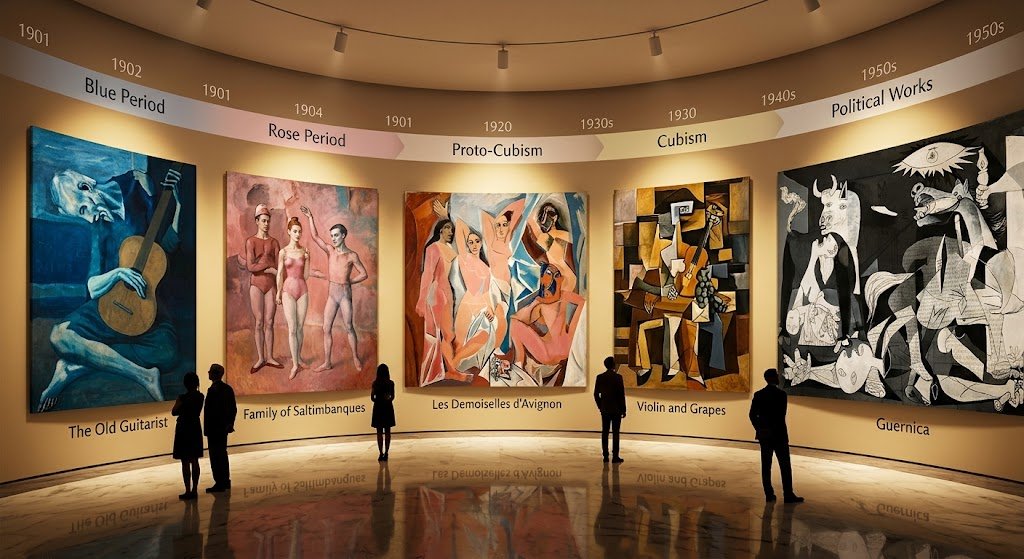
After a close friend’s suicide, Picasso painted mostly in blue and blue-green tones. These works focus on poverty, loneliness, and the elderly. The Old Guitarist (1903–1904) is the best-known example and hangs in the Art Institute of Chicago.
The Rose Period (1904–1906)
Warmer pinks, oranges, and earthy tones replaced the blues. Circus performers and acrobats became favorite subjects, and the mood softened. The emotional tone shifted from sadness toward quiet calm.
Proto-Cubism and African Influence (1907–1909)
Les Demoiselles d’Avignon (1907) broke sharply with tradition. Its angular, mask-like faces were inspired partly by African and Iberian sculpture, and it is now seen as a turning point for modern art.
Cubism and Later Works (1909–1950s)
Working with Georges Braque, Picasso developed Cubism, which reduced objects to geometric planes. Later, he painted bold portraits, such as Girl Before a Mirror (1932), using vivid color and curving lines.
The Political Period (1937 Onward)
Guernica (1937) responded to the bombing of a Basque town during the Spanish Civil War. Its black, white, and gray forms convey terror and grief without a single flag or uniform.
Here is a quick summary of how these periods compare:
| Period | Years | Key Colors and Features | Famous Example |
|---|---|---|---|
| Blue Period | 1901–1904 | Blue tones, poverty, loneliness | The Old Guitarist |
| Rose Period | 1904–1906 | Pinks, circus performers, softer mood | Family of Saltimbanques |
| Proto-Cubism | 1907–1909 | Angular forms, African influence | Les Demoiselles d’Avignon |
| Cubism | 1909–1919 | Fragmented planes, multiple viewpoints | Violin and Grapes |
| Late and Political | 1930s–1950s | Bold lines, emotional drama | Guernica |
How to Appreciate and Buy Picasso Paintings
Whether you want to enjoy his work or invest in it, a structured approach helps. Follow these steps.
- Start with a museum visit. Look at originals in person so you can see brushwork, texture, and scale that photographs cannot capture. Museums like the Musée Picasso in Paris offer extensive collections for beginners.
- Compare two periods side by side. Pair a Blue Period work with a Cubist canvas to see how dramatically his approach changed. Noticing the contrast will deepen your understanding of his development.
- Read about the context. Learn what was happening in Picasso’s life when he painted a work. Context often explains the mood, subject, and choice of color.
- Set a realistic budget. Prints, lithographs, and ceramics are far more affordable than oil paintings. Decide on your range first, then search within it.
- Verify provenance before buying. Ask for documented ownership history, exhibition records, and references to the catalogue raisonné. Reputable dealers always provide complete paperwork.
- Consult a specialist. Before any major purchase, work with a qualified art advisor or appraiser who can assess condition and authenticity.
Common Mistakes and Myths About Picasso Paintings
Many people hold assumptions about Picasso that do not match the facts. Clearing these up will sharpen your judgment.
- Myth: Picasso’s paintings are random or childlike. Picasso trained rigorously from a young age and could paint realistically. His abstraction was a deliberate choice built on that skill.
- Mistake: Assuming every Picasso is extremely expensive. Original paintings sell for millions, but prints and lithographs often cost far less. Prices vary widely by medium, period, and condition.
- Myth: Cubism meant Picasso painted everything in geometric shapes. Cubism was a phase, not his whole career. He moved between many styles, including classical and neoclassical approaches.
- Mistake: Trusting any signed piece. Forgeries of Picasso are common, so a signature alone proves nothing. Always check provenance and expert opinion before trusting a work.
- Myth: Guernica is just a picture of a bombing. The painting works as a universal protest against violence, and its symbols, such as the bull and the wounded horse, carry layered meanings.
Expert Tips for Best Results With Picasso Paintings
- Look at the edges and back. Labels, stamps, and exhibition tags on the reverse side can reveal a work’s history.
- Study the catalogue raisonné. This authoritative listing documents known works, so you can check a piece against it.
- Learn his signature variations. Picasso’s signature changed over time, so compare any signature against documented examples from the same period.
- Join a guided tour or lecture series. Experts point out details you would miss alone, and that turns a quick visit into a rich experience.
- Track auction results over time. Review past sales to understand how prices move for different periods and mediums before you bid.
Frequently Asked Questions About Picasso Paintings
What is the most famous Picasso painting?
Guernica is often considered his most important work. Painted in 1937 as a response to the bombing of a Basque town, it is now housed at the Reina Sofía in Madrid. Many people also know Les Demoiselles d’Avignon from 1907, which is widely credited with launching modern art. Both works are worth seeing in person, since their scale and emotional force are hard to capture in photographs.
How much are Picasso paintings worth?
Prices range enormously. Small prints and ceramics can cost a few hundred to a few thousand dollars, while major oil paintings sell for tens or hundreds of millions at top auctions. Value depends on period, subject, condition, and provenance. Always get a professional appraisal before buying or selling, since market prices shift and personal estimates can be misleading.
How can I tell if a Picasso painting is real?
Start by checking provenance, which means the documented ownership history of the work. Next, compare it with the catalogue raisonné and seek opinions from recognized experts. Technical analysis, such as pigment and canvas testing, can also help. Never rely on a signature alone, because forgeries are common. If a price seems too good to be true, treat that as a warning sign and investigate further.
Final Thoughts
Three ideas stand out from this guide. First, Picasso paintings evolved through distinct periods, from the Blue and Rose phases to Cubism and political works like Guernica. Second, understanding his development makes his work far more rewarding to view. Third, buying or valuing his art requires careful verification of provenance and authenticity.
Start today by visiting a museum or browsing a digital collection of his work. Pick one period, study three paintings from it, and notice what changes in your reaction.