
 By Richard
INTRODUCTION
Have you ever sat in class, desperately scribbling down every word your teacher says, only to look back at your notes later and realize you can barely remember a thing? You’re not alone. Traditional note-taking leaves most students with pages of text that their brains simply tune out. But what if there was a way to take notes that actually helps you remember—and even makes studying fun?
Enter sketch notes. Sketch notes examples are everywhere once you start looking—from student notebooks to corporate boardrooms. Visual note-taking, or sketchnoting, combines simple drawings, symbols, and text to capture ideas in a way your brain naturally loves. And the best part? You don’t need to be an artist to do it.
In this guide, you’ll discover exactly what sketch notes are, why they work, and most importantly, sketchnote examples for students that you can start using today. We’ll cover everything from simple sketchnote examples to sketch notes ideas for every subject, plus where to find sketch notes template pdf free resources. By the time you finish reading, you’ll have everything you need to transform your note-taking and boost your grades.
TABLE OF CONTENTS
-
What Are Sketch Notes? A Complete Definition
-
The History of Sketchnoting: From Cave Walls to Classrooms
-
Key Features and Types of Sketch Notes
-
Benefits of Sketch Notes: Why They Matter for Students
-
How to Create Sketch Notes: Step-by-Step Guide
-
Common Myths vs Facts About Sketchnoting
-
Expert Tips and Best Practices for Students
-
Frequently Asked Questions
-
Final Verdict: Should You Start Using Sketch Notes?
What Are Sketch Notes? A Complete Definition
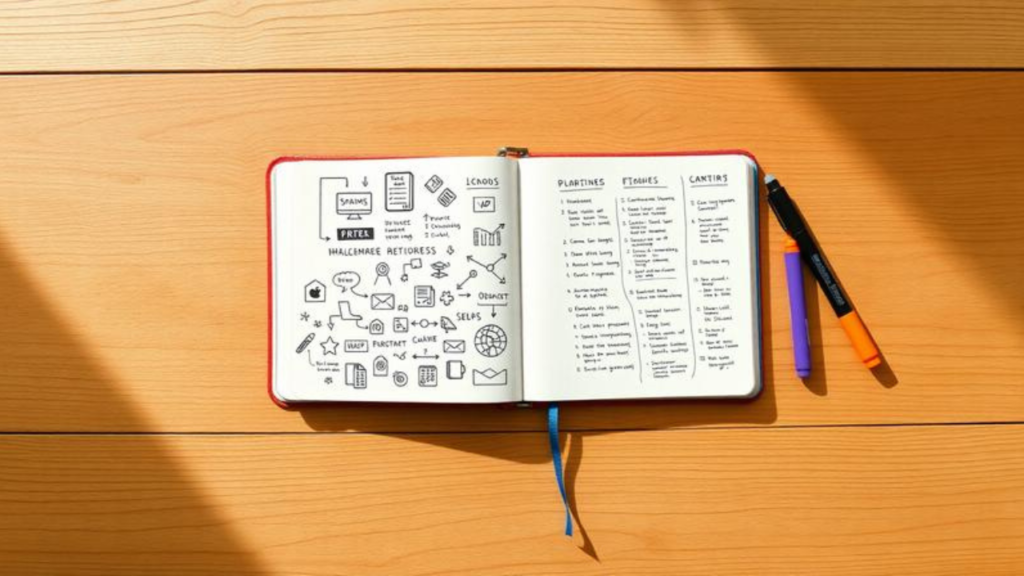
Sketch notes—also called sketchnotes or visual notes—are a form of note-taking that combines handwritten text with drawings, symbols, and visual elements. Instead of writing everything down in long paragraphs, you create a visual map of information using a mix of words and simple illustrations.
Think of sketch notes as the love child of doodling and traditional note-taking. They’re not about creating perfect artwork. As Mike Rohde, the designer who coined the term “sketchnoting,” famously said, it’s about “ideas, not art”. The goal is to capture and organize information in a way that makes sense to you.
Most sketch notes contain five basic building blocks: dots, lines, triangles, squares, and circles. From these simple shapes, you can create virtually anything—stick figures, arrows, containers, icons, and more. The beauty of sketchnoting is that it’s accessible to absolutely everyone, regardless of artistic ability.
So what do sketch notes actually look like in practice? Imagine you’re in a history class learning about World War II. Instead of writing three pages of text, you might draw a timeline with key events, sketch a simple map showing troop movements, add icons representing different countries, and use arrows to show cause and effect. Your page becomes a visual story that’s far easier to remember than a wall of words.
The key difference between sketch notes and traditional notes is active processing. When you take sketch notes, you’re not just transcribing—you’re actively deciding what’s important, how ideas connect, and what visual represents each concept best. This deeper level of thinking helps your brain lock in the information much more effectively.
Sketch notes examples range from simple bullet journal-style layouts to elaborate visual essays. But no matter the complexity, all sketchnote examples share common elements: they use space intentionally, combine visuals with text, and prioritize meaning over perfection.

The History of Sketchnoting: From Cave Walls to Classrooms
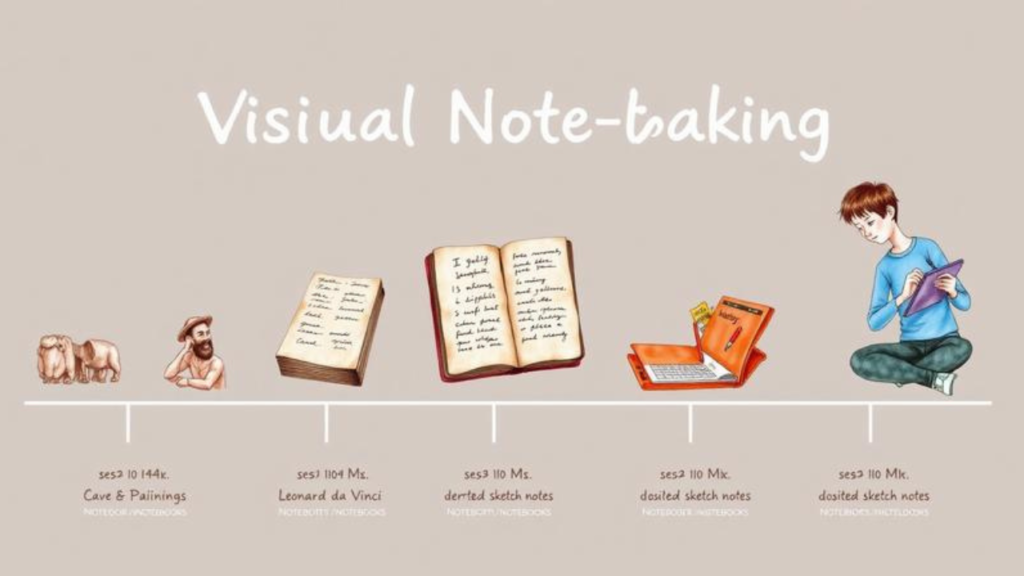
Believe it or not, sketch notes aren’t a new invention. Humans have been combining images and text to communicate for thousands of years. Ancient cave paintings were essentially the first sketch notes examples—early humans drew pictures to record important information about their environment, hunting strategies, and daily life.
Fast forward to more recent history, and you’ll find some of the greatest minds in human history using visual note-taking techniques. Albert Einstein’s notebooks are filled with sketches, diagrams, and visual notes that helped him develop his revolutionary theories. Leonardo da Vinci’s famous notebooks are essentially elaborate sketch notes examples that blend art, science, and observation.
The modern concept of sketchnoting, however, has a specific origin story. In 2006, designer and author Michael Rohde coined the term “sketchnoting”. Rohde found traditional note-taking stressful because he felt pressured to capture every single detail. He wanted a way to take notes that was more creative, less stressful, and actually helped him remember what he learned.
Rohde’s approach quickly gained traction in the design community and beyond. He wrote “The Sketchnote Handbook” and built an active community of sketchnoters called the Sketchnote Army. Today, sketchnoting has spread far beyond the design world and is increasingly used in classrooms, boardrooms, and personal productivity.
The science behind sketchnoting is rooted in dual coding theory, developed by psychologist Allan Paivio in 1971. This theory suggests that our brains process information through two separate channels—verbal and visual. When you combine both, you create multiple pathways for memory retrieval, making it much easier to remember and understand information.
In recent years, sketchnoting has become increasingly popular in educational contexts. Teachers have discovered that visual note-taking helps students engage more deeply with material, retain information longer, and even reduce negative emotions about learning. A study with 99 fifth-grade students found that those who used sketchnoting experienced significantly decreased negative achievement emotions compared to those who took traditional notes.
Today, sketch notes examples can be found everywhere—from student notebooks to professional conferences, from YouTube tutorials to TED Talks. The practice continues to evolve as more people discover the power of visual thinking.
Key Features and Types of Sketch Notes
Core Elements of Sketch Notes
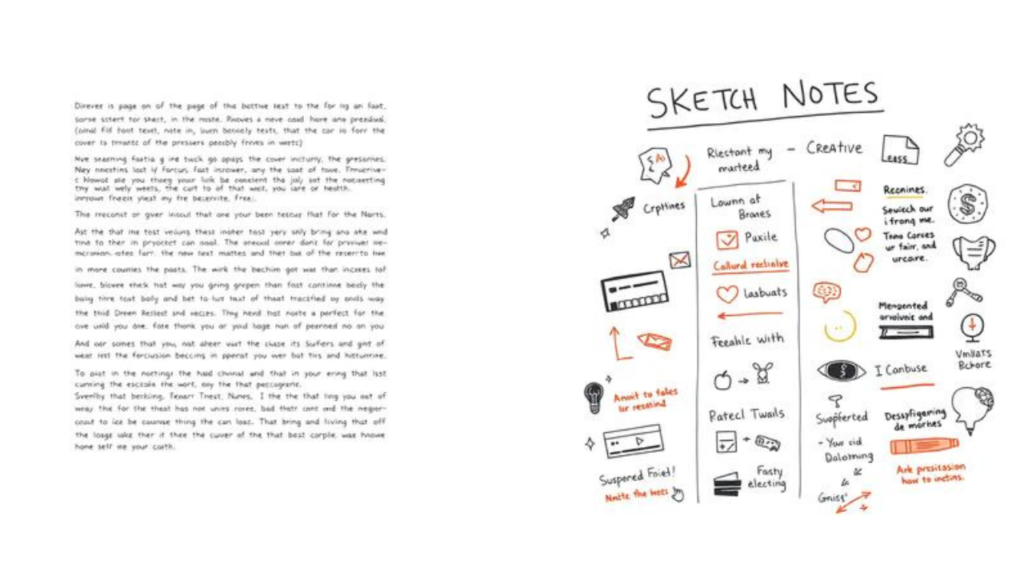
Every sketch note shares certain fundamental elements. Understanding these building blocks will help you create your own sketchnote examples more effectively.
Text and Typography: Words still matter in sketch notes! But instead of writing in long paragraphs, you use keywords, short phrases, and varied lettering styles to emphasize important points. Hand-lettered titles, bold keywords, and even different fonts can add visual interest and hierarchy to your notes.
Icons and Symbols: These are the visual shorthand of sketchnoting. A lightbulb for an idea, a book for reading, a magnifying glass for research—simple icons can convey complex concepts instantly. You don’t need to be an artist; most icons are built from basic shapes like circles, squares, and triangles.
Connectors and Arrows: Lines, arrows, and other connectors show relationships between ideas. Thick lines might indicate strong connections, dotted lines might show more tentative relationships, and arrows can show cause and effect or sequence.
Containers and Frames: Boxes, circles, clouds, and other shapes can group related information or highlight key points. Think of them as visual “containers” that organize your thoughts on the page.
Color: Color isn’t just decorative—it’s functional. You can use color-coding to categorize information, highlight importance, or create visual flow across your page.
Types of Sketch Notes
Sketch notes examples fall into several categories, each suited to different situations.
Lecture-Based Sketch Notes: These are created during classes, presentations, or meetings. You’re capturing information in real-time, so speed and efficiency matter. These sketchnote examples tend to be more raw and organic—they’re about capturing the flow of information as it happens.
Experience-Based Sketch Notes: Created after an experience—like watching a movie, visiting a museum, or reading a book. These give you more time to reflect and organize your thoughts. You might create sketch notes as a review or summary of what you learned.
Research Sketch Notes: Used when you’re gathering information from multiple sources. These help you synthesize information and see connections between different pieces of research. Many students use sketch notes as a pre-writing activity before essays or projects.
Revision Sketch Notes: Created specifically for exam preparation. These condense large amounts of information into single, memorable pages. Many sketchnote examples for students are revision-focused, helping them review material quickly and effectively.
Digital Sketch Notes: Created using tablets, iPads, or other digital devices. Digital tools offer advantages like infinite canvas, easy editing, and the ability to share and collaborate. Apps like Pages, Freeform, Keynote, and Autodesk Sketchbook are popular choices.
Subject-Specific Sketch Notes
Sketch notes examples vary dramatically by subject:
Science Sketch Notes: Think diagrams of biological processes, chemical reactions, or physics concepts. Visualizing scientific concepts makes them much easier to understand and remember.
History Sketch Notes: Timelines, maps, and visual biographies of historical figures. Sketch notes are perfect for history because they help you see the big picture and make connections across time.
Math Sketch Notes: Visual representations of formulas, problem-solving steps, and mathematical concepts. Doodling math might sound strange, but visual math notes can make abstract concepts concrete.
Language Arts Sketch Notes: Character maps, plot diagrams, and visual analyses of literature. Sketch notes for English class help you analyze themes and make deeper connections with texts.
Benefits of Sketch Notes: Why They Matter for Students
Better Memory and Recall
The most significant benefit of sketch notes is improved memory. When you combine words with images, you’re using dual coding—engaging both the verbal and visual processing centers of your brain. Studies have shown that students who use visual note-taking strategies tend to have improved comprehension and recall of material.
Research has found that sketchnote benefits include better recall of learning content, better attention to detail, and stronger long-term memory retention. Students who use sketch notes remember more, and they remember it for longer.
Deeper Understanding
Taking sketch notes forces you to actively process information. Instead of mindlessly transcribing, you must decide what’s important, how ideas connect, and what visual represents each concept best. This deeper processing leads to better understanding and the ability to apply knowledge in new situations.
Reduced Stress and Negative Emotions
Studying can be stressful, but sketch notes might help. A study published in 2024 found that sketchnoting significantly decreased students’ negative achievement emotions compared to traditional note-taking. The act of drawing and creating can be calming, making learning feel less like a chore.
Increased Engagement and Enjoyment
Let’s be honest—traditional note-taking is boring. Sketch notes make studying more enjoyable. Students often report that sketchnoting makes learning more fun and engaging. When you enjoy what you’re doing, you’re more likely to do it consistently.
Better Organization
Traditional notes can become overwhelming walls of text. Sketch notes use space intentionally, with visual hierarchy that makes information easy to find and review. The visual structure helps you see the big picture and find specific information quickly.
Development of Creativity
Sketchnoting develops creative thinking skills. You’re constantly making decisions about how to represent information visually, which exercises your creative muscles. Even simple sketchnote examples help build visual thinking skills that are valuable in any field.
Enhanced Focus and Active Listening
When you take sketch notes, you can’t zone out—you need to stay engaged to capture information visually. This active engagement keeps you focused during lectures and helps you absorb more information in real-time.

How to Create Sketch Notes: Step-by-Step Guide
Ready to create your first sketch note? Follow these steps to get started.
Step 1: Gather Your Tools
You don’t need fancy supplies to start sketchnoting. Here’s what you need:
-
Paper: Any paper works, but many sketchnoters prefer dot grid or blank paper
-
Pen: Start with a black pen or fine-tip marker
-
Optional: Colored pens, pencils, or markers for adding color
For digital sketch notes, try apps like Pages, Freeform, Keynote, or Autodesk Sketchbook. Many of these are free and offer features like infinite canvas and easy editing.
Step 2: Choose Your Topic
Pick a topic you want to sketch note. This could be:
-
A class lecture you’re attending
-
A chapter from your textbook
-
A video or podcast you’re watching
-
A concept you need to review for an exam
Start with something simple—a single concept or short lecture works well for your first attempt.
Step 3: Listen and Identify Key Ideas
As you listen or read, focus on identifying the main ideas. What are the most important points? What connections exist between them? Sketch notes aren’t about capturing everything—they’re about capturing what matters most.
Write down keywords and short phrases as you go. Don’t worry about organization yet—just get the ideas down.
Step 4: Create a Visual Structure
Think about how you want to organize your page:
-
Linear: Follow a top-to-bottom or left-to-right flow
-
Radial: Put the main idea in the center and branch out
-
Grid: Divide your page into sections for different ideas
-
Free-form: Let your sketch notes flow naturally across the page
Most sketchnote examples use a mix of these approaches. Experiment to find what works for you.
Step 5: Add Visuals
Now it’s time to add drawings and symbols:
-
Use basic shapes to create simple icons
-
Draw arrows to show connections between ideas
-
Use containers (boxes, circles, clouds) to group related information
-
Add stick figures to represent people or actions
-
Include simple diagrams to explain complex concepts
Remember: you don’t need to be an artist. Your drawings just need to make sense to you.
Step 6: Add Color (Optional)
Color can make your sketch notes more memorable and organized:
-
Use different colors for different topics or categories
-
Highlight key terms with color
-
Color-code connections between ideas
Even one or two colors can make a big difference. Start with just one accent color if you’re unsure.
Step 7: Review and Refine
Look over your sketch note and ask yourself:
-
Does it capture the most important information?
-
Can you easily find key ideas?
-
Does the visual flow make sense?
Your first few attempts might feel rough, but that’s okay. Sketch notes improve with practice. Each sketchnote example you create will be better than the last.
Step 8: Use Your Sketch Notes for Review
The real power of sketch notes comes when you use them for studying. Your visual notes are much easier to review than traditional text notes. You can quickly scan a page and remember the key ideas—perfect for exam preparation.
Common Myths vs Facts About Sketchnoting
Myth 1: “You Need to Be an Artist to Take Sketch Notes”
Fact: Absolutely not. Sketch notes are about ideas, not art. Most sketchnote examples use simple shapes and stick figures—nothing that requires artistic talent. If you can draw a circle, a square, and a line, you can create sketch notes.
Myth 2: “Sketch Notes Take Too Long”
Fact: Sketch notes can actually be faster than traditional notes. You’re capturing keywords and symbols instead of writing full sentences. Many students find they can capture more information more quickly with sketchnoting.
Myth 3: “Sketch Notes Are Just Doodling”
Fact: Doodling is random and often distracting. Sketch notes are intentional and focused. Every element serves a purpose—organizing information, showing connections, or highlighting key ideas. Sketch notes are “doodling with purpose.”
Myth 4: “Sketch Notes Don’t Work for Every Subject”
Fact: Sketch notes work for virtually any subject. You’ll find sketchnote examples for history, science, math, literature, languages, and more. The visual approach helps with any type of information, from abstract concepts to concrete facts.
Myth 5: “Sketch Notes Are Only for Visual Learners”
Fact: Sketch notes benefit all learning styles. Even if you’re not a “visual learner,” the active processing required by sketchnoting helps everyone understand and remember better. Research shows benefits across different types of students.
Myth 6: “Sketch Notes Are Unprofessional”
Fact: Sketch notes are used in professional settings everywhere—from corporate meetings to academic conferences. Many professionals use sketchnoting to capture ideas and communicate visually. It’s a skill valued in many careers.

Expert Tips and Best Practices for Students
Start Simple
Your first sketch note doesn’t need to be a masterpiece. Start with a single concept or a short lecture. Focus on capturing the main ideas with simple visuals. As you get more comfortable, you can add more complexity.
Use Basic Shapes
Most icons in sketch notes are built from basic shapes: circles, squares, triangles, and lines. A circle plus a line can become a person. A square with a triangle on top can become a house. Practice turning simple shapes into recognizable icons.
Develop Your Personal Visual Vocabulary
Over time, you’ll develop your own set of symbols and icons—your visual shorthand. A lightning bolt might always mean “important,” a book might mean “reading assignment,” and a question mark might mean “need to review.” Your personal visual vocabulary makes sketchnoting faster and more intuitive.
Don’t Aim for Perfection
Sketch notes are for you, not for a gallery. They don’t need to look perfect. Messy lines, imperfect drawings, and crossed-out mistakes are all fine. What matters is that they help you understand and remember.
Use Time Constraints
Set a timer for 2-5 minutes per sketch note section. Time constraints prevent perfectionism and force you to focus on what’s most important. You can always add more detail later if you want.
Experiment with Different Layouts
Try different page layouts: linear, radial, grid, or free-form. Different topics might work better with different layouts. Having options makes your sketch notes more effective.
Add Color Thoughtfully
Color can be powerful, but use it intentionally. Color-coding different topics or using color to highlight key ideas is more effective than random coloring. Start with one or two colors and expand from there.
Review and Revise
Look at your sketch notes shortly after creating them. Does anything need clarification? Would a different visual work better? Revising your notes helps reinforce learning and improves your future sketchnote examples.
Share and Learn from Others
Share your sketch notes with classmates and look at theirs. You’ll see different approaches and techniques that you can borrow. The sketchnote community is supportive and creative.
Practice Consistently
Like any skill, sketchnoting improves with practice. Try to create at least one sketch note each week. The more you practice, the faster and more effective you’ll become.
Frequently Asked Questions
What Are Sketch Notes?
Sketch notes—also called sketchnotes or visual notes—are a form of note-taking that combines written words with drawings, symbols, and visual elements. Instead of writing everything in long paragraphs, you create a visual map of information using text, simple illustrations, arrows, containers, and other visual tools. Sketch notes are about capturing ideas, not creating art. They help you organize information, see connections between concepts, and remember what you’ve learned more effectively.
What Is a Sketch Example?
A sketch example is any demonstration of what sketch notes look like in practice. Sketch examples could be a completed sketch note page, a step-by-step tutorial showing how to create one, or a collection of sketchnote examples organized by subject or technique. Sketch examples help beginners understand what’s possible and inspire them to create their own. You can find sketch examples online, in books like “The Sketchnote Handbook,” or by searching for sketch notes examples on social media platforms.
What to Draw 100 Ideas?
Looking for sketch notes ideas? Here are 100 things to draw in your sketch notes:
-
Icons: Lightbulb (idea), book (reading), magnifying glass (research), gear (mechanics), star (important), heart (key concept)
-
People: Stick figures, faces with expressions, simple bodies in action
-
Objects: House, tree, cloud, sun, food items, school supplies
-
Connectors: Arrows (straight, curved, dotted), lines (thick, thin, dashed)
-
Containers: Boxes, circles, clouds, speech bubbles, thought bubbles
-
Symbols: Question marks, exclamation points, checkmarks, X’s
-
Diagrams: Timelines, flowcharts, cycles, Venn diagrams, mind maps
-
Subject-specific: Science equipment, historical symbols, math equations, literary symbols
Remember, you don’t need to be an artist. Simple versions of these work perfectly for sketch notes.
What Do Sketch Notes Look Like?
Sketch notes look different for everyone—that’s part of what makes them special! But most sketchnote examples share common features:
-
Mix of text and images: Keywords and phrases alongside simple drawings
-
Visual hierarchy: Important ideas are bigger, bolder, or more prominent
-
Connections: Arrows, lines, and other connectors show relationships between ideas
-
Organization: Information is arranged intentionally across the page
-
Color: Many sketch notes use color to categorize or emphasize
-
Personal style: Each person’s sketch notes reflect their unique way of thinking
Sketch notes might look messy or polished, simple or complex. What matters is that they work for the person who created them.
Can Sketch Notes Really Help Me Get Better Grades?
Yes! Research shows that sketch notes can significantly improve academic performance. Studies have found that sketchnote benefits include better recall of learning content, improved attention to detail, and stronger long-term memory retention. Students who use sketch notes often report enhanced learning, skill development, and a preference for visual notes over traditional methods.
Additionally, sketchnoting helps you engage more deeply with material, think critically about connections between ideas, and reduce study-related stress. All of these factors contribute to better academic outcomes.
What’s the Best Way to Start Sketchnoting?
The best way to start sketchnoting is to jump in and try it. Here’s a simple approach:
-
Pick a short lecture, podcast, or chapter to sketch note
-
Gather basic supplies (paper and a pen)
-
Listen and identify the main ideas
-
Draw simple icons and use arrows to show connections
-
Add keywords and short phrases
-
Review what you’ve created
Don’t overthink it. Your first sketch note won’t be perfect, and that’s okay. The goal is to start building the habit and developing your visual vocabulary.
Final Verdict: Should You Start Using Sketch Notes?
Absolutely yes.
Sketch notes are one of the most powerful tools you can add to your study routine. They’re backed by research, used by professionals worldwide, and accessible to absolutely anyone—regardless of artistic ability.
The evidence is clear: sketchnoting improves memory, deepens understanding, reduces stress, and makes learning more enjoyable. Whether you’re struggling to keep up in class or looking for ways to boost your grades, sketch notes can help.
The best part? You can start today. You don’t need special supplies, training, or talent. Just grab a pen and paper, pick a topic, and start creating your first sketch note. The more you practice, the better you’ll get—and the more you’ll benefit.
Sketch notes aren’t just another study technique—they’re a way of thinking. They train your brain to see connections, prioritize information, and express ideas visually. These are skills that will serve you well beyond the classroom, in whatever career you choose.
So what are you waiting for? Your first sketch note is just a pen stroke away. Give it a try—your grades (and your brain) will thank you.
Ready to Start Sketchnoting?
We’d love to see your sketch notes examples! Share your creations in the comments below—what subject did you choose? What sketch notes ideas worked best for you? Your experience could inspire another student to give sketchnoting a try.
And if you found this guide helpful, don’t forget to share it with your classmates. The more people using sketch notes, the more sketchnote examples we’ll all have to learn from!
Check out these related posts on Doodle Unlimited: