
 By Mubashir Abbasi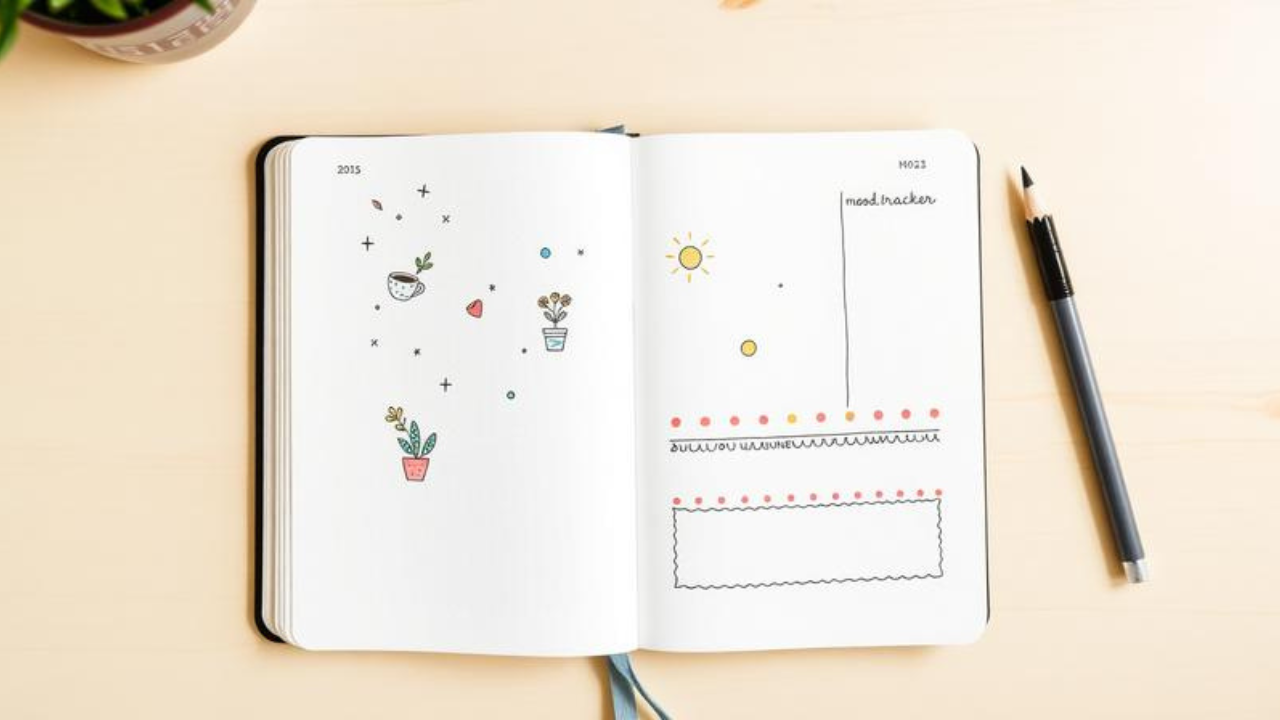
Opening your bullet journal should feel like a breath of fresh air. It’s a space for organization, mindfulness, and a dash of personality. Yet, for many beginners, staring at that pristine white grid page triggers a wave of anxiety. “What if I can’t draw?” “What if my spreads look boring?”
Enter the savior of the overwhelmed planner: Doodle art for bullet journal enthusiasts.
Doodling isn’t about being the next Picasso. It is about rapid, intuitive drawing that fills empty spaces, tracks habits, and makes your journal feel like yours. In this guide, we will explore how to integrate simple sketchwork into your layouts, boost productivity through creativity, and turn your BuJo into a visual masterpiece—no art degree required.
Why Doodle Art Belongs in Your Bullet Journal
Before we pick up a pen, let’s talk about psychology. A standard bullet journal is a productivity tool. A doodled bullet journal is a happy place.
Research suggests that doodling helps maintain arousal and prevents the brain from drifting off into a daydream. When you add small sketches to your daily log, you aren’t wasting time; you are anchoring your attention. Furthermore, doodle art for bullet journal layouts breaks the monotony of long text lists. It creates visual landmarks.
-
Memory Retention: You are more likely to remember an event if it has a tiny icon next to it (like a coffee cup for a meeting or a plane for a trip).
-
Emotional Regulation: The repetitive motion of drawing lines (hatching, stippling, scalloping) is meditative.
-
Rapid Prototyping: Unlike complex watercolors or washi tape collections, a pen doodle is instant. No prep, no drying time.
Essential Tools for the Doodling Beginner
You do not need a $200 art kit to start. In fact, using too many tools can sometimes cause decision paralysis. To master doodle art for bullet journal spreads, focus on three core items:
-
The Fine Liner (Black): The Sakura Pigma Micron (sizes 01, 03, or 05) is the industry standard. The ink is waterproof and won’t bleed through standard journal paper.
-
A Ghosting Test Pen: A standard ballpoint pen (Bic or Papermate) works wonders for light sketching before you commit to ink.
-
A Touch of Color (Optional): Mildliners or colored pencils work best. Avoid alcohol-based markers (like Copics) because they bleed heavily on standard 120gsm paper.
Pro Tip: If you are worried about shadowing (seeing the drawing on the other side of the page), draw less heavy lines. A light hand is the secret to clean doodle art for bullet journal pages.
10 Fundamental Doodles You Can Draw in 30 Seconds
Let’s break the ice. We are going to build a visual vocabulary. These shapes are the ABCs of your new artistic language. Practice these in a “scrap” section of your journal before moving to your monthly spread.
The “Minimalist” Series
-
The Coffee Cup: Draw a rectangle. Add a curved handle. Top it with a swirl of steam (three curly lines). Done.
-
The House Plant: A terracotta trapezoid, a thick vertical line for the stem, and 5-6 overlapping circles for leaves.
-
The Sleeping Cat: A squashed oval, two triangle ears, a swirly tail. (No eyes needed; minimalist doodles suggest rather than detail).
Functional Icons
-
The Checkbox: Instead of a boring square, draw a tiny circle, a diamond, or a cloud. Use these for your daily task list.
-
The Weather Icon: A sun is a circle with lines around it. Rain is a few vertical dots with tiny triangles at the bottom.
-
The Mood Tracker Face: A semi-circle for a smile, a straight line for a neutral face, or an upside-down semi-circle for a sad day.
Decorative Accents
-
Scalloped Borders: A line of connected “U” shapes to frame your weekly log.
-
Dotted Trails: A line of small dots that leads the eye from your task list to a note in the margin.
-
Abstract Shapes: Blobs, crosses, and starbursts. These are great for filling empty corners.
Action Step: Take five minutes right now to fill a page with 20 tiny coffee cups. Repetition is the mother of skill in doodle art for bullet journal creation.
How to Integrate Doodles Into Your Weekly Spreads
Knowing how to draw is one thing. Knowing where to draw is another. Many users make the mistake of trying to illustrate every single word. Do not do this. Use the “Header, Divider, Embellishment” rule.
1. The Artistic Header
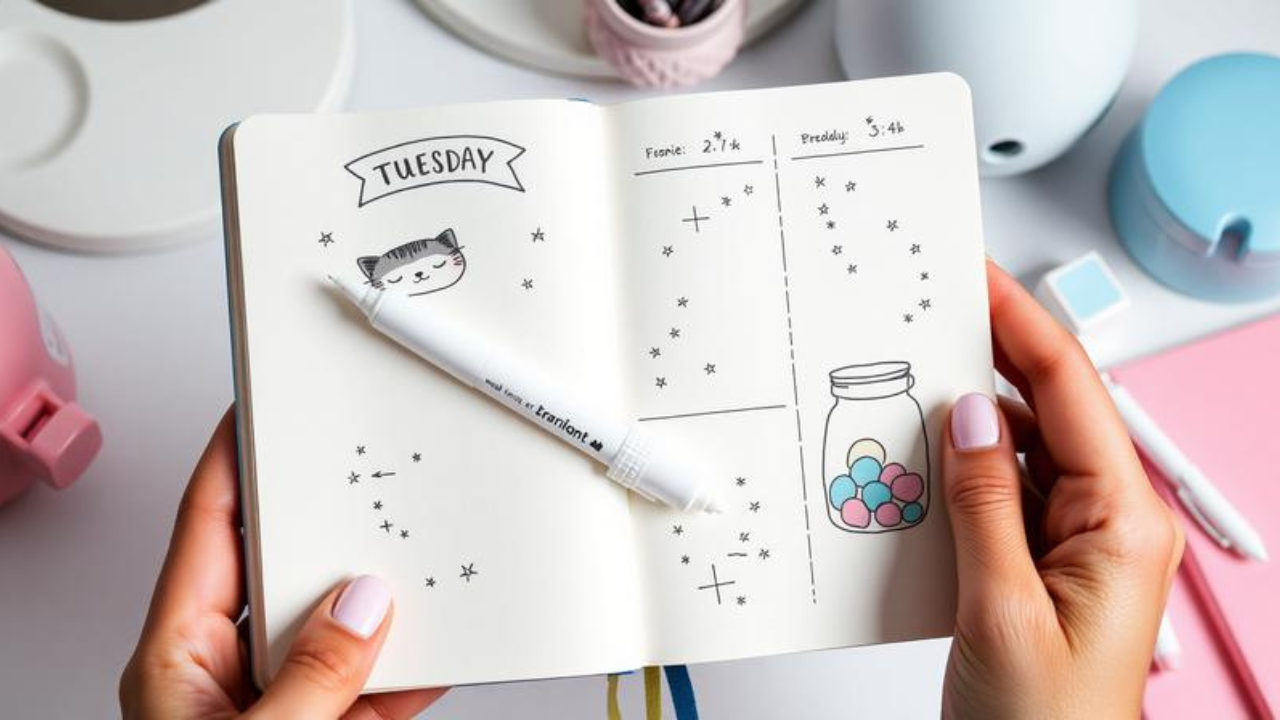
Instead of writing “Monday” in boring print, write it in block letters and add a shadow. Better yet, draw a banner. A “ribbon banner” is the holy grail of doodle art for bullet journal headers.
-
How to: Draw two parallel horizontal lines. Connect the ends with diagonal lines. Color in the “tails” of the ribbon.
2. The Section Divider
Your daily log might end halfway down the page, leaving a massive white space. Instead of starting “Tuesday” immediately, draw a horizontal divider line. But make it fun: a wavy line, a line of zig-zags, or a line of tiny triangles.
3. The “Margin Doodle”
As you look at your weekly spread, scan the left and right margins. Is there empty space? Draw a vertical vine growing up the side of the page. Add a few leaves every time you complete a task. This gamifies your productivity.
Solving the “Fear of the Blank Page”
The biggest obstacle to doodle art for bullet journal success is perfectionism. We look at Instagram feeds with flawless cityscapes and think, “I can’t do that.”
Here is the truth: Those artists started with stick figures. Your journal is a tool, not a museum. It is allowed to be ugly.
The “Pencil First” Rule: Always draft in graphite. If the eye looks wonky, erase it. Only go over it in pen when you love it.
The “Wabi-Sabi” Mindset: Embrace the mistake. Did you draw a line too long? Turn that line into a shading hatch mark. Doodle art is forgiving because it is abstract by nature.
Seasonal Themes to Keep Things Fresh
If you practice doodle art for bullet journal spreads all year, you risk getting bored. Rotate your themes based on the season to keep the inspiration flowing.
-
Spring: Florals, vines, raindrops, umbrellas, butterflies. Focus on curved lines and organic shapes.
-
Summer: Beach waves, sunglasses, ice cream cones, sunbursts. Use high contrast and thick lines.
-
Autumn: Mushrooms, acorns, falling leaves, knit sweaters. Focus on texture (drawing small “v” shapes for knitting).
-
Winter: Evergreen trees, string lights, mugs of hot cocoa, snowflakes (using intersecting lines).
Step-by-Step: Doodling a Monthly Mood Tracker
Let’s put theory into practice. Here is a complete tutorial for a simple but stunning doodle art for bullet journal habit tracker.
Step 1: The Concept
Draw one large, empty jar at the bottom of your monthly calendar page.
tep 2: The “Dots”
Inside the jar, draw 30 empty circles arranged roughly in a pyramid (like a jar full of marbles).
Step 3: The Key
At the top of the page, write: Blue = Great, Green = Good, Yellow = Meh, Grey = Tired.
Step 4: The Daily Ritual
Every night, you color in one circle based on your mood. By the end of the month, you have a beautiful jar full of colored “gems.”
Notice how the only “art” required was drawing a jar and circles. Yet, it looks complex and decorative.
Advanced Techniques: Shadows and Texture
Ready to level up? The difference between a flat doodle and a professional looking doodle art for bullet journal entry is usually two things: shadows and texture.
Drop Shadows
Take your simple coffee cup. Now, draw a duplicate line just below the bottom edge of the cup, offset to the right. Color in that gap grey. Suddenly, the cup is floating off the page.
Hatching (Texture)
Instead of coloring an entire shape in black (which bleeds ink), use hatching.
-
Cross-hatching: Draw lines in one direction, then layer lines going the opposite direction.
-
Stippling: A thousand tiny dots. This takes time but looks incredible for clouds or shadows.
Frequently Asked Questions
Q: I have zero artistic talent. Can I really do this?
A: Absolutely. You are not painting a portrait; you are drawing icons. If you can draw a square and a circle, you can draw 90% of the icons needed for a bullet journal.
Q: My pen keeps bleeding through the page. Help!
A: This is a paper issue, not a skill issue. Look for journals with at least 160gsm paper (like Archer & Olive) or use a ballpoint pen which puts down less ink than a gel pen.
Q: How long does it take to set up a weekly spread with doodles?
A: If you are keeping it simple (headers + 3 icons), roughly 10-15 minutes. If you are doing a full illustrated page, maybe an hour. Start simple.
The SEO Secret: Why Your “Ugly” Doodles Rank for Happiness
Search engines look for dwell time and engagement. But real life looks for joy. When you search for doodle art for bullet journal ideas, you aren’t just looking for pictures; you are looking for permission to play.
Your bullet journal is a judgment-free zone. Those small drawings add up to a massive impact on your mental clarity. They break the tyranny of the to-do list.
Your 7-Day Doodle Challenge
To ensure you aren’t just reading but doing, here is a challenge. For the next seven days, commit to 60 seconds of doodling in your journal each morning.
-
Day 1: Draw your breakfast (a bowl of cereal is just a circle with smaller circles inside).
-
Day 2: Draw the shoes you are wearing.
-
Day 3: Draw the object on your desk to the left of your keyboard.
-
Day 4: Draw the weather.
-
Day 5: Draw an envelope for your “emails to send” task.
-
Day 6: Draw a bookshelf with three books.
-
Day 7: Draw a “selfie” (a circle with two dots and a curve).
Conclusion: Pick Up Your Pen
The secret to mastering doodle art for bullet journal layouts is not talent. It is repetition. The more you doodle, the more your hand learns the muscle memory. Your lines will get straighter. Your curves will get smoother. And most importantly, you will look forward to opening your planner every single morning.
Stop waiting for the perfect spread or the expensive markers. Grab the pen next to you. Turn to a fresh page. Draw a wobbly circle. Call it a pebble. You have officially started.
Call to Action:
Ready to prove that you can do this? Drop a comment below with your first doodle attempt—even a simple dot counts! Tell us what theme you are trying for this month, or share your biggest struggle with blank pages. Let’s build a community of doodlers who support each other, one scribble at a time. Don’t forget to tag us on social media with #BuJoDoodleChallenge so we can share your progress!