 By Mubashir Abbasi
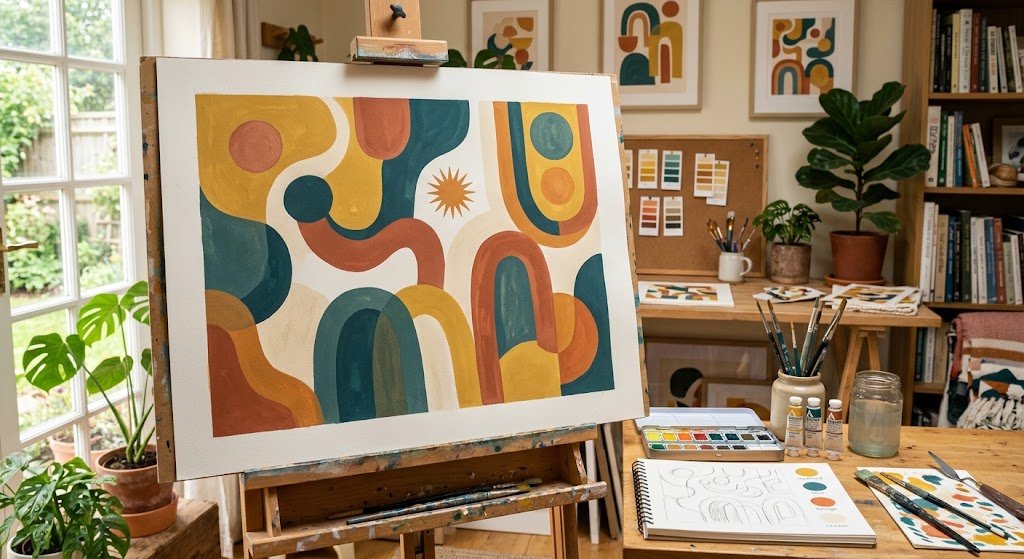
Picture a canvas with the warm oranges and soft curves of a 1960s living room, painted with crisp, contemporary strokes. That blend is vintage modern art, a style that captures nostalgia without feeling outdated. Artists are drawn to it in 2026 because it feels both familiar and fresh.
Many beginners find it tricky to balance the two. Pieces can slide into costume-like throwbacks or lose their retro character entirely.
This guide shows you how to get the balance right. You will learn what vintage modern art is, why it matters, and the key traits that define it. You will also discover a clear, step-by-step process for creating your own pieces, plus the mistakes that quietly ruin otherwise strong work.
Whether you paint, draw, or work digitally, every section gives you something to try. By the end, you will know how to build a piece that feels timeless without feeling tired.
Table of Contents
- What Is Vintage Modern Art?
- Why Does This Style Matter? Key Benefits
- Vintage Modern Art: Key Facts and Types
- How To Create Vintage Modern Art
- Retro-Modern Mistakes and Myths to Avoid
- Expert Tips for Retro-Modern Results
- Vintage Modern Art FAQs
- Final Thoughts on Retro-Modern Art
What Is Vintage Modern Art?
Vintage modern art combines the look of mid-century design, roughly the 1940s through the 1960s, with contemporary techniques and subject matter. Think of it as a remix. The shapes, colors, and simplicity come from the past, while the composition and ideas feel current.
Here is an easy way to picture it. Imagine a record player with rounded knobs and warm wood grain, placed in a digital photo edited with modern lighting. The object is old, but the image is new. Artists who work in this style borrow familiar forms and reshape them for today, whether they use a brush, a pencil, or a stylus.
The style shows up in a few recognizable ways. You will usually see clean lines, organic or geometric shapes, and muted but warm color palettes such as mustard, teal, and burnt orange. Subjects often include furniture, household objects, landscapes, and abstract forms. The result feels calm and nostalgic, yet never dusty.
Why Does This Style Matter? Key Benefits
Working in this style gives you more than a look. It gives you practical advantages that help your work stand out.
- Instant recognizability: Viewers spot retro-inspired palettes and shapes within seconds, so your work makes an impression fast.
- Emotional warmth: Nostalgic color and gentle forms make people feel comfortable, which encourages them to look longer.
- Simple structure: Limited palettes and clean shapes help you build strong compositions without overworking details.
- Flexibility across media: The approach works in acrylic, gouache, printmaking, and digital illustration, so you can grow without changing direction.
- Market appeal: Interior designers and home decor buyers often look for retro-inspired pieces, which can make your work easier to sell.
- Lasting relevance: Blending eras helps the work avoid the trend cycles that date more literal retro pieces.
The influence is easy to measure in everyday life. Mid-century design, which shaped the “vintage” half of this style, flourished roughly between 1945 and 1969 and still influences modern homes.
Vintage Modern Art: Key Facts and Types
Not every piece looks the same. Most work falls into three broad approaches, and each has its own feel. Understanding them helps you choose the direction that fits your style.
Retro Color Palettes
Color does most of the heavy lifting. Artists often use warm earth tones like rust, ochre, and olive, then add a single bright accent such as turquoise or tomato red. Limiting yourself to five or six colors keeps the piece cohesive and gives it an unmistakable era feel.
Organic and Geometric Shapes
This approach mixes soft, amoeba-like curves with clean geometric forms such as circles, arches, and triangles. The contrast creates movement and balance. You can see it in mid-century furniture, where a kidney-shaped table sits beside straight-legged chairs.
Textures and Materials
Texture adds depth. You can layer grainy, risograph-style textures over digital work or add subtle paper grain to a gouache painting. This keeps the look tactile, which is a big part of why the style feels both handmade and contemporary.
| Feature | Vintage Modern | Mid-Century Modern | Retro Pop Art |
|---|---|---|---|
| Era of inspiration | 1940s–1960s, reimagined now | 1945–1969, original period | 1950s–1970s |
| Color palette | Warm, muted, with one accent | Earthy neutrals and teal | Bold, saturated primaries |
| Shapes | Organic mixed with geometric | Clean lines, simple forms | Comic-style outlines |
| Best for | Home decor, illustration, fine art | Furniture and interiors | Posters and pop culture |
How To Create Vintage Modern Art
Follow these steps to build a piece from start to finish. Each one is simple on its own, and together they give your work a clear direction.
- Gather reference images. Collect photos of mid-century furniture, posters, and packaging you find appealing. Study how their shapes and colors work together. Save at least ten references so you can spot patterns.
- Choose a limited palette. Pick five or six colors, including one warm base, one dark neutral, and one bright accent. Test them on a small swatch sheet before you commit. Limited color keeps the piece unified.
- Sketch simple shapes first. Block in the main forms with loose pencil marks, using circles, arches, and gentle curves. Ask yourself whether each shape supports the composition. Remove anything that feels cluttered.
- Add one retro detail. Introduce a starburst, a sunset gradient, or a stylized sun. Keep it small so it accents the piece rather than overpowers it.
- Build texture and depth. Layer grain, stippling, or subtle brushwork over flat areas. In digital work, use a grain brush at low opacity. This adds warmth and keeps the surface from looking sterile.
- Step back and refine. View your piece from a distance or in a mirror to check balance. Adjust contrast and spacing until your eye moves smoothly across the work. Then sign and date it to finish.
Retro-Modern Mistakes and Myths to Avoid
Myth: The style just means copying old posters. The best work borrows the spirit of the past and adds your own voice. Direct copies rarely feel fresh, so use references for inspiration, not tracing.
Mistake: Using too many colors. Eight or nine hues can make a piece feel busy. Stick to a tight palette and let one accent do the work.
Mistake: Overusing retro clichés. Sunbursts and atomic patterns can quickly feel like a costume. Use one motif per piece so it supports the composition.
Myth: It only works for furniture or interiors. Portraits, landscapes, and abstract work all suit this approach. Shape, color, and texture principles apply to any subject.
Mistake: Ignoring contrast. Muted palettes can look flat when values are too close. Check your piece in grayscale to confirm there is enough light and dark separation.
Expert Tips for Retro-Modern Results
- Keep a swatch library. Save color combinations you love in one file so you can reuse them quickly.
- Work small first. Test compositions on index cards or small panels before committing to a large surface.
- Mix media on purpose. Combine gouache with colored pencil or digital grain to add texture without extra steps.
- Study online design archives. Browse museum collections of mid-century posters and furniture to sharpen your eye for shape and color.
- Check colors in daylight. Warm indoor lighting can shift your palette, so review your work in natural light before you share it.
Vintage Modern Art FAQs
What is vintage modern art?
Vintage modern art is a style that blends the look of mid-century design with contemporary techniques. It usually features warm, muted colors, simple organic or geometric shapes, and subtle textures. Artists use it in painting, illustration, printmaking, and digital work to create pieces that feel nostalgic yet fresh. You can start with a limited palette and a few clean shapes to see whether the look suits your work.
How do I make vintage modern art as a beginner?
Start by collecting reference images of mid-century furniture, posters, and packaging you enjoy. Choose five or six colors, then sketch your main shapes in pencil before painting. Add one retro detail, such as a sunburst or curved arch, to create a focal point. Practice on small sheets, since quick tests help you find your style without wasting materials. Expect your style to develop over several weeks of regular practice.
Is vintage modern art still popular in 2026?
Yes, the style remains widely appreciated in 2026, especially in home decor, illustration, and print design. Many buyers want pieces that feel warm and personal in a digital world. Designers often blend retro forms with modern tools, which keeps the look relevant. Interest rises and falls over time, but the core elements of color, shape, and texture have lasted for decades. Artists who focus on those fundamentals usually find the most lasting audience.
Final Thoughts on Retro-Modern Art
Vintage modern art works because it balances two things people love: nostalgia and freshness. Three ideas matter most. First, a limited, warm color palette creates instant cohesion. Second, simple organic and geometric shapes give your composition structure. Third, subtle texture keeps the work feeling handmade and alive.
Start today. Pick five colors, grab a sketchbook, and draw three simple shapes before you do anything else. Your first piece does not need to be perfect. It only needs to show you where your style begins.
Which vintage modern element would you most like to try first? Tell us in the comments.