 By Richard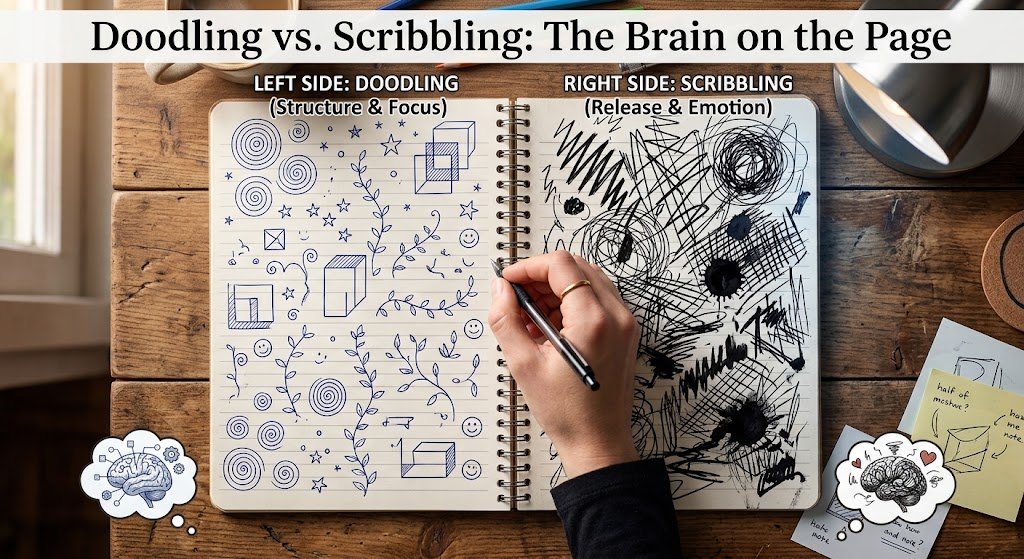
Your hand has been moving across the margin of your notebook for ten minutes, and you can’t remember deciding to draw. Was that doodling or scribbling? The doodling vs scribbling question trips up almost everyone, because both look like random pen marks to an outsider.
Here is the surprise: they are not the same thing, and they do different jobs for your brain. Doodling is usually shaped, repeated, and semi-intentional. Scribbling is looser, faster, and driven by energy or emotion.
In this guide, you will learn the doodling meaning and the scribble meaning. You will see how each habit affects your focus and stress, and how to build a simple practice in 2026. You will also get a step-by-step routine, five mistakes to skip, and answers about ADHD, cute drawing ideas, and the seven types of drawing.
Grab a pen. By the end, you will know which habit fits your day.
Table of Contents
- What Is Doodling vs Scribbling?
- Why Do Doodling and Scribbling Matter? Key Benefits
- Doodling vs Scribbling: Key Facts and Types
- How to Start Doodling and Scribbling Today
- Common Doodling and Scribbling Mistakes and Myths
- Expert Tips for Better Doodle Art and Scribble Art
- Frequently Asked Questions
What Is Doodling vs Scribbling?
The doodling meaning is simple. A doodle is a small, casual drawing you make while your attention is somewhere else, like during a phone call or a long meeting. Think stars, spirals, boxes, tiny faces, and vines crawling along the edge of a page.
The scribble meaning is different. Scribbling is fast, loose mark-making with little or no planned shape. Think tangled lines, hard zigzags, and filled-in blobs. The word also describes a toddler’s first drawings, which is where most of us started.
Here is an analogy. Doodling is like humming while you cook. It is a gentle background rhythm that keeps your mind company. Scribbling is like shouting into a pillow. It is a release valve for energy or frustration.
When you plan and polish a doodle, people call it doodle art. When you layer scribbles on purpose to build texture and color, you get scribble art.
Why Do Doodling and Scribbling Matter? Key Benefits
Both habits do more than fill empty paper. Here is what they can do for you:
- Better focus: A simple, repetitive doodle gives your restless brain a small job, so your mind stays on the main task.
- Stronger memory: Drawing while you listen keeps your brain from drifting into daydreams.
- Stress relief: Scribbling lets you dump tension through your hand without needing words.
- Creative warm-up: Doodle art loosens your thinking before you write, design, or solve a problem.
- A low-pressure habit: Nobody grades a doodle, so you can practice drawing with zero fear of failure.
The research backs this up. In a well-known 2009 study in Applied Cognitive Psychology, psychologist Jackie Andrade found that people who doodled while listening to a dull phone message recalled about 29% more information than non-doodlers.
Doodling vs Scribbling: Key Facts and Types
Both habits live on the same spectrum of mark-making. The difference comes down to intention, speed, and shape.
Doodling: Shaped and Repetitive
Doodles use recognizable forms: hearts, flowers, arrows, patterns, and little characters. You often repeat them, which creates a calm, rhythmic feeling. Common styles include pattern doodles, character doodles, and lettering doodles.
Scribbling: Loose and Expressive
Scribbles skip shapes and follow your hand’s energy. You might fill a page with circles, hard back-and-forth lines, or messy spirals. Many people use scribble art for emotional release, and art therapists often use it as a warm-up exercise.
Where Doodle Art and Scribble Art Overlap
A scribble can turn into a doodle when you spot a shape in it and trace it. Many artists start with scribbles and “find” a face or animal inside. That is a fun trick if you freeze at the sight of a blank page.
| Feature | Doodling | Scribbling |
|---|---|---|
| Main goal | Pass time, stay focused | Release energy or emotion |
| Shapes | Recognizable, repeated | Random, abstract |
| Speed | Slow to medium | Fast |
| Pressure on pen | Light to medium | Medium to heavy |
| Best for | Meetings, studying, relaxing | Stress relief, warm-ups |
| Can become art? | Yes, as doodle art | Yes, as scribble art |
The takeaway in the doodling vs scribbling debate: doodling calms and focuses you, while scribbling releases and loosens you.
How to Start Doodling and Scribbling Today
You do not need talent or fancy supplies. Follow these six steps.
- Pick your tools. Grab a pen and any paper. If you want structure, search for a doodling and scribbling book or a doodling and scribbling PDF with printable prompts. Many are free, so you do not need to spend money to begin.
- Try a digital option. A doodling and scribbling app lets you draw on your phone during a commute. Any free sketching app works, so choose the one that feels simplest.
- Set a two-minute timer. Short sessions remove pressure. Two minutes is enough to start a habit, and you can always keep going.
- Start with a scribble. Move your pen in loose loops across the page without lifting it. Do not aim for anything. This warms up your hand and quiets your inner critic.
- Turn a scribble into a doodle. Look for a shape hiding in the mess. Add eyes to a blob, leaves to a curve, or windows to a box.
- Repeat one pattern. Pick a simple shape, like a triangle or a wave, and repeat it until it fills a corner. This is the calm, focused state that makes doodling so useful.
[ free printable doodle prompts on doodleunlimited.com]
Do this daily for a week, and you will see your lines get steadier and your ideas flow faster.
Common Doodling and Scribbling Mistakes and Myths
Many people give up because of a few false beliefs. Here are the five biggest.
Mistake 1: Thinking doodling means you are not paying attention. The truth is the opposite. Doodling can keep your mind on the task by stopping it from wandering.
Mistake 2: Believing you need artistic skill. Doodle art is about play, not perfection. Stick figures count, and so do wobbly circles.
Mistake 3: Treating scribbling as childish. Scribbling is a real stress-relief tool, and adults use it in art therapy. Your messiest page may be your most useful one.
Mistake 4: Mixing up the two in the doodling vs scribbling debate. If you scribble when you want to focus, you may feel more wound up. Match the habit to your goal.
Mistake 5: Throwing away your pages. Your old doodles show your patterns and favorite shapes. Keep a small folder, and you will build a personal style over time.
Expert Tips for Better Doodle Art and Scribble Art
- Use one pen you love. A smooth pen makes every line feel good, which keeps you coming back.
- Doodle during calls. Phone calls and online lectures are perfect moments to practice drawing without extra time.
- Limit your palette. Two colors force creative choices and keep your pages looking clean.
- Try the opposite hand. Scribbling with your non-dominant hand drops your perfectionism instantly.
- Build a prompt list. Keep ten ideas ready, like “fruit with faces” or “a house on a hill,” so you never stare at a blank page.
Frequently Asked Questions
Is doodling part of ADHD?
Doodling is not a symptom of ADHD, but many people with ADHD say it helps them focus. A simple drawing task can occupy the restless part of the brain while you listen. Anyone can doodle, whether or not they have ADHD. If you have concerns about attention, talk to a qualified healthcare professional for guidance.
What to draw: 100 cute ideas?
Start with small, easy subjects: bubble tea, sleepy clouds, tiny cacti, smiling moons, mushrooms, cats in boxes, stacked books, planets with faces, and cupcakes. Mix themes like food, nature, space, and animals to reach 100 quickly. Add a face or a tiny accessory to anything for instant cuteness. Pick ten and draw them this week.
What are the 7 types of drawing?
Common lists name these seven: figure drawing, still life, landscape, portrait, cartoon or comic drawing, technical drawing, and abstract drawing. Doodling and scribbling often sit inside the abstract and cartoon groups. They also work as warm-ups for every other type, so they make a great starting point for beginners.
Conclusion
Here are the three points to remember about doodling vs scribbling:
- Doodling is shaped and repetitive, and it helps you focus and remember.
- Scribbling is loose and fast, and it helps you release stress and warm up.
- Both habits are free, easy, and open to every beginner.
Start today. Grab a pen, set a two-minute timer, scribble a few loops, and turn one into a doodle. Small sessions add up quickly.
So tell us in the comments: are you a doodler, a scribbler, or a bit of both?