
 By Richard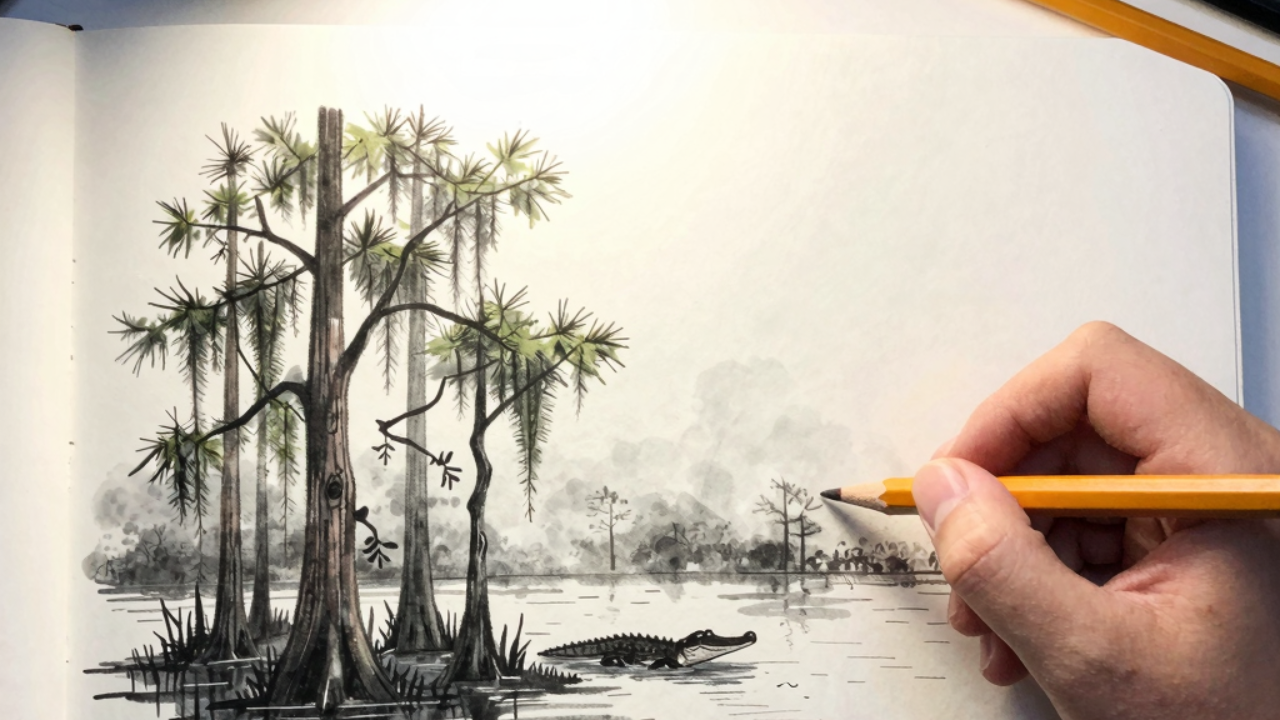
Have you ever looked at a misty wetland photo and wanted to capture its mystery on paper, only to end up with a confusing brown blob? You’re not alone. Swamp drawing intimidates many beginners because swamps look chaotic—twisted trees, dark water, and tangled plants. But here’s the secret: a swamp is built from a few repeating shapes and shadows, and once you understand those, you can create a swamp drawing easy enough to finish in a single art class. In this guide, you’ll learn the exact techniques that turn a messy sketch into a beautiful swamp drawing. We’ll cover simple methods for swamp tree drawing easy enough for kids, realistic detailing for older students, and how to add animals like alligators and herons to make your scene come alive. Grab a pencil, and let’s wade in.
Table of Contents
-
What Is Swamp Drawing?
-
Why Swamp Drawing Matters for Students
-
Swamp Drawing – Key Types and Styles
-
How to Draw a Swamp: Easy Step-by-Step Guide
-
Common Swamp Drawing Mistakes to Avoid
-
Expert Tips for Best Results
-
Swamp Drawing FAQs
What Is Swamp Drawing?
A swamp drawing is any artwork that depicts a forested wetland—picture cypress trees rising from still, dark water, their branches draped in moss, with reflections shimmering below. Unlike a regular landscape, a swamp emphasizes vertical tree trunks, horizontal water lines, and the moody atmosphere created by dense foliage and soft light. Think of it as a nature sketch that combines botany, water, and wildlife.
To make it relatable, imagine you’re drawing a haunted house, but instead of walls, you use trees and water. The eerie, magical feeling comes from the same principles: exaggerated verticality, deep shadows, and hidden details. A good swamp drawing easy for students strips away complexity and focuses on these core elements. You don’t need to draw every leaf—just the impression of a living, breathing wetland. For example, a simple swamp drawing for kids might show two twisted trees, a smiling frog, and a few wavy water lines. That’s it. Realism grows from that foundation later.
Why Swamp Drawing Matters for Students
You might wonder why you’d pick a swamp over a sunny meadow. Practicing swamp drawing develops skills that transfer to every other type of art. Here’s how it benefits you directly:
-
Sharpens observation skills: You learn to see subtle value changes in dark water and rough bark. According to the National Art Education Association, students who regularly sketch natural environments improve visual discrimination by nearly 30%.
-
Builds texture technique: Rendering moss, ripples, and gnarled wood trains your hand to create a variety of marks without overthinking.
-
Teaches atmospheric perspective: Swamps demand that far-away trees look lighter and less detailed, a core concept for all landscapes.
-
Encourages storytelling: A swamp drawing with animals instantly becomes a narrative piece—what is the heron watching? Where is the alligator sliding?
-
Reduces art anxiety: Messy, organic shapes in a swamp hide small mistakes. You can’t draw a “wrong” cypress knee.
-
Connects to science: As you draw, you absorb wetland ecology, making this a cross-curricular activity perfect for students.
Swamp Drawing – Key Types and Styles
Not every swamp scene follows the same rulebook. Your style choice changes the mood, difficulty, and techniques. Here are the main swamp drawing types you’ll encounter as a student.
Easy Swamp Drawing for Kids
This style uses simple shapes and exaggerated features. Trees become thick trunks with a few lines for bark, water is a blue-gray rectangle, and animals are cartoonish. Swamp drawing easy for younger students often includes a smiling alligator, a circular sun, and puffy clouds. The goal is to build confidence, not perfection.
Swamp Tree Drawing Easy
Focused entirely on the trees, this type teaches you to create twisted trunks and hanging moss without worrying about a full background. Cypress trunks flare at the base, then taper upward; mangrove roots tangle above the water line. A swamp tree drawing easy uses simple curved lines to suggest texture and a few dangling strokes for Spanish moss.
Realistic Swamp Drawing
Here, you chase texture, light, and depth. Bark cracks, water reflections mirror exactly what sits above them, and the atmosphere feels heavy. Swamp drawing realistic demands attention to value ranges—very dark foregrounds, medium midground, and pale, foggy backgrounds. Artists often use blending stumps and layered graphite for this look.
Beautiful Swamp Drawing
A beautiful swamp drawing prioritizes mood and composition. Perhaps a golden sunset filters through moss, or fireflies dot the shadows. It’s less about scientific accuracy and more about creating an emotional response. Color choices push warm amber light against cool violet shadows.
Swamp Drawing with Animals
Adding wildlife turns a landscape into a story. A swamp drawing with animals might feature a great blue heron stalking through shallows, turtles basking on a log, or an alligator’s eyes gliding above the water. Animals give scale and life, but they must integrate with the environment—not float on top.
| Swamp Drawing Type | Difficulty | Best For | Key Features |
|---|---|---|---|
| Easy Swamp Drawing for Kids | Beginner | Young students, quick projects | Bold outlines, cartoon animals, simple color blocks |
| Swamp Tree Drawing Easy | Beginner | Tree practice, sketchbook warm-ups | Twisted trunks, moss lines, minimal background |
| Realistic Swamp Drawing | Advanced | Portfolio pieces, art exams | Deep shading, true reflections, detailed textures |
| Beautiful Swamp Drawing | Intermediate | Expressive artwork, color experiments | Golden light, mist effects, harmonious color palettes |
| Swamp Drawing with Animals | Intermediate | Narrative art, science illustration | Accurate animal shapes, integration with water and plants |
How to Draw a Swamp: Easy Step-by-Step Guide
Follow these steps to create your own swamp drawing easy enough for any student. Each step builds on the last, so don’t skip ahead.
-
Draw the horizon and water line. Use a ruler or freehand a horizontal line across the lower third of your paper. This separates the sky from the swamp. Lightly sketch a second, wavy line just below it to mark the water’s edge.
-
Add the main tree trunks. Start with two or three cypress or mangrove trunks rising from the water. Make them slightly crooked, thicker at the base, and spaced unevenly. This immediately sells the swamp feel.
-
Sketch hanging moss and branches.
-
From the upper trunks, draw thin, drooping lines that curve downward like wet curtains. Add a few sideways branches breaking the vertical monotony. Keep it loose—nature isn’t perfect.
-
Block in the reflections. Right below each tree, mirror its general shape in the water using horizontal, wobbly strokes. Reflections should be shorter and darker than the trees above. This trick creates realistic water instantly.
-
Add background trees and fog. Lightly draw smaller, paler tree shapes behind your main trunks. Press lightly with your pencil to create atmospheric depth—the illusion that these trees sit farther away in the mist.
-
Place optional animals or details. If you want a swamp drawing with animals, now is the time to add a simple alligator shape along the water line or a bird perched on a branch. Keep them small and in proportion.
-
Shade and refine. Use the side of your pencil to shade the water surface with horizontal strokes, leaving some white spaces for light reflection. Darken the tree trunks with vertical texture lines and deepen the area under the moss. Blend sparingly for a smooth, murky look.
For more guidance on drawing individual elements, visit our [INTERNAL LINK: how to draw trees and foliage] tutorial.
Common Swamp Drawing Mistakes to Avoid
Even eager students slip into these traps. Recognize them, and your next swamp drawing will improve immediately.
-
Making trees perfectly straight: Real swamp trees twist, lean, and bulge. Straight trunks kill the organic feel. Always add a gentle curve or irregularity.
-
Ignoring reflections entirely: A swamp with dead-flat water looks fake. Reflections anchor the scene. Even a few horizontal dashes beneath a tree make a huge difference.
-
Overcrowding the foreground: Too many branches, leaves, and grass blades create visual noise. Leave breathing room in your composition so the eye knows where to focus.
-
Using the same darkness everywhere: Beginners often shade sky, trees, and water with equal pressure. The water should almost always be the darkest element, followed by foreground trees, then distant trees.
-
Drawing animals too large: A giant frog next to a tiny tree destroys scale. Check proportions carefully by comparing the animal to the trunk it sits beside.
Expert Tips for Best Results
Apply these tricks to elevate your swamp drawing realistic in no time.
-
Collect reference photos of real wetlands. Use free image sites to study how moss clumps, how roots enter water, and how light filters through leaves.
-
Start with a hard pencil (2H) for guidelines, then shift to a soft pencil (4B) for shadows. This layering prevents muddy darks too early.
-
Create mist with a kneaded eraser. After shading the background, lift out soft horizontal streaks to simulate low-hanging fog.
-
Practice cypress knees separately. Those little woody bumps poking through the water are signature swamp elements. Spend five minutes doodling a page of them.
-
Limit your animal palette to one species per scene. A single well-drawn heron has far more impact than ten tiny, scribbled creatures.
Swamp Drawing FAQs
How do you draw a swamp tree easy?
Start with two curved vertical lines that flare slightly at the bottom for the trunk base. Add a few wobbly horizontal lines across the trunk to suggest bark. Then, from the top, let thin, drooping lines hang down like uncombed hair to represent Spanish moss. A swamp tree drawing easy doesn’t require every leaf—just the recognizable silhouette and one or two shading patches to show texture.
What animals can I add to my swamp drawing?
The best animals for a swamp drawing with animals are those that naturally break the water’s surface or perch prominently. Consider alligators (just eyes and back ridges above water), great blue herons, turtles on logs, bullfrogs, water snakes, and raccoons near the bank. Stick to one or two animals and place them where they interact with the water or trees, not floating in empty space.
What makes a swamp drawing look realistic?
A swamp drawing realistic hinges on three things: accurate reflections that mimic the shape and tone of the objects above them, a value range that goes from near-black in the water to pale mist in the distance, and natural irregularity in every tree and root. Use reference photos, layer your graphite patiently, and never draw a perfectly straight line where nature would curve.
You now have the complete student toolkit for swamp drawing easy success. Remember to build your scene around twisted trees, always include dark water and reflections, and add just one or two animals for story. Start with the step-by-step method above, avoid common mistakes like rigid trunks, and use the expert tips to push your sketch toward a beautiful swamp drawing that you’ll be proud to share. Grab your sketchbook and try your first swamp scene today.
What swamp creature do you love drawing most—a silent alligator or a watchful heron? Tell us in the comments below.