 By Richard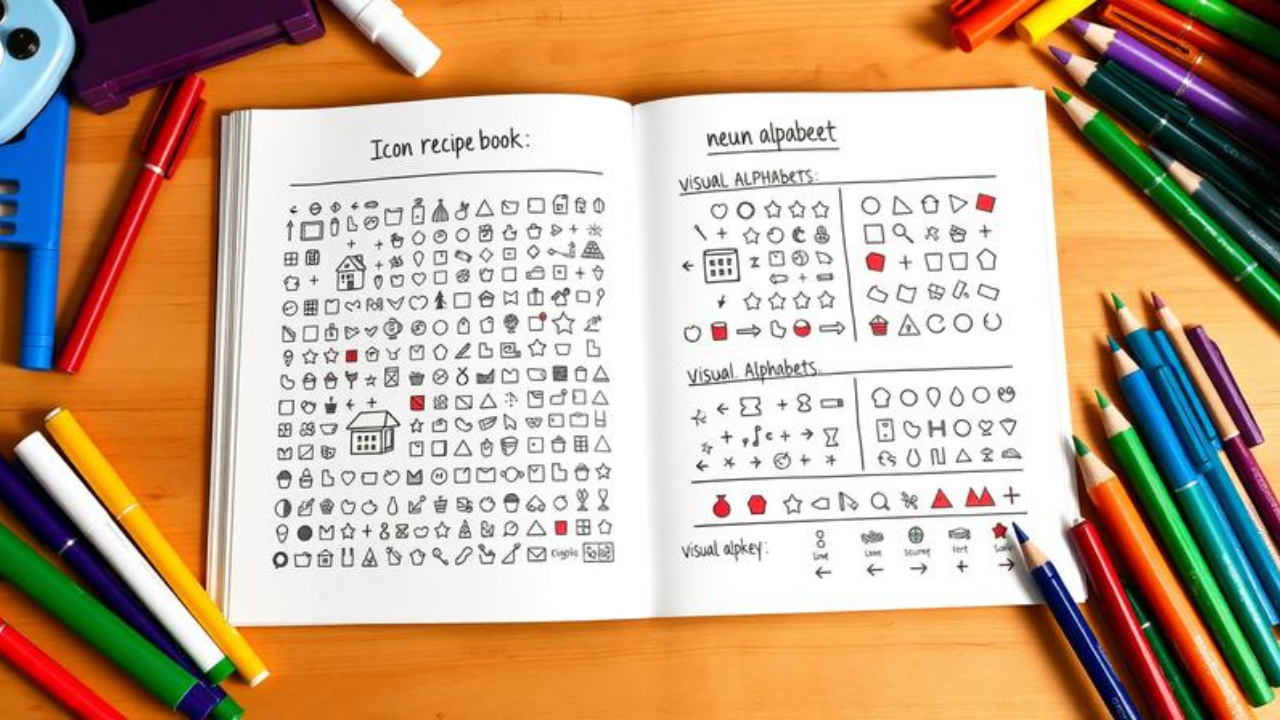
Introduction
You’re in the middle of a meeting, capturing ideas with your sketchnote. The speaker mentions a “lightbulb moment.” You freeze. How do you draw a lightbulb? Your mind goes blank, your pen hovers over the page, and by the time you’ve figured it out, you’ve missed the next three points.
Here’s the truth: the single biggest obstacle to sketchnoting isn’t listening, structuring, or even finding the time—it’s the fear of drawing icons. Mike Rohde, the designer who popularized sketchnoting, has heard this from thousands of people. They’re convinced they “can’t draw.” But here’s the secret they don’t know yet: you already can.
Every icon you’ll ever need is built from just five basic shapes: a dot, a line, a square, a circle, and a triangle. That’s it. If you can draw those five shapes, you can draw anything.
In this guide, I’ll walk you through exactly how to build a visual vocabulary from scratch—step by step, icon by icon. No artistic talent required. Just a pen, some paper, and a willingness to see the world as a collection of simple shapes.
Background / Context
Sketchnoting—the practice of combining handwritten notes with drawings, symbols, and structure—has grown from a niche design technique into a global movement. At its heart is the humble icon: a simple, graphic symbol that represents an idea, an object, or a concept.
The cognitive science behind icons is compelling. When you pair text with a simple visual, you’re engaging what psychologists call “dual coding”—processing information through both verbal and visual channels. The result? Better recall, deeper understanding, and notes that actually make sense when you look at them a week later.
But here’s what most beginners don’t realize: icons are not drawings. A drawing is a detailed, realistic representation that can take hours. An icon is a fast pictograph meant to communicate an idea quickly. It’s two-dimensional, graphic, and symbolic—not realistic. And it can be drawn in seconds.
As Mike Rohde puts it in his workshops, the goal is recognizable, not realistic. The words around your icon carry some of the meaning. Your job is simply to create a visual anchor that helps your brain—and anyone else reading your notes—grasp the idea instantly.
The best part? You can practice this anywhere. Look around you right now. Everything you see can be broken down into those five basic shapes. That coffee cup? A rectangle with a curved handle. That laptop? A rectangle with a smaller rectangle inside. That person? A circle on top of a rectangle. Once you start seeing the world this way, drawing icons becomes second nature.
Main Body
Step 1: Master Your Visual Alphabet
Before you draw a single icon, you need to become friends with your visual alphabet—the five basic shapes that form the foundation of every icon you’ll ever create.
The Fab Five:
-
Dot (•)
-
Line (—)
-
Square / Rectangle (▢)
-
Circle (◯)
-
Triangle (△)
That’s it. Every icon, from a house to a lightbulb to a person, is just a combination of these five elements. Even the most complex things you might need to draw can be simplified into basic shapes, and your brain will still recognize them.
Your first exercise: Take a blank page and fill it with these five shapes. Draw them big, draw them small, draw them overlapping. Get comfortable with the feeling of your pen creating these forms. This isn’t busywork—it’s building muscle memory. Just as you can spell common words without a dictionary, your goal is to be able to draw these shapes without thinking.
Once you’ve mastered the shapes, start combining them. A house is a square with a triangle on top. A tree is a rectangle (trunk) with a circle or cloud shape (leaves). A pencil is a rectangle with a triangle at the end.
Remember: your icons don’t have to look like mine. Depending on how your brain interprets different words, your icons may look different—and that’s perfectly okay. The important thing is that the icons are meaningful to you.
Step 2: Build Your Icon Library, One Shape at a Time
Now comes the fun part: actually drawing icons. Let’s start with some everyday objects that you’ll use again and again.
The House:
-
Draw a square
-
Add a triangle on top (the roof)
-
Draw a smaller square inside (a door)
-
Add two tiny squares for windows
That’s five shapes. Five seconds. And now you have a house.
The Coffee Cup:
-
Draw a rectangle (the cup body)
-
Add a small curve on the side (the handle)
-
Draw a curved line across the top (the rim)
-
Add a little steam wiggling up (three tiny wavy lines)
The Book:
-
Draw a rectangle
-
Add a line down the middle (the spine)
-
Draw a few tiny lines on the side (the pages)
The Lightbulb:
-
Draw a circle
-
Add a small rectangle underneath (the base)
-
Draw a few lines radiating from the top (the glow)
Here’s a powerful technique from Mike Rohde’s Sketchnote Lab: quantity over quality. When you’re building your icon library, don’t worry about making each icon perfect. Just draw as many as you can. Then, use an “iterator” sheet to refine your best ideas into clean, repeatable icons. Your final icon library becomes a reference you can practice against and use immediately.
Resource tip: If you ever get stuck, do a quick image search for “icon [object]”—for example, “icon tent”. Looking at how other people have simplified an object into an icon can unlock your own creativity.
Step 3: Bring Your Icons to Life with Faces and People
Drawing people is where most beginners panic. But it doesn’t have to be scary.
Start with a simple stick figure. A circle for the head, a line for the body, lines for arms and legs. That’s it. You’ve drawn a person.
But here’s where it gets interesting: you can animate that stick figure with just a few tiny changes.
The Face Matrix: Try combining different eyebrow shapes with different mouth shapes. A straight line for eyebrows with a curved smile = happy. Angled eyebrows with a straight line = serious. A dot for an eye with a tiny curve = sleepy. Moving the mouth from the center of the face to the side or changing the shape of the head itself gives you even more expression.
Body language matters too: A head directly on top of a body with a long neck signifies youth, while less neck (or no neck) can show stooping and signify age. A simple line for a nose can denote direction—where is this person looking?
The Grey Method: Once you’re comfortable with basic stick figures, start adding accessories. Give them a hat, glasses, a briefcase, a laptop. These small details make your people instantly recognizable and help your brain remember names and roles.
And here’s a secret: you can give faces to anything. As one sketchnoter put it: “You can sometimes make your sketchnotes more speaking by giving things you draw a face. This way you can also let objects have emotions”. A sad coffee cup. An angry cloud. A surprised lightbulb. This isn’t just cute—it’s memorable.
Step 4: Make Your Icons Pop with Simple Techniques
You’ve drawn your icons. They’re simple, they’re clear, but somehow they’re getting lost on the page. Here’s how to fix that.
Add shadows. This is the single most effective technique for making simple icons stand out. Use a lighter shade of grey next to your sketch—a brush pen for analog notes, or a separate layer for digital notes. Start by just outlining the shadow; later you can make it stretch back further. Keep shadows consistent: imagine the light comes from one corner, and shadows should fall in the opposite direction.
Use containers. Boxes, speech bubbles, thought clouds, and banners draw the eye to important information. They also create visual hierarchy—your icons feel grounded and intentional.
Add emphasis. Use different font styles for different types of content. Block letters for titles, cursive for quotes, all caps for key takeaways.
Connect with arrows. Arrows show relationships, flow, and sequence. They turn a collection of icons into a story.
Experiment with visual metaphors. Moving from drawing objects to capturing abstract ideas is the next level of sketchnoting. How do you draw “growth”? A plant sprouting. “Risk”? An iceberg (the visible tip hides the danger below). “Collaboration”? Two hands shaking. The best visual metaphors come from Dario Paniagua’s community, which offers in-depth training on this skill.
Counterargument
Let’s be honest: not everyone needs to draw icons from scratch.
Some sketchnoters prefer to use pre-made icon sets, stamps, or stencils. Others rely entirely on text and structure, using only the occasional arrow or container. And that’s perfectly valid. Sketchnoting is a personal practice—there’s no “right” way to do it.
There’s also the question of speed vs. polish. Drawing icons from scratch takes practice. In the beginning, you will be slower than you would be with text-only notes. If you’re in a fast-paced meeting or lecture, that trade-off might not be worth it.
The nuance: Icons are a tool, not a requirement. Mike Rohde himself suggests a gradual approach: “First add icons and drawings to your text notes, then experiment with more and more imagery in your sketchnotes. It’s a process, so take your time!”
The goal isn’t to become an icon-drawing machine. The goal is to make your notes more memorable and more useful. If drawing an icon helps you remember a concept, draw it. If it slows you down and distracts you, skip it. Your sketchnotes are yours—they should work for you.
Actionable Takeaways
-
Start with the five basic shapes. Practice drawing dots, lines, squares, circles, and triangles until they feel automatic.
-
Build your visual vocabulary gradually. Draw a few new icons each day. Focus on objects and concepts that come up often in your work or studies.
-
Use templates. Mike Rohde offers free Icon Template Sheets in US Letter and A4 formats—print them out and practice.
-
Think “recognizable, not realistic.” Simple icons work better than detailed drawings. Let your words carry some of the meaning.
-
Practice with low-stakes content. Sketchnote a podcast episode, a TED talk, or even your morning routine. Build confidence before you tackle high-pressure situations.
-
Build a reference library. Collect icons you like—from the Noun Project, from other sketchnoters, from your own practice. Use them as inspiration.
FAQs
1. I can’t draw at all. Can I really learn to draw icons?
Yes. Absolutely. Icons are built from just five basic shapes. If you can draw a dot, a line, a square, a circle, and a triangle, you can draw any icon. It’s about simplification, not artistic talent.
2. How do I know what to draw?
Listen for key concepts, repeated words, and metaphors. Then translate them into simple visual representations. If you’re stuck, do a quick image search for “icon [concept]” for inspiration.
3. How do I draw abstract concepts like “growth” or “risk”?
Use visual metaphors. Growth = a plant sprouting. Risk = an iceberg (the visible tip hides the danger below). Collaboration = two hands shaking. Dario Paniagua’s community offers excellent training on this.
4. What’s the difference between an icon and a drawing?
An icon is a fast, graphic symbol meant to communicate an idea quickly. A drawing is a detailed, realistic representation that can take hours. For sketchnoting, you want icons—not drawings.
5. How do I make my icons stand out on the page?
Add simple shadows using a lighter shade of grey. Use containers like boxes and speech bubbles. Add emphasis with different font styles. Connect with arrows to show relationships.
6. How do I draw people without them looking weird?
Start with a simple stick figure. Then use a face matrix to add expressions—combine different eyebrow shapes with different mouth shapes. Add accessories to make them recognizable.
7. What if my icons don’t look like anyone else’s?
That’s perfectly fine. The important thing is that the icons are meaningful to you. Your brain will recognize them, and that’s what matters for memory and recall.
Conclusion
Drawing sketchnote icons from scratch isn’t about becoming an artist. It’s about seeing the world differently—as a collection of simple shapes waiting to be combined.
That lightbulb moment? It’s a circle with a rectangle underneath. That person you need to remember? It’s a circle on top of a rectangle with some lines for limbs. That complex idea you’re struggling to capture? It’s a visual metaphor, waiting for you to discover it.
The five basic shapes—dot, line, square, circle, triangle—are your alphabet. Your visual vocabulary is the language you build from them. And like any language, it grows with practice. Draw a little every day. Build your library. Embrace imperfection.
Because here’s the real secret: every expert sketchnoter started exactly where you are right now. They froze. They doubted. hey drew wonky houses and weird-looking people. And then they kept going.
Your first icons won’t be perfect. They shouldn’t be. They’re the first words in a new visual language—a language that will make your notes clearer, your thinking sharper, and your ideas unforgettable.
So pick up your pen. Look at the world around you. And start drawing.
Mike Rohde’s The Sketchnote Handbook and The Sketchnote Workbook remain the definitive guides to visual note-taking. For icon-specific practice, Tanja Wehr’s Die Sketchnote Starthilfe offers over 200 step-by-step icon instructions. Free Icon Template Sheets are available from the Sketchnote Lab.