
 By Richard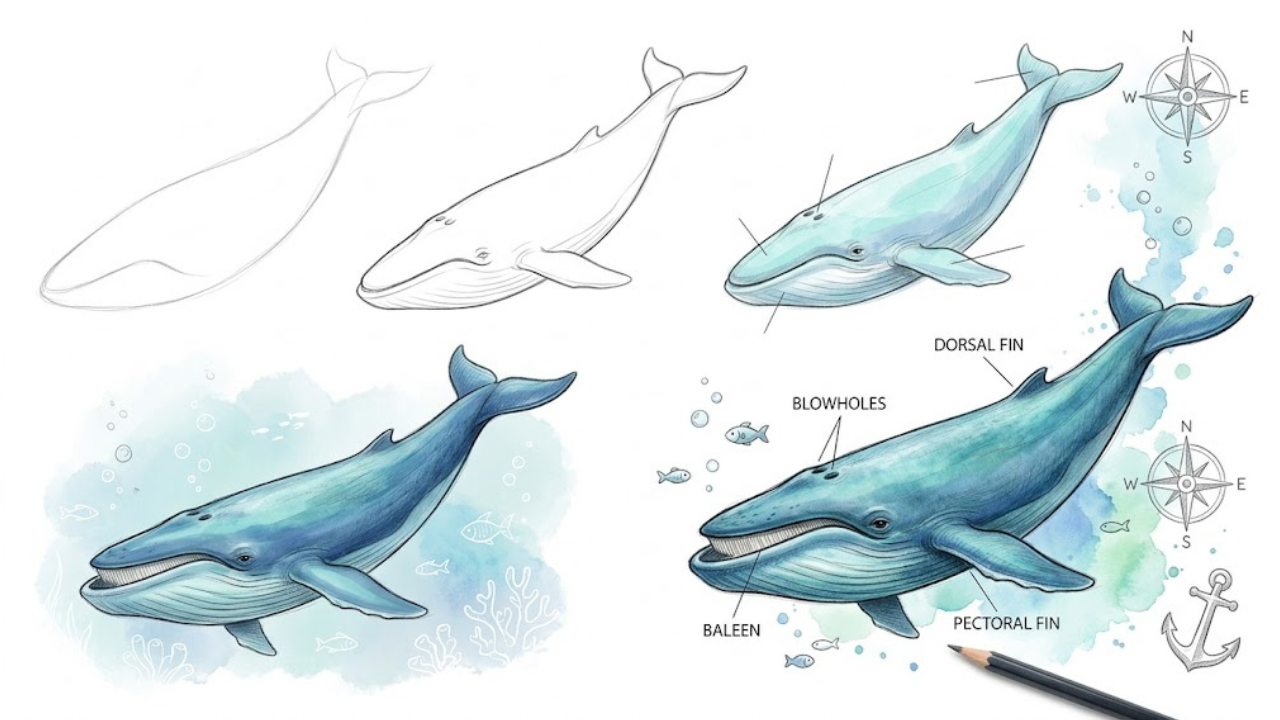
Introduction
What if the largest animal ever known could fit inside your notebook as one simple curved line? A blue whale sketch helps you study scale, movement, anatomy, and ocean life while turning a fascinating science subject into practical artwork.
In this student-friendly guide, you will learn how to create a blue whale sketch easy enough for beginners and detailed enough for a school project. You will discover how to build the body from simple shapes, position the fins and tail, create a blue whale sketch realistic with shading, and finish a blue whale drawing with colour.
You will also compare pencil, outline, and coloured approaches, learn important blue whale facts, and avoid common drawing mistakes. A blue whale looks complex at first, but its body follows a clear structure: a long body, a broad head, small fins, a dorsal ridge, and a powerful tail. Start with those large forms, then add details gradually.
By the end, you will have a repeatable method for making a confident marine-life illustration.
Table of Contents
-
What Is a Blue Whale Sketch?
-
Why Does a Blue Whale Sketch Matter?
-
Blue Whale Sketch: Key Facts and Styles
-
How to Draw a Blue Whale Sketch
-
Common Blue Whale Sketch Mistakes to Avoid
-
Expert Tips for Better Blue Whale Drawings
-
Frequently Asked Questions About Blue Whales
What Is a Blue Whale Sketch?
A blue whale sketch is an artwork that represents the body, movement, and identifying features of a blue whale using lines, shapes, shading, or colour. It can be a quick outline, a scientific study, a realistic pencil drawing, or a bright illustration for a classroom display.
The easiest way to understand the whale’s body is to imagine a long submarine with a rounded front and a narrow rear. Its head forms the widest section, the body tapers toward the tail, and the flukes spread like two broad leaves.
A student sketch does not need to show every anatomical detail. It should show the whale’s recognizable features: a large rounded head, blowholes, pectoral fins, a small dorsal fin, a long body, and a split tail.
A simple reference method recommended by the Beaty Biodiversity Museum begins with a long oval for the body, then adds the mouth, dorsal fin, pectoral fin, and tail flukes. This shape-first method makes your drawing easier to control.beatymuseum sites.olt.ubc
Why Does a Blue Whale Sketch Matter?
Drawing a whale combines science and observation. You do not merely copy an animal; you learn how its shape supports life in the ocean.
-
It improves observation skills. You learn to notice proportion, curves, texture, and movement.
-
It supports biology lessons. A labeled drawing can show fins, blowholes, baleen, and body shape.
-
It strengthens hand control. Long curves and repeated shading build pencil confidence.
-
It encourages conservation awareness. Art can help classmates care about threatened marine animals.
-
It makes facts memorable. A whale’s enormous size becomes easier to remember when you draw it beside a boat or person.
Blue whales can grow to about 31 metres, or 100 feet, roughly the length of a basketball court. Their average lifespan is estimated at 80 to 90 years, while their global population remains far below historical levels.fisheries.noaa+1
Blue Whale Sketch: Key Facts and Styles
Before you draw, decide which visual style matches your assignment. Each style needs a different level of detail.
Blue Whale Sketch Simple
A blue whale sketch simple uses a few clean shapes and lines. Begin with an oval body, add a rounded head, place the fins, and finish with a forked tail.
This style works well for younger students, quick notes, posters, and beginner practice. Keep the eye small and avoid adding too many lines.
Blue Whale Drawing Pencil
A blue whale drawing pencil depends on value rather than colour. Use light pressure for the first outline, medium pressure for the underside, and darker strokes beneath the flippers, around the mouth, and near the tail.
Pencil shading can suggest the whale’s mottled skin. Use short, uneven marks instead of perfectly repeated dots, because natural textures are irregular.
Blue Whale Sketch Realistic
A blue whale sketch realistic needs accurate proportions, subtle anatomy, and believable water movement. The head should remain broad, the body should taper gradually, and the dorsal fin should stay relatively small.
Realism also depends on light. Choose one light source and keep the upper back lighter than the lower body.
Blue Whale Sketch With Colour
A blue whale sketch with colour can use navy, turquoise, gray-blue, white, and muted purple. Avoid colouring the entire whale with one flat blue shade.
Layer darker blue along the belly and tail, then blend lighter blue across the back. Add pale highlights to show wet skin and a soft white spray above the blowholes.
Blue whales are baleen whales, meaning they filter tiny food such as krill rather than hunting large prey. Their streamlined shape helps them travel efficiently through ocean water.
How to Draw a Blue Whale Sketch
Follow these steps to create a blue whale drawing with colour or a clean pencil version.
1. Collect your materials
Use a pencil, eraser, ruler, black fineliner, drawing paper, and coloured pencils or markers. If you want soft shading, prepare at least three graphite grades, such as HB, 2B, and 4B.
Choose a reference image that shows the whale from a clear side or three-quarter view. Avoid switching between several conflicting references during the first attempt.
2. Draw the main body shape
Lightly draw a long, horizontal oval. Make the front wider and rounder than the rear, then taper the body toward the tail.
Do not press hard. This guide shape should disappear under your final outline.
3. Shape the head and mouth
Extend the front of the oval into a broad, slightly rounded head. Draw the mouth as a long, gentle curve along the lower front section.
Blue whales have a wide head, so do not make the nose pointed like a dolphin’s. Keep the jaw smooth and heavy.
4. Add fins and tail
Place one pectoral fin along the lower side of the body. Draw it as a long, tapered triangle with a gently curved edge.
Add a small dorsal fin near the rear third of the body. At the end, draw two wide tail flukes that spread outward like a shallow “V.”
5. Add the facial features
Place a tiny eye above the mouth line and add the paired blowholes on top of the head. Keep both details subtle because the whale’s head is much larger than its eye.
You may add a few baleen lines inside the mouth, but do not fill the mouth with sharp teeth. Blue whales do not have teeth.
6. Refine the outline
Trace the best lines with a fineliner or darker pencil. Vary your line weight: use stronger lines beneath the body and lighter lines along the back.
Erase the construction oval carefully after the ink or graphite has dried. Leave a few soft sketch marks if you want a natural study effect.
7. Shade the body
For a blue whale drawing pencil style, shade beneath the jaw, pectoral fin, belly, and tail. Use diagonal strokes that follow the body’s direction rather than scribbling randomly.
Blend lightly, then restore a few texture marks with a sharp pencil. This creates skin without making the whale look furry.
8. Add colour and water
For a blue whale drawing with colour, apply pale blue first, then build darker layers near the belly and tail. Add gray or violet patches to suggest mottled skin.
Finish the ocean with horizontal blue strokes. Add a lighter water line around the whale and a soft spray above the blowholes to show movement.
9. Label the science
If your drawing is for school, add labels such as blowholes, pectoral fin, dorsal fin, baleen, fluke, and tail stock. Include one fact box, such as “Blue whales are the largest animals ever known to have lived.”
Internal link suggestion: [INTERNAL LINK: Easy Ocean Animal Drawings for Students]
Common Blue Whale Sketch Mistakes to Avoid
-
Making the whale look like a fish. A blue whale is a mammal, so show blowholes, flippers, and a horizontal tail fluke.
-
Drawing a pointed nose. Blue whales have broad, rounded heads rather than sharp dolphin-like snouts.
-
Making the eye too large. A small eye keeps the scale believable and improves realism.
-
Using one flat blue colour. Layer several cool tones to create volume, skin texture, and reflected light.
-
Forgetting body taper. The whale should be thickest near the head and gradually narrow toward the tail.
-
Adding teeth. Blue whales use baleen plates to filter food; they do not chew prey with teeth.
-
Ignoring the water environment. Even a simple curved horizon, bubbles, or surface light can make the whale feel part of the ocean.
Expert Tips for Better Blue Whale Drawings
-
Measure before detailing. Compare the head, body, fins, and tail before adding texture.
-
Use curved strokes. Follow the whale’s form so shading makes the body appear three-dimensional.
-
Keep the outline flexible. Natural animals rarely have perfectly smooth, mechanical edges.
-
Create contrast. Darken the underside and place lighter highlights on the upper back.
-
Show scale. Add a small boat, diver, or school of fish to communicate the whale’s enormous size.
-
Test colours first. Try blue combinations on scrap paper before applying them to your final artwork.
-
Protect the highlights. Leave small areas of paper uncoloured to suggest wet skin and reflected light.
-
Study movement. A curved body and raised tail can make your sketch appear active rather than stiff.
Frequently Asked Questions About Blue Whales
Can a blue whale live 100 years old?
Yes. Blue whales commonly live around 80 to 90 years, but some may reach or exceed 100 years. Scientists estimate age by studying layers in waxy earplugs found after death. One reported blue whale was estimated to be about 110 years old, although researchers still have limited data because these animals are difficult to study throughout their entire lives.extapps dec.ny
What is the biggest creature to ever exist?
The blue whale is generally recognized as the largest animal known to have ever lived. Some individuals can reach roughly 31 metres in length and weigh more than many large dinosaurs. For your drawing, place the whale beside a basketball court, boat, or human figure to help viewers understand its scale.fisheries.noaa
Is a blue whale friendly to humans?
Blue whales are not usually aggressive toward people, but “friendly” is not the best scientific description. They are wild animals that feed on krill and generally avoid human contact. Boats should keep a safe distance because a whale’s size and movement can create serious risks, while vessel strikes and noise can harm whales.
Conclusion
A strong blue whale sketch begins with three essentials: accurate body proportions, clear anatomical features, and controlled shading or colour. Build the whale from simple shapes, refine the head and tail, then add texture only after the structure looks right.
For a beginner project, choose a blue whale sketch simple enough to finish confidently. For an advanced assignment, develop a blue whale sketch realistic with layered pencil tones, water reflections, and scale references.
Start today with one oval, two flippers, and a split tail. Which style will you try first: pencil shading, a simple outline, or a colourful ocean scene?