
 By Richard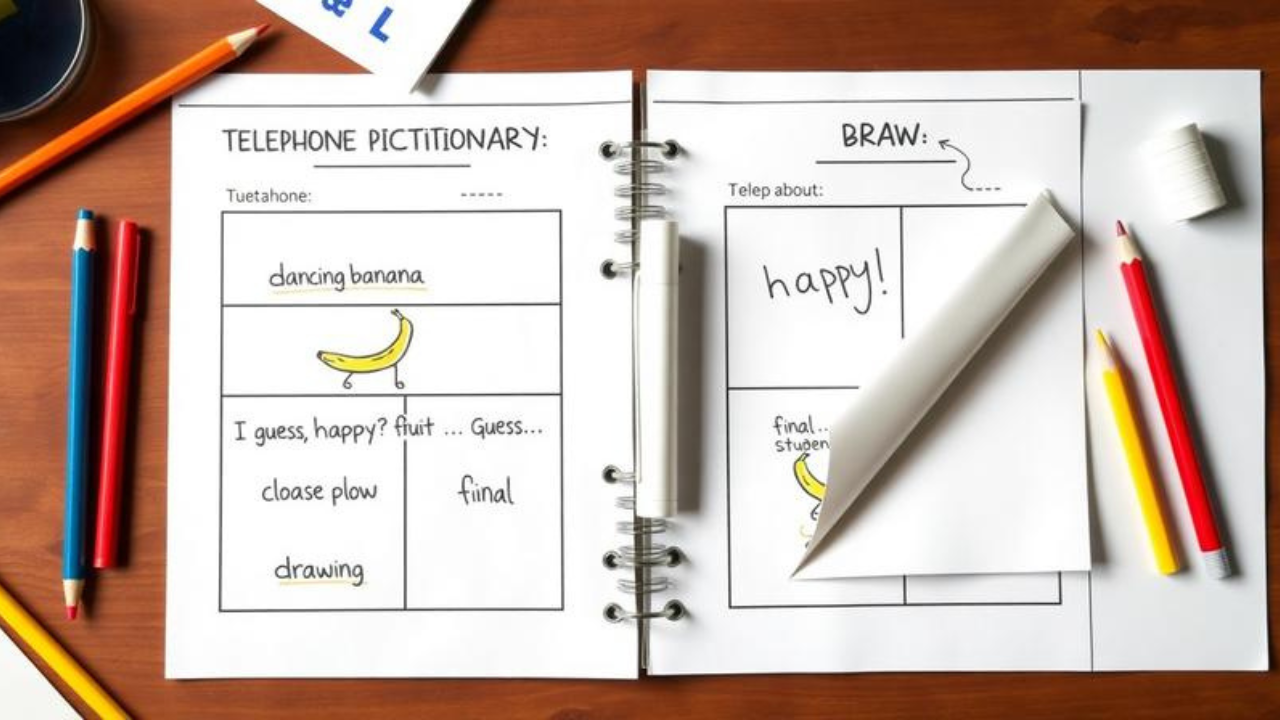
Have you ever tried to draw a flamingo in ten seconds, only to have your friend guess “spaghetti monster”? That glorious chaos has a name, and with a telephone pictionary template in your hands, it becomes the best part of your day. A telephone pictionary template transforms a messy stack of paper into an organized chain of whispered sketches and wild guesses. In this guide, you’ll learn exactly what the game is, why it belongs in every student’s social toolkit, the different template types you can use, and a step-by-step method to run a perfect round. You’ll also discover common mistakes, expert tips, and a ready-to-print template to steal the show at your next gathering.
Table of Contents
-
What Is a Telephone Pictionary Template?
-
Why Telephone Pictionary Games Matter for Students
-
Types of Telephone Pictionary Templates
-
How to Use a Telephone Pictionary Template: Step-by-Step
-
Common Mistakes to Avoid with Telephone Pictionary
-
Expert Tips for Best Telephone Pictionary Results
-
Telephone Pictionary Template FAQs
What Is a Telephone Pictionary Template?
A telephone pictionary template is a pre-structured sheet that keeps the classic drawing and guessing game organized from start to finish. Think of it as a comic strip with blank panels, but each panel alternates between a phrase you write and a sketch someone else draws. One player starts with a secret word or sentence, the next person draws it, the third person guesses a new phrase just from that drawing, and the chain continues. The template holds all these steps in a tidy, foldable grid so nothing gets lost or revealed too early. It’s the essential tool that turns “telephone pictionary” from a chaotic scramble into a smooth, laugh-filled relay race for your eyes and hands.
Why Telephone Pictionary Games Matter for Students
You might see this as just a party game, but it pulls serious weight in a student’s creative and social development. Here’s how a simple round of telephone pictionary benefits you directly.
-
Ignites lateral thinking: Interpreting a squiggly drawing as a concrete phrase forces your brain to make unexpected connections, a core skill in problem-solving and innovation.
-
Sharpens non-verbal communication: You learn to convey complex ideas through quick, symbolic sketches—a visual language skill that transfers to note-taking, design, and presentations.
-
Lowers social anxiety: The inevitable absurd outcomes generate shared laughter, reducing social pressure and making it easier for shy students to participate. According to Edutopia, collaborative drawing games increase student engagement and comfort in group settings by over 30%.
-
Builds rapid visualization: With a timer ticking, you practice distilling an image to its essence fast. This is a fundamental warm-up exercise for any visual art student.
-
Strengthens group cohesion: The chain only succeeds when every player pays attention and contributes, naturally building trust and teamwork without a lecture.
-
Creates lasting inside jokes: The wild transformations become stories your friend group retells for weeks, deepening social bonds.
Types of Telephone Pictionary Templates
No two groups play exactly the same way. Pick the template style that matches your crowd and setting.
Printable Paper Template
The classic. A single sheet with numbered, foldable panels. You print one copy per player, and the physical folding keeps previous steps hidden. Perfect for classrooms, dorm lounges, and any place where screens aren’t welcome. This is the go-to telephone pictionary template for quick, hands-on fun.
Digital Template for Online Play
Built for remote students. Shared slide decks in Canva, Google Jamboard, or FigJam offer real-time collaboration. Each slide acts as a panel, and you flip through them sequentially. A digital telephone pictionary template allows screen sharing and saves the entire hilarious chain as a permanent record.
Customizable Blank Template
A flexible grid with empty boxes and no pre-set word prompts. You decide the chain length based on your group size. This printable game template gives you maximum freedom—write your own instructions, add doodle spaces, or adjust the number of steps for a shorter or longer game.
Themed Template
Pre-loaded with starter phrases tailored to a topic, like “school life,” “animals,” or “movie titles.” Ideal for younger students, ESL learners, or subject-specific classrooms. A themed telephone pictionary template lowers the barrier of thinking up a first phrase and keeps the game focused.
| Template Type | Best For | Key Feature | Group Size |
|---|---|---|---|
| Printable Paper | In-person parties, classrooms | Foldable panels, no devices needed | 4–12 |
| Digital | Online classes, remote clubs | Real-time collaboration, save history | 4–20 |
| Customizable Blank | Flexible groups, any situation | Adjustable chain length, total control | Any |
| Themed | Young students, ESL, subject review | Starter phrases, built-in vocabulary | 4–10 |
How to Use a Telephone Pictionary Template: Step-by-Step
Grab your chosen template and gather a group. Follow these six steps exactly to run a flawless round of telephone pictionary.
-
Print or share the template. Give every player one copy of your telephone pictionary template, ensuring the panels match the number of people in the group. A six-player game works best with a template that has six panels.
-
Write a secret starting phrase. Each person writes a short, visual phrase in the very first “Write” box. Examples: “a penguin surfing,” “homework eating a student,” “a taco playing guitar.” Keep it simple, specific, and image-friendly.
-
Pass and draw the phrase. Everyone passes their template to the left. That next player reads the phrase, then draws it in the first “Draw” box. The drawing must not include words, letters, or numbers.
-
Fold and pass again. The artist folds the paper back so the original phrase is completely hidden, then passes the template. The next person sees only the drawing and writes a new phrase interpreting what they see in the next “Write” space. Then fold the drawing away.
-
Repeat the drawing-guessing alternation. Continue passing and folding after each turn, with players switching between drawing and guessing until the template is full. Always ensure only the most recent panel is visible.
-
Unfold and reveal the transformation. When the chain ends, unfold the templates and compare the original phrase to the final drawing or guess. Read them aloud in order—the most distorted evolution wins the biggest laugh.
For more group activity ideas, check out our
Mockingbird Drawing Easy
collection.
Common Mistakes to Avoid with Telephone Pictionary
Even enthusiastic players derail the fun with these fixable errors. Spot them before they spoil your chain.
-
Skipping the fold or cover step. If players peek at previous panels, the telephone effect disappears, and you end up with a boring, accurate chain. Use a firm fold and binder clip if needed.
-
Writing overly abstract or long phrases. “The existential dread of a forgotten burrito” is nearly impossible to draw. Stick to concrete nouns and active verbs. A good rule: if you can’t sketch it in 30 seconds, simplify it.
-
Drawing with zero context. A single stick figure could be anyone. Add a prop, an arrow, or a simple background to clarify your intent. Even a wavy line under a surfer communicates ocean.
-
Using a template with too few panels. A chain of three steps shows minimal mutation; you want the distortion to build. Aim for at least five panels for optimal silliness.
-
Forgetting a time limit. One perfectionist can hold up the entire group. Set a 60-second timer per drawing or phrase to keep energy high and pencils moving.
Expert Tips for Best Telephone Pictionary Results
-
Laminate your printable templates and use dry-erase markers so a single set lasts an entire school year.
-
Start with a practice round using one-word prompts like “cat” or “pizza” to warm up everyone’s drawing muscles.
-
Keep a “phrase jar” filled with silly, ready-to-use prompts for players who freeze when it’s their turn to start a chain.
-
On digital templates, activate version history to replay the entire transformation frame by frame for maximum comic effect.
-
Embrace exaggeration: the funniest chains come from drawings that over-emphasize one feature, like a gigantic hat or tiny, furious eyes.
Telephone Pictionary Template FAQs
How do you make a telephone pictionary template?
Use a word processor or drawing app to create a vertical column of alternating “Write” and “Draw” boxes. Number them sequentially and add folding lines between each box. Leave enough space for a short sentence and a small sketch. Print one copy per player, and you have a custom telephone pictionary template ready in minutes.
What is the difference between telephone pictionary and regular Pictionary?
Regular Pictionary has one person drawing a given word while teammates guess in real time; the goal is correct identification. Telephone pictionary adds a written relay chain: a drawing gets interpreted as a new phrase, which then gets drawn again. The objective isn’t accuracy—it’s the hilarious transformation across multiple hands, making it a distinct drawing and guessing party game.
How many people do you need for telephone pictionary?
You need a minimum of four players for a satisfying chain, but the game truly shines with six to eight. Each person needs one template, and the template’s panel count should match the number of players to ensure everyone contributes exactly once. Larger groups can split into smaller circles and compare final mutations.
A telephone pictionary template is your fast pass to unforgettable group fun—just print, pass, and let the giggles build. Remember to fold after every turn, keep your phrases visual, and set a timer to maintain momentum. Whether you use a printable sheet or a shared digital canvas, this game sharpens your sketching, sparks creative thinking, and turns any study break into a highlight. Grab the template, gather your friends, and run your first chain tonight.
What’s the most hilariously wrong final drawing your group has ever produced? Share your favorite transformation story in the comments.