 By Richard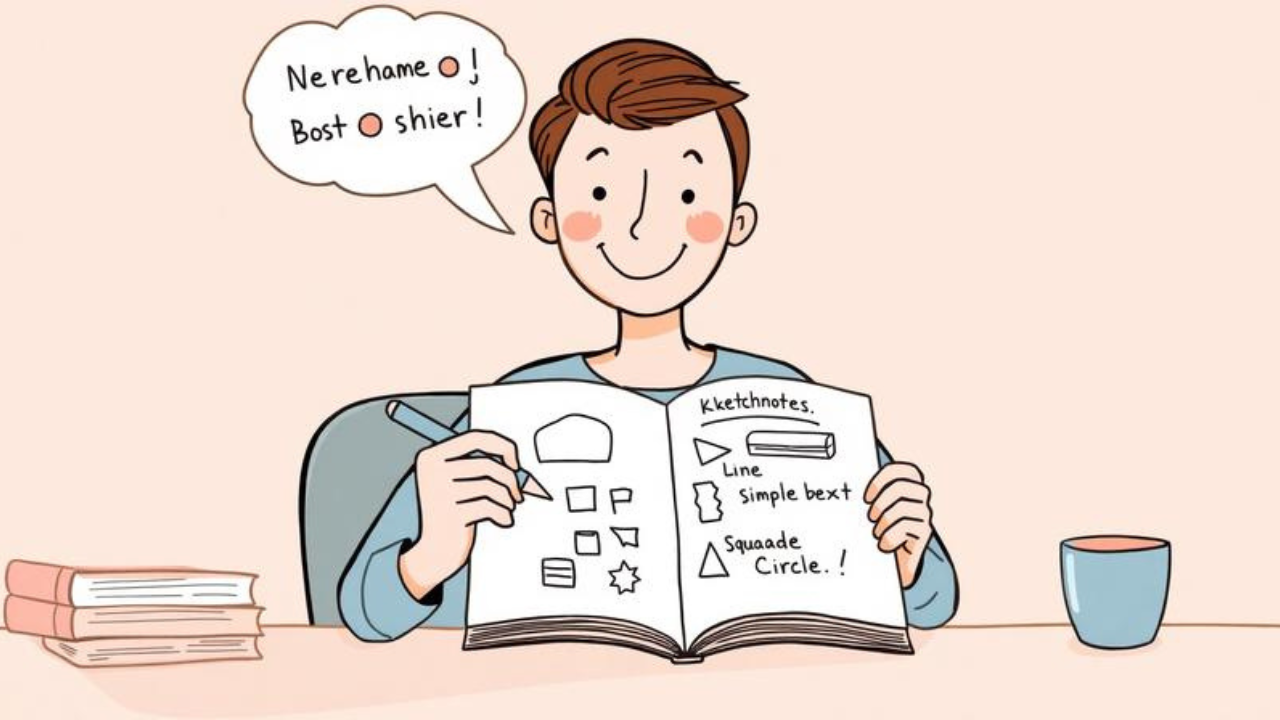
Your fourth-grade teacher was wrong. Doodling in class doesn’t mean you’re not paying attention—it might mean you’re paying more attention than anyone else in the room.
Introduction
Picture this: You’re sitting in a lecture, a meeting, or a conference. The speaker is racing through slides, and you’re frantically scribbling words you’ll probably never read again. Your hand cramps. Your mind wanders. By the time you walk out the door, you’ve already forgotten half of what was said.
Now imagine a different scene. Same speaker. Same information. But instead of a wall of text, your notebook looks like a work of art—bubbles containing key ideas, arrows connecting related concepts, little icons that trigger your memory, and bold headings that make the entire page scannable in seconds. You walk out not just remembering what was said, but understanding it.
That’s sketchnoting.
Sketchnoting—also known as visual notetaking—is the creative process of recording ideas through a combination of illustrations, symbols, structures, and text. It’s not about being an artist. It’s about being a better thinker. And according to a growing body of research, it might be one of the most underutilized tools for learning, retention, and creativity in both classrooms and boardrooms.
In this guide, I’ll walk you through everything you need to know: what sketchnoting actually is, why it works (science included), how to start even if you “can’t draw,” and why this simple practice could change the way you process information forever.
Background: The Accidental Invention That Became a Movement
In 2006, a designer named Mike Rohde was frustrated. Traditional notetaking stressed him out—he felt like he could never capture every detail. So he started experimenting. What if he combined words with sketches? What if notes didn’t have to be linear? hat if they could be fun?
Rohde started calling his creations “sketchnotes“—a portmanteau of “sketch” and “notes”. He tested the technique at conferences, then uploaded his hand-drawn visual guides online. The response was overwhelming. People weren’t just interested; they were inspired. Seven years later, Rohde published The Sketchnote Handbook and The Sketchnote Workbook, launching a global movement.
Today, sketchnoting has its own global community called the Sketchnote Army. It’s being taught everywhere from engineering seminars at Auburn University to MBA programs, and it’s even been the subject of peer-reviewed academic studies.
But here’s the thing: sketchnoting isn’t new. Look back at history and you’ll find sketchnoters everywhere. Einstein’s notebooks are filled with sketches, notes, and diagrams. Leonardo da Vinci’s journals are essentially one giant sketchnote. The only thing that’s changed is that we finally have a name for it—and the science to prove why it works.
What Exactly Is Sketchnoting?
At its core, sketchnoting is a note-taking technique that combines standard written notes with visual sketches and graphics. It’s a more creative style of note-taking that integrates eye-catching, memorable visuals with supplementary written notes for a more unique and effective way to communicate information.
But sketchnoting is more than just “drawing in your notebook.” It’s a way of thinking. As one educator put it, “To sketch is to think”. When you sketchnote, you’re not just recording information—you’re processing it.
Traditional notetaking is largely passive. You hear words, you write words. Your brain is essentially a transcription machine. But sketchnoting forces you to listen, filter, synthesize, and translate. You have to decide what matters, how ideas connect, and how to represent them visually. That’s not passive—that’s active learning.
The result is information that is captured and communicated visually and artistically. And because our brains are programmed to consume information visually, sketchnotes are easier to understand, remember, and share.
The Building Blocks: What Actually Goes Into a Sketchnote?
Here’s the good news: you don’t need to be an artist. You don’t need fancy supplies. And you definitely don’t need to draw like Leonardo da Vinci.
As Mike Rohde explains, most doodles contain just five basic components: a dot, a line, a triangle, a square, and a circle. That’s it. Everything else is just combinations of these shapes.
Here are the core elements of any sketchnote:
Text — Your everyday handwriting. It doesn’t have to be perfect, just legible.
Emphasis Text — Headings, titles, and key takeaways in bold, all caps, or bubble letters.
Basic Shapes — Circles, triangles, squares as alternatives to bullet points.
Containers — Boxes, speech bubbles, thought clouds, and banners that group related ideas.
Connectors — Arrows, lines, and dotted lines that show how ideas relate.
Icons and Symbols — Simple drawings that represent words or concepts.
That’s it. You can create an entire sketchnote using nothing but these six elements and a single pen.
Why Sketchnoting Works: The Science Behind Visual Thinking
Your Brain on Sketchnotes
The science behind sketchnoting is compelling. When you combine graphics with text, you’re engaging multiple parts of your brain simultaneously. You’re not just writing—you’re thinking about how to map information out, what drawing suits the information, and using your motor processes to put pen to paper.
Research has shown that sketchnoting leads to higher levels of memory retention. Studies have found that students who use visual note-taking strategies tend to have improved comprehension and recall of material. Visual note-taking strategies have been shown to be effective in improving the retention of complex information.
Beyond memory, sketchnoting has been linked to better attention to detail, development of creativity, a calming effect, and development of manual dexterity. It helps you paraphrase, determine importance, summarize, and synthesize. In turn, you remember more. You remember longer.
Real Results in Real Classrooms
The numbers are compelling. A 2025 study published in Integrative and Comparative Biology replaced traditional high-stakes exams with sketchnoting assignments. Student feedback indicated enhanced learning, skill development, and a preference for sketchnotes over exams—despite a similar workload. Notably, this flexible assessment correlated with reduced performance disparities.
Other research has found that sketchnoting can decrease students’ negative achievement emotions and provides space for linking new learning content to real-world experiences. Students report that sketchnoting helps them stay focused, organize information, and actually enjoy the learning process.
The message is clear: sketchnoting isn’t just a nice alternative to boring notes. For many people, it’s a better way to learn.
How to Start Sketchnoting Today (Even If You “Can’t Draw”)
Step 1: Gather Your Tools
All you need is paper and something to write with. Seriously. A notebook and a pen will get you started. As you get more comfortable, you can experiment with colored highlighters, markers, or even digital tools. Popular digital apps include Procreate, Goodnotes, Notability, and Adobe Draw. But don’t overthink this. The tool doesn’t matter nearly as much as the practice.
Step 2: Practice Listening, Not Transcribing
Sketchnoting is not about capturing every word. It’s about capturing the ideas. Think of yourself as a thought curator. What’s the one major point from this presentation? What’s the most surprising thing the speaker said? What connections can you draw between concepts?
Start by practicing with something low-stakes—a TED Talk, a podcast, or even a book chapter. The pressure is lower, and you can pause and rewind as needed.
Step 3: Develop Your Visual Vocabulary
You don’t need to invent visual symbols from scratch. Borrow from others. Look at how other sketchnoters represent common concepts. Build your own “visual dictionary” over time. A lightbulb for ideas. A speech bubble for quotes. Arrows for cause and effect. You’ll find that certain symbols become second nature.
Step 4: Embrace Imperfection
Here’s the hardest part for most people: your sketchnotes won’t look good at first. That’s fine. They’re not supposed to be gallery pieces. They’re supposed to help you think. As one educator wrote, “Sketchnotes are thinking made visible”. The goal is not aesthetic perfection—it’s better thinking.
The Nuance: Sketchnoting Isn’t for Everyone (and That’s Okay)
Let’s be honest for a moment.
Sketchnoting requires cognitive effort. You’re not just transcribing—you’re translating, filtering, and creating in real time. For some people, that’s energizing. For others, it’s exhausting. There’s a reason traditional notetaking persists: it’s efficient and requires less mental bandwidth.
There’s also a learning curve. Your first few sketchnotes will probably look messy. You might feel self-conscious. You might worry that you’re “doing it wrong.” As one educator noted, there are debates over how sketchnoting should be incorporated into classes—as an optional or obligatory practice. The consensus seems to be that forcing it on people who don’t connect with it is counterproductive.
Additionally, some research has found mixed results. One study found no significant difference in test scores between participants who used sketchnoting and those who took standard written notes. However, the same study found that the sketchnoting group enjoyed note-taking slightly more on average.
The key takeaway? Sketchnoting is a tool, not a religion. Use it when it helps. Put it down when it doesn’t. The goal is better thinking, not sketchnoting for its own sake.
Actionable Takeaways
-
Start with a single pen and paper. Don’t overthink tools. Just begin.
-
Practice with low-stakes content. TED Talks, podcasts, and book chapters are perfect for building your skills without pressure.
-
Master the five basic shapes. A dot, a line, a triangle, a square, and a circle can create almost anything.
-
Think like a curator, not a transcriber. Capture ideas, not words.
-
Develop your own visual vocabulary. Borrow symbols from others, then make them your own.
-
Embrace imperfection. Your sketchnotes don’t need to look good—they need to help you think.
-
Review your sketchnotes. The act of revisiting them cements the concepts in your mind.
Frequently Asked Questions
1. Do I need to know how to draw to sketchnote?
Absolutely not. Sketchnoting relies on basic shapes—dots, lines, circles, squares, and triangles. As Mike Rohde explains, it’s more like building with Lego blocks than creating fine art.
2. What supplies do I need to get started?
Just paper and something to write with. A single pen works fine. You can add colored markers or digital tools later.
3. Is sketchnoting scientifically proven to work?
Yes. Research shows that sketchnoting leads to higher levels of memory retention, better comprehension, and improved cognitive strategies. A 2025 study found that sketchnoting correlated with enhanced learning and reduced performance disparities.
4. Can sketchnoting replace traditional notetaking?
It depends on the context. Sketchnoting works well for concepts, relationships, and narratives but may be less suitable for precise details or heavily quantitative information. Many people use a combination of both methods.
5. How long does it take to get good at sketchnoting?
Like any skill, it takes practice. Start with low-stakes content like TED Talks. Most people see significant improvement within a few weeks of regular practice.
6. What’s the difference between sketchnoting and mind mapping?
Mind mapping is a specific technique for organizing information around a central concept. Sketchnoting is broader—it can include timelines, cycles, hierarchies, and other structures.
7. Is sketchnoting only for students?
Not at all. Sketchnoting is used in business meetings, conferences, planning sessions, and personal journaling. It’s a tool for anyone who wants to think more clearly and remember more effectively.
Conclusion: The Pen That Thinks
Sketchnoting isn’t about making pretty pictures. It’s about making your thinking visible. It’s about taking the invisible ideas in your head and giving them a form you can see, touch, and rearrange. t’s about saying, “Someone spent time thinking here.”
We live in an age of information overload. We’re bombarded with more data, more meetings, more content than any human brain can process. The old ways of notetaking—frantically transcribing words we’ll never read again—aren’t working. We need a better way.
Sketchnoting is that better way.
It’s not magic. It’s not easy. And it’s not for everyone. But for those who try it, the rewards are real: better memory, deeper understanding, and a more engaged mind. Whether you’re a student struggling to stay awake in lecture, a professional drowning in meetings, or just someone who wants to think more clearly, sketchnoting offers a path forward.
So pick up a pen. Open a notebook. And start drawing. Your brain will thank you.
“Visible notetaking unleashes invisible thinking in words and images: it gushes forth to flood the page.”