
 By Richard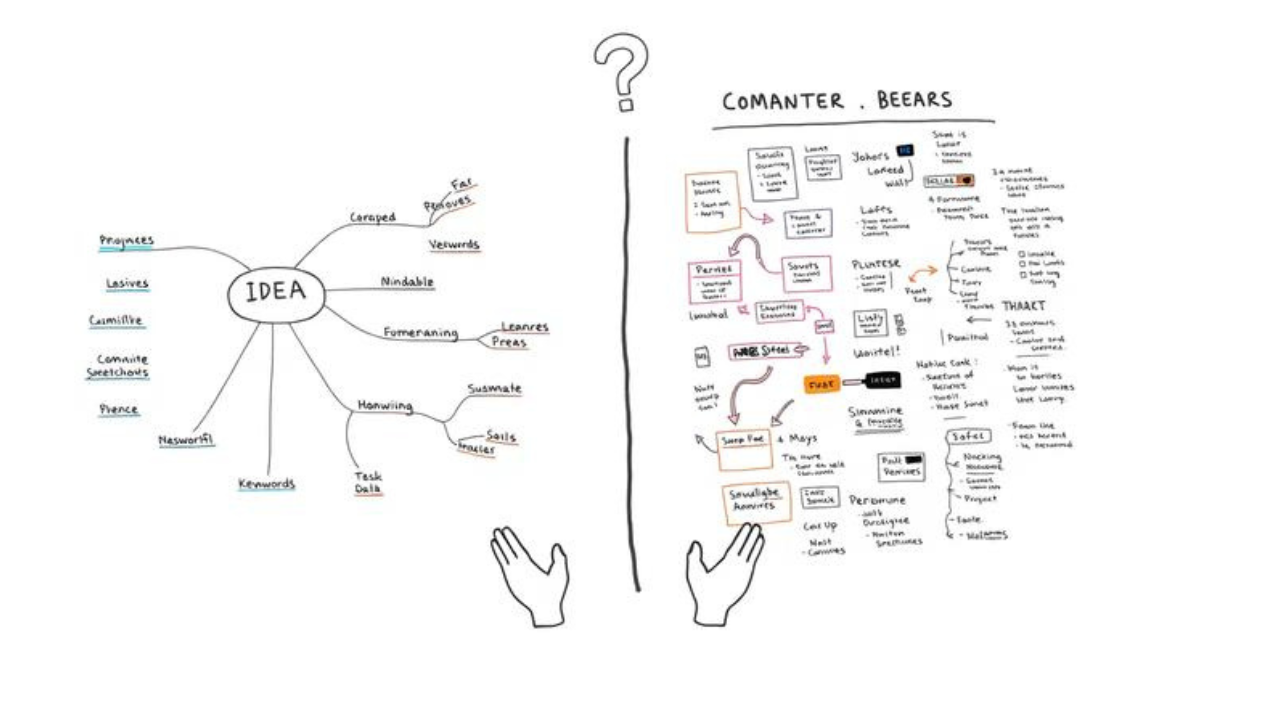
Your brain doesn’t think in straight lines—so why are your notes still stuck in them?
Introduction
Picture two people in the same lecture. The first student’s notebook is a sprawling, colorful diagram—branches radiating from a central idea, keywords dangling like fruit from a tree. The second student’s page is a visual feast of icons, arrows, containers, and handwritten text arranged in a flowing, organic layout. Both are taking visual notes. Both are engaged. But they’re doing something fundamentally different.
One is mind mapping. The other is sketchnoting.
If you’ve ever wondered which of these popular visual thinking methods is right for you, you’re not alone. They look similar at first glance—both use words and images, both reject the linear tyranny of traditional outlines, both are more engaging than walls of text. But beneath the surface, mind mapping and sketchnoting are as different as a family tree and a travel journal.
Mind mapping is about structure—hierarchy, relationships, and logical connections radiating from a central idea. Sketchnoting is about flow—capturing ideas as they unfold, creating a visual story that mirrors the natural rhythm of thought.
Understanding the difference isn’t just academic trivia. It’s the difference between choosing the right tool for the job and wrestling with a hammer when you really need a screwdriver. This guide will show you exactly what sets these two methods apart, when to use each, and how to combine them for maximum impact.
Background: Two Branches of the Visual Thinking Tree
Both mind mapping and sketchnoting emerged from the same fundamental insight: our brains don’t process information in neat, linear rows. They work through association, connection, and imagery.
Mind mapping has the longer pedigree. Tony Buzan popularized the technique in the 1970s, arguing that traditional notetaking was “anti-brain” because it forced thinking into unnatural straight lines. His method—start with a central idea, branch outward with related concepts, use colors and images—became a global phenomenon. Today, mind mapping is used everywhere from corporate strategy sessions to nursing education, with research showing it significantly improves critical thinking skills.
Sketchnoting is the newer kid on the block. Designer Mike Rohde coined the term in 2006, frustrated with the stress of trying to capture every word in meetings. He started experimenting with combining simple drawings, arrows, and symbols with handwritten notes. The result was a more flexible, narrative-driven approach to visual notetaking that didn’t require a central organizing structure.
Both methods share a common philosophy: expressing ideas visually. Both leverage the power of dual coding—engaging both verbal and visual processing systems in the brain. But their differences are what make each uniquely valuable.
The Anatomy of a Mind Map: Structure Rules
Hierarchy Above All
A mind map is, at its core, a hierarchical diagram. Start with a central concept in the middle of the page. Branch out to main subtopics. Branch again to supporting details. The result is a tree-like structure that shows how ideas relate to each other from general to specific.
Mind maps can be created with just words and lines. You can add images and colors—and you should, because they help identify areas of interest at a glance—but the structure is the star. Lines physically connect ideas, laying out a radial or tree hierarchy that makes relationships immediately visible.
When Mind Mapping Shines
Mind mapping is your go-to tool when you need to:
-
Brainstorm and generate ideas—the radial structure encourages free association
-
Organize complex information—hierarchies make large amounts of data digestible
-
Plan projects or essays—the structure naturally reveals gaps and connections
-
Study for exams—mind maps help you see the big picture and recall details
The research backs this up. A meta-analysis found that mind mapping has a significant positive effect on critical-thinking skills. Students report that mind maps support permanent learning, extend attention and focus time, and improve creativity.
The Mind Map Mindset
Creating a mind map requires you to think about relationships. Every branch asks: “How does this connect to the main idea? How do these subtopics relate to each other?” It’s a tool for analysis, synthesis, and planning. You’re building a map of your thinking.
The Anatomy of a Sketchnote: Flow Over Structure
Freedom From the Center
A sketchnote doesn’t start from a central point. It can start anywhere—top left, bottom right, middle, or even in multiple places simultaneously. The information is organized in an open, flexible way that mirrors the natural flow of a conversation or lecture.
Sketchnotes combine text, drawings, diagrams, shapes, and containers. Arrows show flow and movement. Banners and boxes group related ideas. Icons provide visual memory hooks. But there’s no requirement that everything connect back to a single root.
When Sketchnoting Shines
Sketchnoting is your tool when you need to:
-
Capture live content—lectures, meetings, conferences, podcasts
-
Tell a visual story—the narrative structure follows the speaker’s flow
-
Remember and revisit—visual notes are more memorable than text alone
-
Engage creatively—the freedom to arrange ideas openly reduces cognitive strain
Research shows sketchnoting can decrease negative achievement emotions and provides space for linking new learning content to real-world experiences. In one study, students preferred sketchnotes over traditional exams, and the method correlated with reduced performance disparities.
The Sketchnote Mindset
Creating a sketchnote requires you to think about narrative and emphasis. You’re asking: “What’s the main point? What’s surprising? What deserves a big, bold heading? How does this idea lead to the next?” It’s a tool for listening, filtering, and storytelling.
Head-to-Head: The Key Differences at a Glance
| Aspect | Mind Mapping | Sketchnoting |
|---|---|---|
| Structure | Radial hierarchy from a central point | Open, flexible, can start anywhere |
| Primary Purpose | Organize, brainstorm, plan | Capture, remember, engage |
| Idea Relationship | Shows hierarchy and connections | Shows flow and sequence |
| Visual Requirements | Can be words-only; images optional | By definition includes sketches |
| Best For | Planning, studying, complex analysis | Live notetaking, storytelling, revision |
| Mindset | Analytical, relational | Narrative, selective |
Real-World Stories: When Each Method Wins
The MBA Student Who Mapped His Way to Success
Jason Barron was an MBA student who started sketchnoting his classes—not mind mapping. He drew concepts as they were presented, creating visual narratives of each lecture. His notes became so popular that classmates begged for copies. He compiled them into a book, The Visual MBA, which became a bestseller. Barron’s success came from capturing the flow of complex business concepts, not just their hierarchical relationships.
The Nurse Who Mapped Critical Knowledge
In nursing education, mind mapping has proven remarkably effective for information retrieval. Imagine a nurse needing to quickly recall the steps of a complex procedure or the side effects of a medication. A mind map’s hierarchical structure—central concept, branching details—makes that retrieval fast and intuitive. Structure matters when you need to find information quickly.
The Classroom That Used Both
At Auburn University, engineering students learned sketchnoting and reported that it helped them recall information during exams. Meanwhile, studies across disciplines show mind mapping enhances critical thinking and organization. The smartest students don’t choose one—they use both, depending on the task.
The Nuance: They’re Not Mutually Exclusive
Here’s the thing: you don’t have to pick a side.
Sketchnoting and mind mapping share a common philosophy and can absolutely be combined. Many sketchnoters incorporate mind map elements—a central idea with radiating branches—when it makes sense. Many mind mappers add sketchnote-style icons and containers to make their maps more visually engaging.
As one visual thinking expert put it: “If you like sketchnoting in a mind map format, that’s cool too”. The best practice is to mix them. Start with a mind map to organize your thoughts, then sketchnote the key insights. Or sketchnote a lecture, then summarize it as a mind map for revision.
The key is understanding what each method does well so you can choose—or combine—them intentionally.
Actionable Takeaways
-
Choose mind mapping when you need structure. Use it for brainstorming, planning projects, studying complex topics, or organizing information hierarchically.
-
Choose sketchnoting when you need flow. Use it for capturing live content like lectures, meetings, and conferences, or when you want to tell a visual story.
-
Don’t stress about doing it “right.” Both methods are flexible. A mind map can include sketches. A sketchnote can have a central organizing structure.
-
Start with paper and pen. Both methods work beautifully on paper, and handwriting activates more of your brain than typing.
-
Experiment and combine. Try both methods. Mix them. See what works for your brain and your context. Note-taking fluency comes from finding your own hybrid.
Frequently Asked Questions
1. What’s the main difference between sketchnoting and mind mapping?
Mind mapping uses a radial hierarchy starting from a central idea. Sketchnoting is more open and flexible, organizing information in a flowing, narrative way that doesn’t require a central starting point.
2. Can a sketchnote include a mind map structure?
Absolutely. Many people combine elements of both. The tools are flexible—use what works for you.
3. Which is better for studying?
Both are effective, but for different purposes. Mind mapping is excellent for organizing and understanding relationships between concepts. Sketchnoting is great for capturing lectures and creating memorable visual summaries. Many students use both.
4. Do I need to be able to draw for either method?
Mind mapping can be done with just words and lines. Sketchnoting, by definition, includes sketches—but they don’t need to be good. Simple icons and symbols work fine.
5. Which method is better for brainstorming?
Mind mapping is traditionally better for brainstorming because the radial structure encourages free association and idea generation.
6. Which is better for taking notes during a lecture?
Sketchnoting is often preferred for live notetaking because it follows the speaker’s flow and doesn’t require you to pre-organize information.
7. Are these methods scientifically proven to work?
Yes. Research on dual coding theory supports both methods. Mind mapping has been shown to significantly improve critical-thinking skills. Sketchnoting has been linked to reduced negative emotions and enhanced learning.
Conclusion: Two Tools, One Brain
Here’s the truth: your brain doesn’t care whether you call it a mind map or a sketchnote. What matters is that you’re engaging with information actively, visually, and meaningfully.
Mind mapping and sketchnoting are two expressions of the same fundamental insight: thinking is visual. Ideas have shapes. Relationships have directions. Stories have flows. When we capture these dimensions on paper, we’re not just taking notes—we’re extending our minds.
The choice between them isn’t about which is “better.” It’s about which is better for this moment. Are you planning a project? Map it. Are you listening to a lecture? Sketchnote it. Are you studying for an exam? Do both.
The most powerful visual thinkers don’t limit themselves to one method. They build a personal toolkit—a hybrid of structure and chaos, lists and diagrams, phrases and arrows. They know when to map and when to sketch. And they understand that the goal isn’t perfect notes—it’s better thinking.
So pick up a pen. Try one. Try the other. Mix them up. Your brain will thank you.
“When you write something down, you’re telling your brain: this matters.”