 By Richard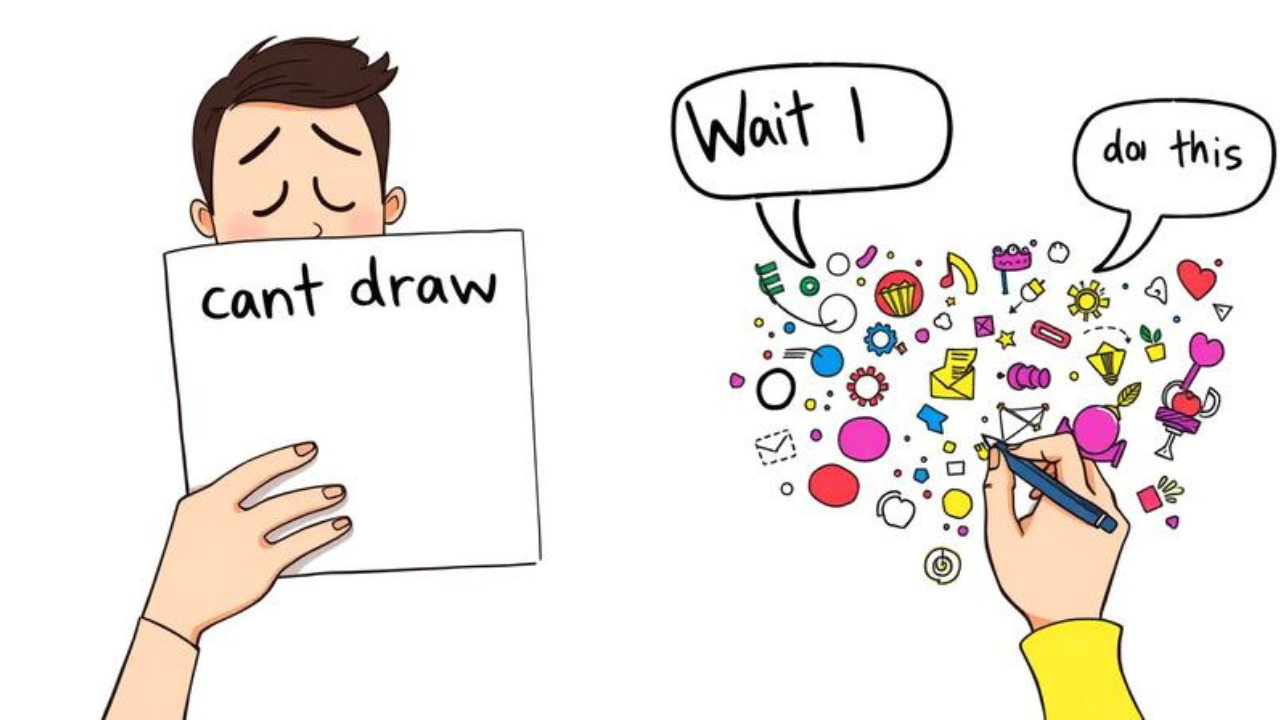
I still remember the moment I almost threw my notebook across the room.
I was at a conference, watching a speaker lay out brilliant ideas, and I’d decided this was the day I’d finally try sketchnoting. My page was blank. My pen felt heavy. And my inner critic was having a field day: “You can’t draw. What are you even doing? This is embarrassing.”
I drew a circle. It looked more like a potato. I drew an arrow. It looked like a squiggly worm. I closed my notebook and didn’t open it again for three months.
Here’s what I didn’t know then: sketchnoting isn’t about being an artist. It never was. The people creating those gorgeous, elaborate sketchnotes you see on social media? They didn’t start out that way. And the ones who claim they did? They’re either lying or conveniently forgetting the years of practice that came before.
The question “can non-artists learn sketchnoting?” is based on a fundamental misunderstanding of what sketchnoting actually is. It’s not illustration. it’s not graphic design. It’s thinking made visible — and thinking is something you already know how to do.
This article will show you why your “I can’t draw” excuse is the biggest myth in the sketchnoting world, what the science says about visual thinking, and how you can start your own sketchnoting journey today — stick figures, potato circles, and all.
What Sketchnoting Actually Is (And What It Isn’t)
Let’s clear this up right now: sketchnoting is not art.
Sketchnotes are a way to take notes that organizes thoughts and ideas in a visually stimulating way, without requiring artistry skills. The practice is really just a way to learn how to paraphrase, summarize, and refocus on what’s truly meaningful.
Think of it this way: traditional note-taking is like transcribing a conversation word-for-word. Sketchnoting is like creating a mind map — you’re capturing the structure and essence of ideas, not every single detail.
Mike Rohde, the designer who popularized the term “sketchnoting” in his bestselling book The Sketchnote Handbook, has spent years showing people that they can incorporate sketchnoting techniques into their note-taking process regardless of their artistic abilities. His work explicitly addresses “most people’s fear of drawing” by demonstrating, step-by-step, how to quickly draw people, faces, type, and simple objects.
The focus is on capturing ideas, not creating art. Once non-artists learn a simpler way to visualize in a flexible setting, they realize they have much more capability than they believe.
The Science: Why Your Brain Already Knows How to Do This
Here’s the most important thing you need to understand: your brain already thinks in pictures.
The dual coding theory, developed by psychologist Allan Paivio, explains that we store information in two ways — verbally (language) and nonverbally (images and sensations). When you use both channels together, you maximize your chances of recall and comprehension.
This isn’t just academic theory. Studies have shown that learners retain information more quickly when they use visuals alongside words — and they don’t have to be good at drawing for it to work.
There’s even a name for this: the Drawing Effect. When you draw something — even badly — you remember it better than when you just write it down. Period.
The cognitive benefits are significant. Sketchnoting engages students’ brains, encourages active listening, and improves note-taking abilities for better retention. Organizing information into pictures and words engages multiple parts of the brain simultaneously. That’s why drawing or doodling while listening to a talk has been shown to heighten retention and increase creativity following the talk.
It’s about thinking, not drawing. And thinking is something you already do every single day.
The Building Blocks: What You Actually Need to Know
Here’s a secret that will change everything: most sketchnotes are built from just five basic components.
As one educator put it, “You DO NOT have to know ‘how to draw’ to sketchnote. Most doodles contain 5 basic components… a dot, a line, a triangle, a square, and/or a circle”.
That’s it. Five shapes. You already know how to make all of them.
From these simple building blocks, you can create:
-
Bullets and boxes to group similar concepts
-
Arrows and dotted lines to connect related ideas
-
Frames and dividers to separate sections
-
Simple icons that represent words or concepts
-
Lettering and fonts (just your handwriting — it doesn’t need to be fancy)
None of these require master drawing skills. And the more you practice, the better your sketchnotes will appear.
The foundational elements of sketchnoting are simple: learn how to use simple lines, connectors, shapes, and text to take dynamic notes. That’s the entire toolkit.
Real People, Real Results: Sketchnoting in Action
The evidence that non-artists can learn sketchnoting isn’t just theoretical — it’s playing out in classrooms, boardrooms, and research labs around the world.
At Auburn University, more than 800 first-year engineering students learned sketchnoting as part of their curriculum. The technique helped them pay attention, retain lecture information, and develop critical thinking skills. One student, electrical engineering major Jack Stewart, found it so valuable that he used sketchnoting to study for his chemistry final. His verdict? “It genuinely helped me recall information during the exam”.
The neuroscience backs this up. As one engineering administrator explained, “Research in neuroscience and learning tells us when students write by hand, the brain areas involved in verbal, visual and motor information processing sync up with areas critical to memory formation”.
Sketchnoting isn’t just for students, either. It’s used by professionals in meetings, researchers synthesizing papers, educators in classrooms, and anyone who wants to think more clearly. The technique has been proposed as an alternative to high-stakes exams, with students reporting that they preferred it and that it correlated with reduced performance disparities.
The message is consistent and clear: artistic ability is not the barrier you think it is.
Common Myths (And Why They’re Nonsense)
Myth #1: “I can’t draw.”
This is the single biggest barrier to sketchnoting, and it’s complete nonsense. One seasoned sketchnoter identifies “fear of ‘not being artistic'” as the biggest mistake people make. People think they need to be Picasso to sketchnote. They don’t. It’s about capturing ideas, not creating masterpieces.
Myth #2: “Sketchnoting is just doodling.”
Not quite. Doodling is often mindless; sketchnoting is intentional. It’s about active listening, synthesis, and visual thinking. As one guide puts it, “Think improvisation, not perfection. Sketchnoting isn’t illustration — it’s content-driven doodling”.
Myth #3: “My notes need to look like the ones I see online.”
No. Just no. The sketchnotes you see on social media are often the result of years of practice. Your first sketchnote will be imperfect. Your tenth will be better.U r hundredth might even surprise you. But even that first, ugly, lopsided sketchnote will help you think more clearly and remember more effectively.
Myth #4: “I don’t have time to learn this.”
You can learn the basics in under an hour. Seriously. The foundational elements — dots, lines, shapes, arrows, boxes — are things you already know how to do. The skill isn’t in the drawing; it’s in the thinking.
The Nuance: Not Everyone Will Become a Master
Let’s be honest for a moment. While anyone can learn to sketchnote, not everyone will become equally skilled at it. Some people will develop a natural fluency with visual language that others won’t. Some will create sketchnotes that look like museum pieces; others will produce functional but unremarkable visual notes.
And that’s okay.
The goal of sketchnoting isn’t to become a professional illustrator. It’s to become a better thinker, listener, and learner. The value is in the process, not the product.
It’s also worth noting that sketchnoting isn’t for everyone in every situation. Sometimes linear, text-based notes are more appropriate. Sometimes you need to capture every detail without worrying about visual hierarchy. Sketchnoting is a tool — one tool among many — and knowing when to use it is as important as knowing how.
Actionable Takeaways: Your 5-Step Plan to Start Today
-
Just start. Pick up a pen and paper and begin. The best advice anyone can give you is to “pick up a pen and just start”. Add a headline or title, then build from there.
-
Practice with videos. Use TED talks or podcasts as low-pressure practice materials. You can pause, rewind, and take your time.
-
Build a visual vocabulary. Start with simple icons: a lightbulb for ideas, an arrow for cause and effect, a box for key concepts. Steal from others and make it your own.
-
Embrace imperfection. Your sketches will be wonky. Your handwriting will be messy. That’s not a bug — it’s a feature. As one guide puts it, “mistakes are often more useful than perfect sketchnotes”.
-
Give yourself grace. When things go wrong, have a chuckle and laugh about it. The goal is progress, not perfection.
Frequently Asked Questions
Q: Do I need to be good at drawing to sketchnote?
Absolutely not. Sketchnoting is about capturing ideas visually, not creating art. It organizes thoughts “without requiring artistry skills”. Simple shapes, arrows, and boxes are all you need to get started.
Q: How long does it take to learn sketchnoting?
You can learn the basics in under an hour. Developing fluency takes practice — like any skill — but you’ll see improvement from your very first attempt.
Q: What tools do I need to start?
Just a pen and paper. That’s it. Digital tools like tablets and styluses are optional extras.
Q: Can sketchnoting help me remember things better?
Yes. The dual coding theory and the “Drawing Effect” both show that combining words with visuals significantly improves memory and recall.
Q: What if my sketchnotes look ugly?
They will — especially at first. That’s completely normal and completely fine. Sketchnoting is about function, not aesthetics.
Q: Is sketchnoting only for students?
No. Sketchnoting is used by professionals in meetings, researchers synthesizing papers, educators in classrooms, and anyone who wants to think more clearly.
Q: Can I sketchnote on a computer or tablet?
Yes. Many people use digital tools like ProCreate, Sketchbook, or Adobe Draw. But pen and paper work just as well.
Conclusion
So, can non-artists learn sketchnoting?
The evidence is overwhelming: yes. The science says your brain is already wired for visual thinking. The practitioners say artistic talent is irrelevant. The success stories — from engineering students to corporate professionals — prove that the skill is accessible to anyone willing to try.
The real question isn’t whether you can learn to sketchnote. It’s whether you’re willing to let go of your fear, pick up a pen, and give it a shot.
Your first sketchnote will be imperfect. U,r tenth will be better. Your hundredth might even surprise you. But here’s the thing: even that first, ugly, lopsided sketchnote will help you think more clearly, remember more effectively, and engage more deeply with the world around you.
And isn’t that worth a few wobbly circles?
So go ahead. Grab a pen. Find a piece of paper. And start sketching your thoughts into existence. The only thing standing between you and your first sketchnote is the belief that you can’t do it — and now you know that belief is a lie.
The page is waiting. What will you draw on it?